Department of Microbiology, Gdańsk University of Technology, 80-233 Gdańsk, Poland.
BMC Microbiol. 2010 Oct 15;10:260. doi: 10.1186/1471-2180-10-260.
In recent years, there has been an increasing interest in SSBs because they find numerous applications in diverse molecular biology and analytical methods.
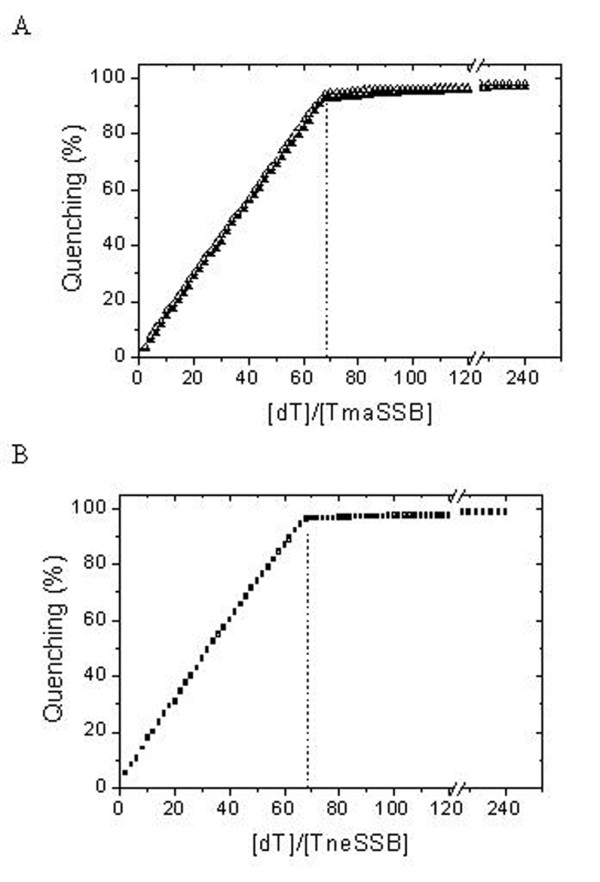
We report the characterization of single-stranded DNA binding proteins (SSBs) from the thermophilic bacteria Thermotoga maritima (TmaSSB) and Thermotoga neapolitana (TneSSB). They are the smallest known bacterial SSB proteins, consisting of 141 and 142 amino acid residues with a calculated molecular mass of 16.30 and 16.58 kDa, respectively. The similarity between amino acid sequences of these proteins is very high: 90% identity and 95% similarity. Surprisingly, both TmaSSB and TneSSB possess a quite low sequence similarity to Escherichia coli SSB (36 and 35% identity, 55 and 56% similarity, respectively). They are functional as homotetramers containing one single-stranded DNA binding domain (OB-fold) in each monomer. Agarose mobility assays indicated that the ssDNA-binding site for both proteins is salt independent, and fluorescence spectroscopy resulted in a size of 68 ± 2 nucleotides. The half-lives of TmaSSB and TneSSB were 10 h and 12 h at 100°C, respectively. When analysed by differential scanning microcalorimetry (DSC) the melting temperature (Tm) was 109.3°C and 112.5°C for TmaSSB and TneSSB, respectively.
The results showed that TmaSSB and TneSSB are the most thermostable SSB proteins identified to date, offering an attractive alternative to TaqSSB and TthSSB in molecular biology applications, especially with using high temperature e. g. polymerase chain reaction (PCR).
近年来,由于 ssB 在多种分子生物学和分析方法中有广泛的应用,因此人们对 ssB 越来越感兴趣。
我们报告了嗜热细菌海洋栖热菌(TmaSSB)和海栖热袍菌(TneSSB)的单链 DNA 结合蛋白(ssB)的特性。它们是已知最小的细菌 ssB 蛋白,由 141 和 142 个氨基酸残基组成,计算分子量分别为 16.30 和 16.58 kDa。这些蛋白质的氨基酸序列非常相似:90%的同一性和 95%的相似性。令人惊讶的是,TmaSSB 和 TneSSB 与大肠杆菌 ssB 的序列相似性都很低(分别为 36%和 35%的同一性,55%和 56%的相似性)。它们作为包含每个单体中一个单链 DNA 结合结构域(OB 折叠)的同四聚体发挥功能。琼脂糖迁移分析表明,两种蛋白质的 ssDNA 结合位点均与盐无关,荧光光谱分析结果表明 ssDNA 结合位点的大小为 68±2 个核苷酸。TmaSSB 和 TneSSB 的半衰期在 100°C 时分别为 10 h 和 12 h。通过差示扫描量热法(DSC)分析,TmaSSB 和 TneSSB 的熔点(Tm)分别为 109.3°C 和 112.5°C。
结果表明,TmaSSB 和 TneSSB 是迄今为止鉴定出的最耐热的 ssB 蛋白,为分子生物学应用中提供了一种有吸引力的替代 TaqSSB 和 TthSSB 的选择,特别是在使用高温(例如聚合酶链反应(PCR))时。