Department of Chemistry and Worm Institute for Research and Medicine, The Scripps Research Institute, La Jolla, California, United States of America.
PLoS Negl Trop Dis. 2010 Oct 5;4(10):e834. doi: 10.1371/journal.pntd.0000834.
Development of robust, sensitive, and reproducible diagnostic tests for understanding the epidemiology of neglected tropical diseases is an integral aspect of the success of worldwide control and elimination programs. In the treatment of onchocerciasis, clinical diagnostics that can function in an elimination scenario are non-existent and desperately needed. Due to its sensitivity and quantitative reproducibility, liquid chromatography-mass spectrometry (LC-MS) based metabolomics is a powerful approach to this problem.
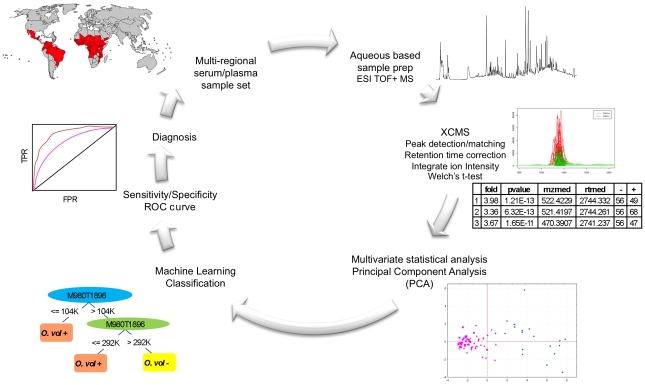
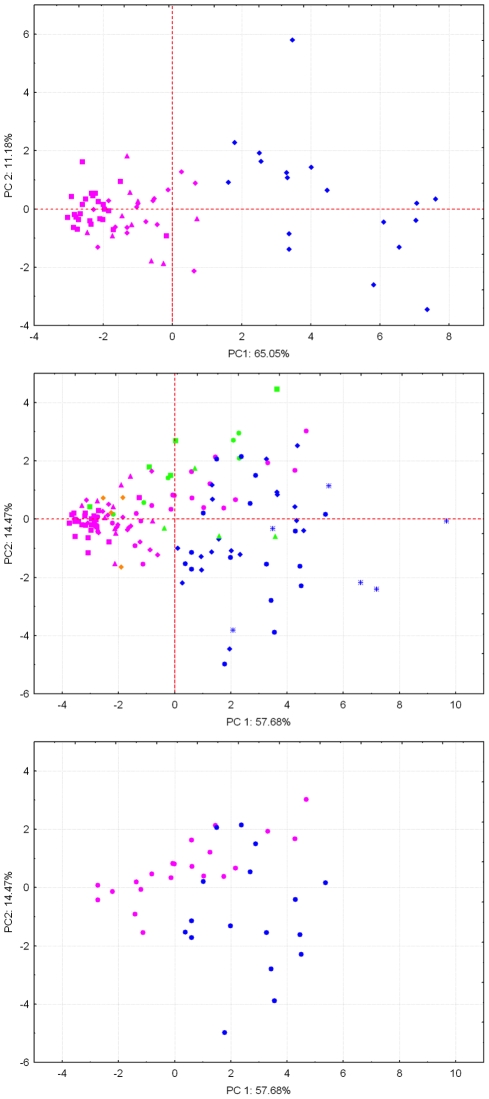
METHODOLOGY/PRINCIPAL FINDINGS: Analysis of an African sample set comprised of 73 serum and plasma samples revealed a set of 14 biomarkers that showed excellent discrimination between Onchocerca volvulus-positive and negative individuals by multivariate statistical analysis. Application of this biomarker set to an additional sample set from onchocerciasis endemic areas where long-term ivermectin treatment has been successful revealed that the biomarker set may also distinguish individuals with worms of compromised viability from those with active infection. Machine learning extended the utility of the biomarker set from a complex multivariate analysis to a binary format applicable for adaptation to a field-based diagnostic, validating the use of complex data mining tools applied to infectious disease biomarker discovery and diagnostic development.
CONCLUSIONS/SIGNIFICANCE: An LC-MS metabolomics-based diagnostic has the potential to monitor the progression of onchocerciasis in both endemic and non-endemic geographic areas, as well as provide an essential tool to multinational programs in the ongoing fight against this neglected tropical disease. Ultimately this technology can be expanded for the diagnosis of other filarial and/or neglected tropical diseases.
开发稳健、敏感和可重现的诊断测试,以了解被忽视的热带病的流行病学,是全球控制和消除规划成功的一个组成部分。在治疗盘尾丝虫病方面,目前还没有能够在消除情况下发挥作用的临床诊断方法,这种方法非常急需。由于其灵敏度和定量重现性,基于液相色谱-质谱(LC-MS)的代谢组学是解决此问题的有力方法。
方法/主要发现:对一个由 73 份血清和血浆样本组成的非洲样本集进行分析,通过多变量统计分析,发现了一组 14 种生物标志物,它们可以极好地区分盘尾丝虫阳性和阴性个体。将该生物标志物集应用于来自盘尾丝虫病流行地区的另一个样本集,这些地区长期使用伊维菌素治疗已取得成功,结果表明该生物标志物集也可以区分那些寄生虫活力受损的个体和那些具有活动性感染的个体。机器学习将生物标志物集的应用从复杂的多变量分析扩展到适用于现场诊断的二进制格式,验证了将复杂的数据挖掘工具应用于传染病生物标志物发现和诊断开发的有效性。
结论/意义:基于 LC-MS 代谢组学的诊断方法有可能监测流行和非流行地区盘尾丝虫病的进展,并且为正在进行的防治这种被忽视的热带病的多国方案提供了一个重要工具。最终,这项技术可以扩展用于诊断其他丝虫病和/或被忽视的热带病。