Department of Molecular Parasitology and Center for Molecular Medicine, Samsung Biomedical Research Institute, Sungkyunkwan University School of Medicine, Suwon, Korea.
PLoS Negl Trop Dis. 2010 Oct 12;4(10):e849. doi: 10.1371/journal.pntd.0000849.
Multiple cysteine proteases of malaria parasites are required for maintenance of parasite metabolic homeostasis and egress from the host erythrocyte. In Plasmodium falciparum these proteases appear to mediate the processing of hemoglobin and aspartic proteases (plasmepsins) in the acidic food vacuole and the hydrolysis of erythrocyte structural proteins at neutral pH. Two cysteine proteases, vivapain (VX)-2 and VX-3 have been characterized in P. vivax, but comprehensive studies of P. vivax cysteine proteases remain elusive.
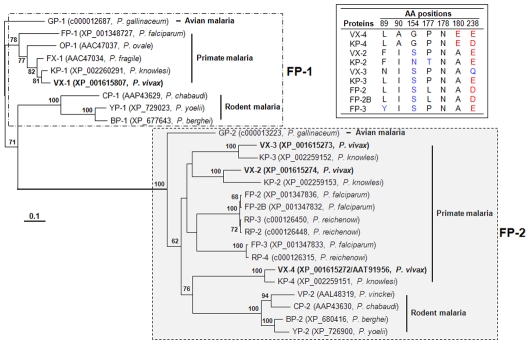
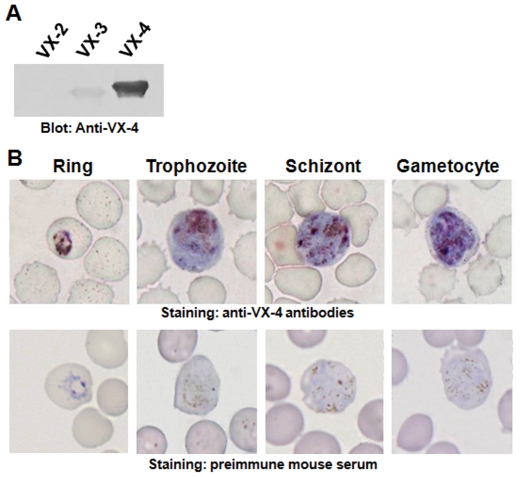
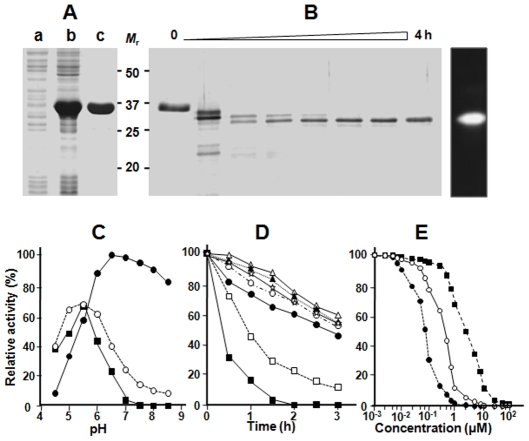
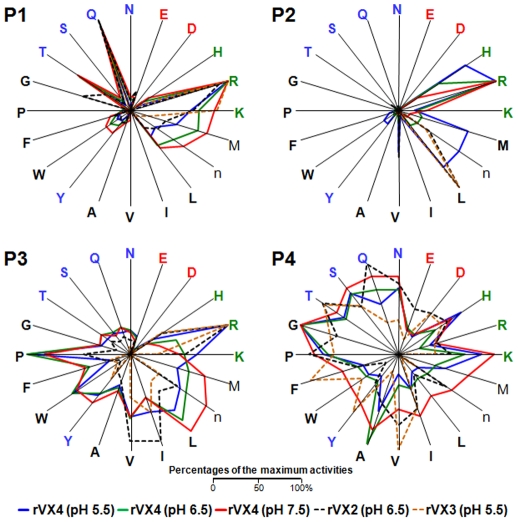
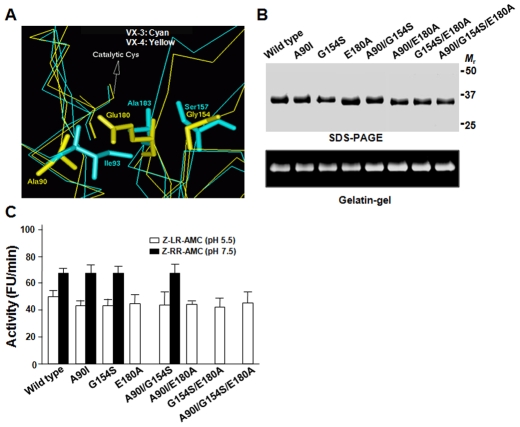
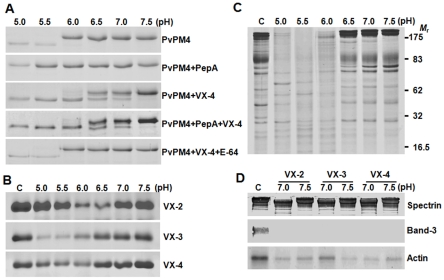
We characterized a novel cysteine protease of P. vivax, VX-4, of which orthologs appears to have evolved differentially in primate plasmodia with strong cladistic affinity toward those of rodent Plasmodium. Recombinant VX-4 demonstrated dual substrate specificity depending on the surrounding micro-environmental pH. Its hydrolyzing activity against benzyloxycarbonyl-Leu-Arg-4-methyl-coumaryl-7-amide (Z-Leu-Arg-MCA) and Z-Phe-Arg-MCA was highest at acidic pH (5.5), whereas that against Z-Arg-Arg-MCA was maximal at neutral pH (6.5-7.5). VX-4 preferred positively charged amino acids and Gln at the P1 position, with less strict specificity at P3 and P4. P2 preferences depended on pH (Leu at pH 5.5 and Arg at pH 7.5). Three amino acids that delineate the S2 pocket were substituted in VX-4 compared to VX-2 and VX-3 (Ala90, Gly157 and Glu180). Replacement of Glu180 abolished activity against Z-Arg-Arg-MCA at neutral pH, indicating the importance of this amino acid in the pH-dependent substrate preference. VX-4 was localized in the food vacuoles and cytoplasm of the erythrocytic stage of P. vivax. VX-4 showed maximal activity against actin at neutral pH, and that against P. vivax plasmepsin 4 and hemoglobin was detected at neutral/acidic and acidic pH, respectively.
VX-4 demonstrates pH-dependent substrate switching, which might offer an efficient mechanism for the specific cleavage of different substrates in different intracellular environments. VX-4 might function as a hemoglobinase in the acidic parasite food vacuole, a maturase of P. vivax plasmepsin 4 at neutral or acidic pH, and a cytoskeleton-degrading protease in the neutral erythrocyte cytosol.
疟原虫的多种半胱氨酸蛋白酶对于维持寄生虫的代谢平衡和从宿主红细胞中逸出至关重要。在恶性疟原虫中,这些蛋白酶似乎介导了血红蛋白和天冬氨酸蛋白酶(裂殖体蛋白酶)在酸性食物泡中的加工,以及在中性 pH 值下红细胞结构蛋白的水解。在间日疟原虫中已经鉴定出两种半胱氨酸蛋白酶,vivapain(VX)-2 和 VX-3,但对间日疟原虫半胱氨酸蛋白酶的综合研究仍然难以捉摸。
我们鉴定了一种新的间日疟原虫半胱氨酸蛋白酶 VX-4,其同源物似乎在灵长类疟原虫中进化出不同的进化关系,与啮齿动物疟原虫的亲缘关系最强。重组 VX-4 表现出双重底物特异性,取决于周围微环境的 pH 值。其对苯甲氧基羰基-Leu-Arg-4-甲基-香豆酰-7-酰胺(Z-Leu-Arg-MCA)和 Z-Phe-Arg-MCA 的水解活性在酸性 pH 值(5.5)下最高,而对 Z-Arg-Arg-MCA 的水解活性在中性 pH 值(6.5-7.5)下最高。VX-4 优先选择带正电荷的氨基酸和 P1 位的 Gln,而在 P3 和 P4 位的特异性要求较低。P2 偏好取决于 pH 值(pH5.5 时为 Leu,pH7.5 时为 Arg)。与 VX-2 和 VX-3 相比,VX-4 中有三个氨基酸取代了 S2 袋(Ala90、Gly157 和 Glu180)。在中性 pH 值下,替换 Glu180 会使 VX-4 对 Z-Arg-Arg-MCA 的活性完全丧失,这表明该氨基酸在 pH 依赖性底物偏好中具有重要作用。VX-4 定位于间日疟原虫红细胞阶段的食物泡和细胞质中。在中性 pH 值下,VX-4 对肌动蛋白表现出最大的活性,而在中性/酸性 pH 值下检测到对间日疟原虫裂殖体蛋白酶 4 和血红蛋白的活性,在酸性 pH 值下检测到对间日疟原虫裂殖体蛋白酶 4 和血红蛋白的活性。
VX-4 表现出 pH 依赖性底物转换,这可能为在不同的细胞内环境中特异性切割不同的底物提供了一种有效的机制。VX-4 可能在酸性寄生虫食物泡中作为血红蛋白酶,在中性或酸性 pH 值下作为间日疟原虫裂殖体蛋白酶 4 的成熟酶,在中性红细胞细胞质中作为细胞骨架降解蛋白酶。