Department of Anesthesiology and Intensive Care Medicine, University Hospital Rostock, Rostock University, Schillingallee 35, Rostock 18057, Germany.
Crit Care. 2010;14(5):R189. doi: 10.1186/cc9301. Epub 2010 Oct 22.
Acute lung injury (ALI) is an inflammatory disorder of pulmonary or extrapulmonary origin. We have previously demonstrated that netrin-1 dampens murine ALI, and in an attempt to advance this finding into future clinical practice we evaluated whether netrin-1 would reduce alveolar inflammation during porcine ALI.
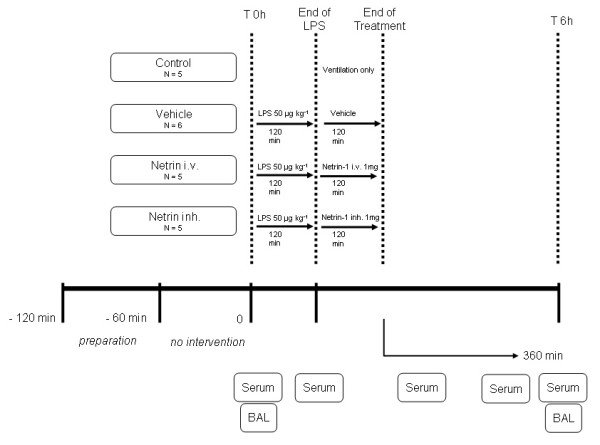
This was a controlled in vivo experimental study in pigs. We induced ALI through lipoploysaccharide (LPS) infusion (50 μg/kg) for 2 hours. Following this, we exposed animals to either vehicle, intravenous netrin-1 (netrin-1 i.v.) or inhaled netrin-1 (netrin-1 inh.). Serum samples and bronchoalveolar lavage (BAL) were obtained to determine levels of tumor necrosis factor-α (TNF-α), interleukin (IL)-1β, interleukin-6 and interleukin-8 at baseline and 6 hours following treatment. Myeloperoxidase activity (MPO) and protein levels were determined in the BAL, and tissue samples were obtained for histological evaluation. Finally, animals were scanned with spiral CT.
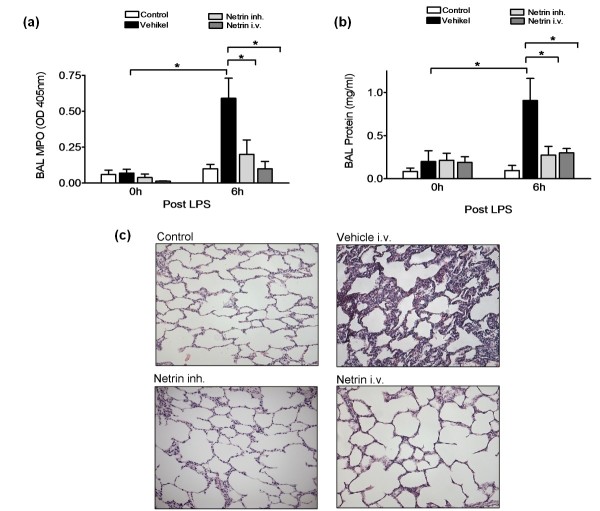
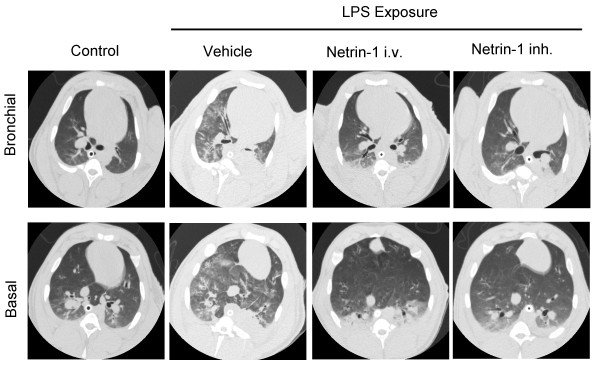
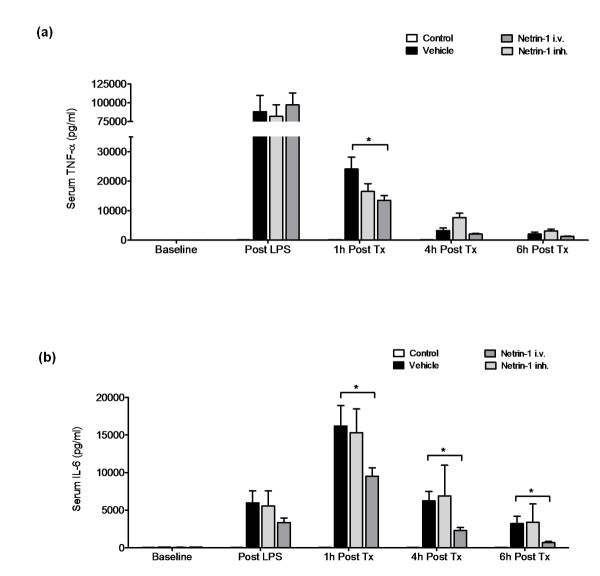
Following LPS infusion, animals developed acute pulmonary injury. Serum levels of TNF-α and IL-6 were significantly reduced in the netrin-1 i.v. group. BAL demonstrated significantly reduced cytokine levels 6 hours post-netrin-1 treatment (TNF-α: vehicle 633 ± 172 pg/ml, netrin-1 i.v. 84 ± 5 pg/ml, netrin-1 inh. 168 ± 74 pg/ml; both P < 0.05). MPO activity and protein content were significantly reduced in BAL samples from netrin-1-treated animals. Histological sections confirmed reduced inflammatory changes in the netrin-1-treated animals. Computed tomography corroborated reduced pulmonary damage in both netrin-1-treated groups.
We conclude that treatment with the endogenous anti-inflammatory protein netrin-1 reduces pulmonary inflammation during the initial stages of ALI and should be pursued as a future therapeutic option.
急性肺损伤(ALI)是一种由肺部或肺外来源引起的炎症性疾病。我们之前已经证明,轴突导向因子 1(netrin-1)可以抑制小鼠的 ALI,为了将这一发现应用于未来的临床实践,我们评估了 netrin-1 是否会减少猪 ALI 期间的肺泡炎症。
这是一项在猪体内进行的对照性体内实验研究。我们通过脂多糖(LPS)输注(50μg/kg)诱导 ALI 2 小时。在此之后,我们使动物暴露于载体、静脉内 netrin-1(netrin-1 i.v.)或吸入性 netrin-1(netrin-1 inh.)中。在基线和治疗后 6 小时,采集血清样本和支气管肺泡灌洗液(BAL),以确定肿瘤坏死因子-α(TNF-α)、白细胞介素(IL)-1β、白细胞介素-6 和白细胞介素-8 的水平。BAL 中测定髓过氧化物酶(MPO)活性和蛋白质水平,并获取组织样本进行组织学评估。最后,对动物进行螺旋 CT 扫描。
在 LPS 输注后,动物发生急性肺损伤。静脉内 netrin-1 组 TNF-α和 IL-6 的血清水平显著降低。BAL 在 netrin-1 治疗后 6 小时显示出显著降低的细胞因子水平(TNF-α:载体 633±172pg/ml、netrin-1 i.v. 84±5pg/ml、netrin-1 inh. 168±74pg/ml;均 P<0.05)。BAL 样本中的 MPO 活性和蛋白含量在 netrin-1 治疗的动物中显著降低。组织学切片证实 netrin-1 治疗的动物炎症变化减少。计算机断层扫描证实了两个 netrin-1 治疗组的肺部损伤减少。
我们得出结论,内源性抗炎蛋白 netrin-1 的治疗可减少 ALI 早期的肺部炎症,应作为未来的治疗选择进行研究。