Department of Surgery, University of Cantabria, Hospital Marqués de Valdecilla, Avda Valdecilla s/n, 39008 Santander, Cantabria, Spain.
World J Surg Oncol. 2010 Nov 1;8:93. doi: 10.1186/1477-7819-8-93.
Patients suffering from symptomatic macromastia are usually underserved, as they have to put up with very long waiting lists and are usually selected under restrictive criteria. The Oncoplastic Breast Surgery subspeciality requires a cross-specialty training, which is difficult, in particular, for trainees who have a background in general surgery, and not easily available. The introduction of reduction mammaplasty into a Breast Cancer Unit as treatment for symptomatic macromastia could have a synergic effect, making the scarce therapeutic offer at present available to these patients, who are usually treated in Plastic Departments, somewhat larger, and accelerating the uptake of oncoplastic training as a whole and, specifically, the oncoplastic breast conserving procedures based on the reduction mammaplasty techniques such as displacement conservative techniques and onco-therapeutic mammaplasty. This is a retrospective study analyzing the outcome of reduction mammaplasty for symptomatic macromastia in our Breast Cancer Unit.
A cohort study of 56 patients who underwent bilateral reduction mammaplasty at our Breast Unit between 2005 and 2009 were evaluated; morbidity and patient satisfaction were considered as end points. Data were collected by reviewing medical records and interviewing patients.
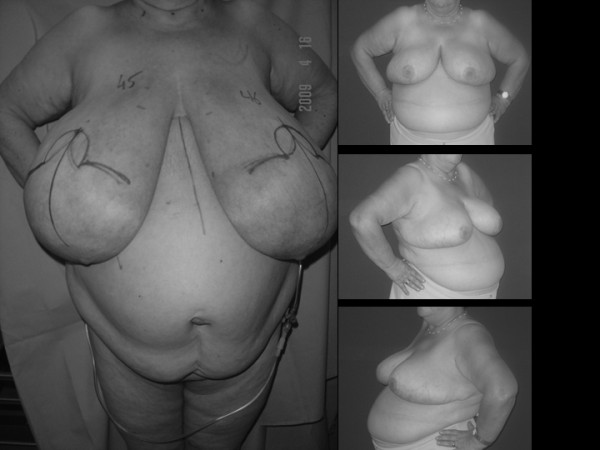
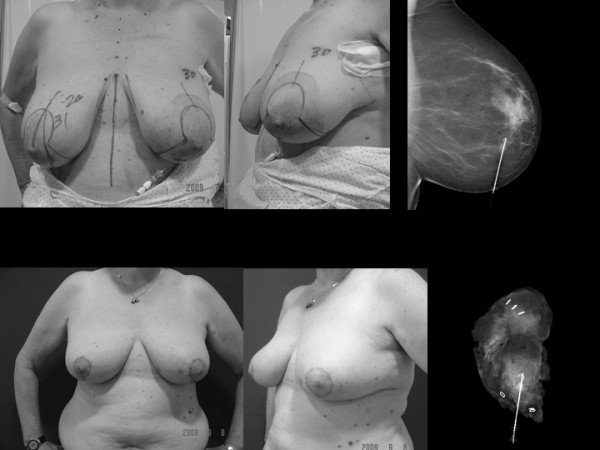
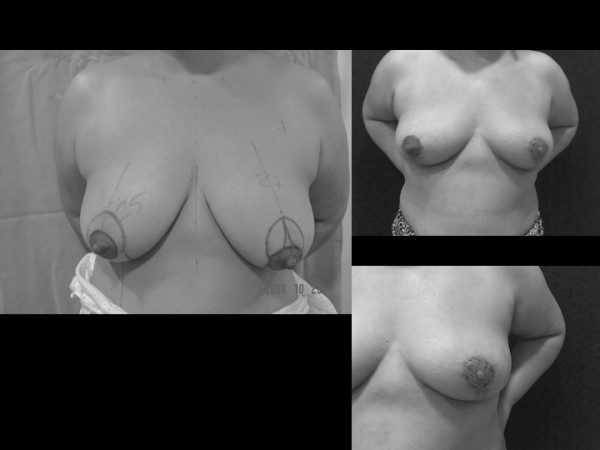
Eight patients (14.28%) presented complications in the early postoperative period, two of them being reoperated on. The physical symptoms disappeared or significantly improved in 88% of patients and the degree of satisfaction with the care process and with the overall outcome were really high.
Our experience of the introduction of reduction mammaplasty in our Breast Cancer Unit has given good results, enabling us to learn the use of different reduction mammaplasty techniques using several pedicles which made it possible to perform oncoplastic breast conserving surgery. In our opinion, this management policy could bring clear advantages both to patients (large-breasted and those with a breast cancer) and surgeons.
患有症状性巨乳症的患者通常得不到充分的治疗,因为他们必须忍受很长的等待时间,而且通常是在限制性标准下被选择。肿瘤整形乳房手术亚专业需要跨专业的培训,这对于那些有普通外科背景的受训者来说是困难的,而且不容易获得。将乳房缩小术引入乳腺癌单位作为治疗症状性巨乳症的方法可能会产生协同效应,使目前这些通常在整形外科治疗的患者能够获得更广泛的治疗选择,并加速整个肿瘤整形培训的普及,特别是基于乳房缩小术技术的肿瘤整形保乳手术,如移位保乳技术和肿瘤治疗性乳房缩小术。这是一项回顾性研究,分析了我们乳腺癌单位对症状性巨乳症患者进行乳房缩小术的结果。
对 2005 年至 2009 年间在我们乳腺癌单位接受双侧乳房缩小术的 56 例患者进行了队列研究;发病率和患者满意度被视为终点。通过查阅病历和访谈患者收集数据。
8 例(14.28%)患者在术后早期出现并发症,其中 2 例再次手术。88%的患者的身体症状消失或明显改善,对治疗过程和整体结果的满意度非常高。
我们在乳腺癌单位引入乳房缩小术的经验取得了良好的效果,使我们能够学习使用不同的带有多个蒂的乳房缩小术技术,从而能够进行肿瘤整形保乳手术。我们认为,这种管理策略对患者(大乳房和乳腺癌患者)和外科医生都有明显的优势。