Outcomes Insights, Inc., Westlake Village.
Outcomes Insights, Inc., Westlake Village.
Ann Oncol. 2011 May;22(5):1181-1188. doi: 10.1093/annonc/mdq552. Epub 2010 Nov 1.
Mortality in patients with myelodysplastic syndromes (MDS) is high, and patients are likely to require hospitalizations, emergency department (ED) visits, and transfusions. The relationships between these events and the MDS complications of anemia, neutropenia, and thrombocytopenia are not well understood.
A total of 1864 patients registered in the United States' Surveillance Epidemiology and End Results (SEER) program and aged ≥ 66 years old when diagnosed with MDS in 2001 or 2002 were included. Medicare claims were used to identify MDS complications and utilization (hospitalizations, ED visits, and transfusions) until death or the end of 2005. Mortality was based on SEER data. Kaplan-Meier incidence rates were estimated and multivariable Cox models were used to study the association between complications and outcomes.
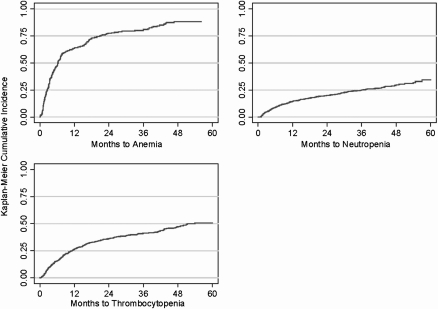
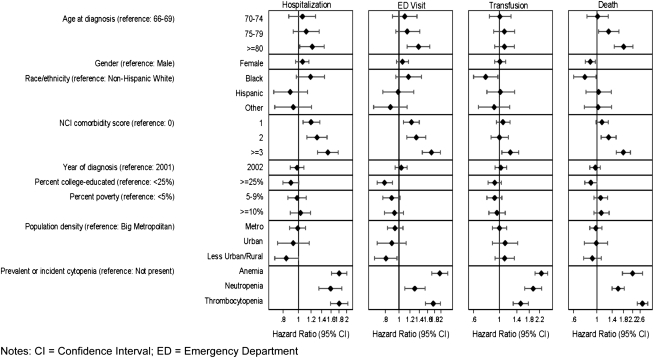
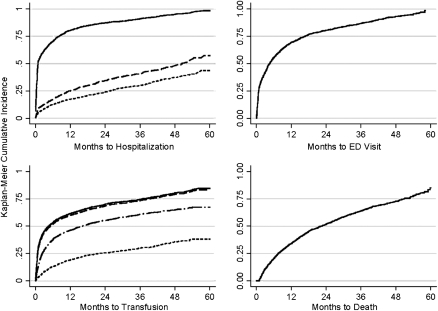
The 3-year incidence of anemia, neutropenia, and thrombocytopenia was 81%, 25%, and 41%, and the incidence of hospitalization, ED visit, and transfusion was 62%, 42%, and 45%, respectively. Median survival time was 22 months. Cytopenia complications were significantly associated with each of these outcomes.
All types of cytopenia are common among patients with MDS and are risk factors for high rates of health care utilization and mortality. Management of the complications of MDS may improve patient outcomes.
骨髓增生异常综合征(MDS)患者的死亡率较高,且他们可能需要住院、急诊就诊和输血。这些事件与 MDS 的贫血、中性粒细胞减少和血小板减少等并发症之间的关系尚未得到很好的理解。
共纳入 1864 名于 2001 或 2002 年在年龄≥66 岁时被诊断为 MDS 的美国监测、流行病学和最终结果(SEER)计划注册患者。使用医疗保险索赔来确定 MDS 并发症和利用情况(住院、急诊就诊和输血),直至死亡或 2005 年底。死亡率基于 SEER 数据。采用 Kaplan-Meier 发生率率进行估计,并采用多变量 Cox 模型研究并发症与结局之间的关系。
贫血、中性粒细胞减少和血小板减少的 3 年发生率分别为 81%、25%和 41%,住院、急诊就诊和输血的发生率分别为 62%、42%和 45%。中位生存时间为 22 个月。细胞减少症并发症与所有这些结局均显著相关。
所有类型的细胞减少症在 MDS 患者中都很常见,是导致高医疗利用率和死亡率的危险因素。MDS 并发症的管理可能会改善患者的结局。