Xia Likun, Zhang Shengnan, Zhou Jiazi, Li Yan
Department of Ophthalmology, Shengjing Hospital, China Medical University, Shenyang, Liaoning Province, People's Republic of China.
Mol Vis. 2010 Oct 13;16:2071-83.
To investigate the effect of the B and T lymphocyte attenuator (BTLA; CD272) on cluster of differentiation (CD)4(+) T cell-mediated corneal immunopathology during murine herpetic stromal keratitis (HSK).
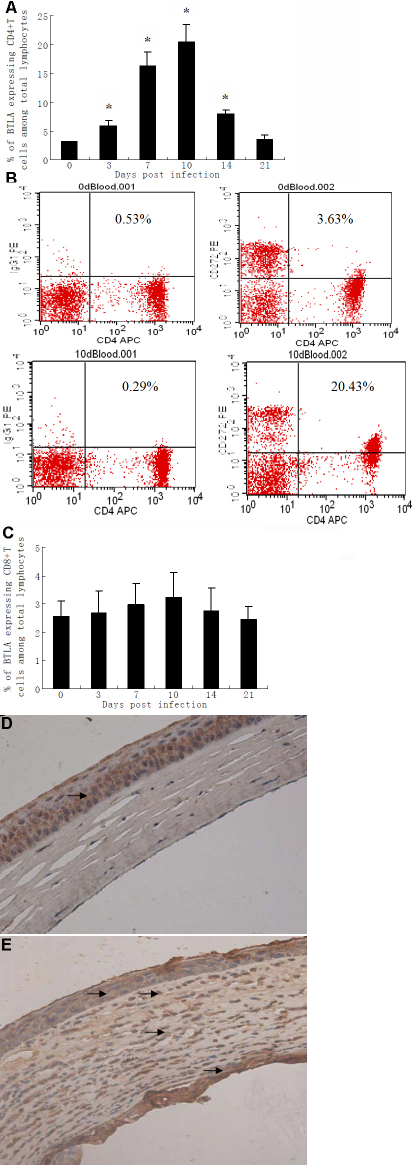
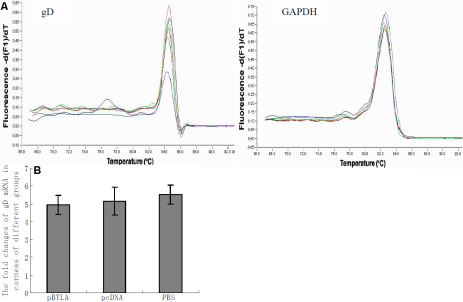
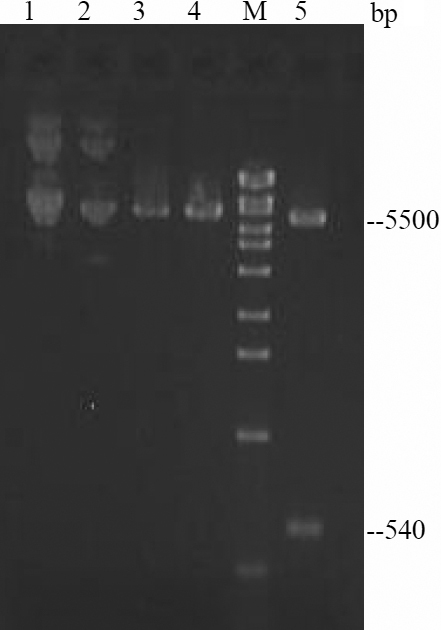
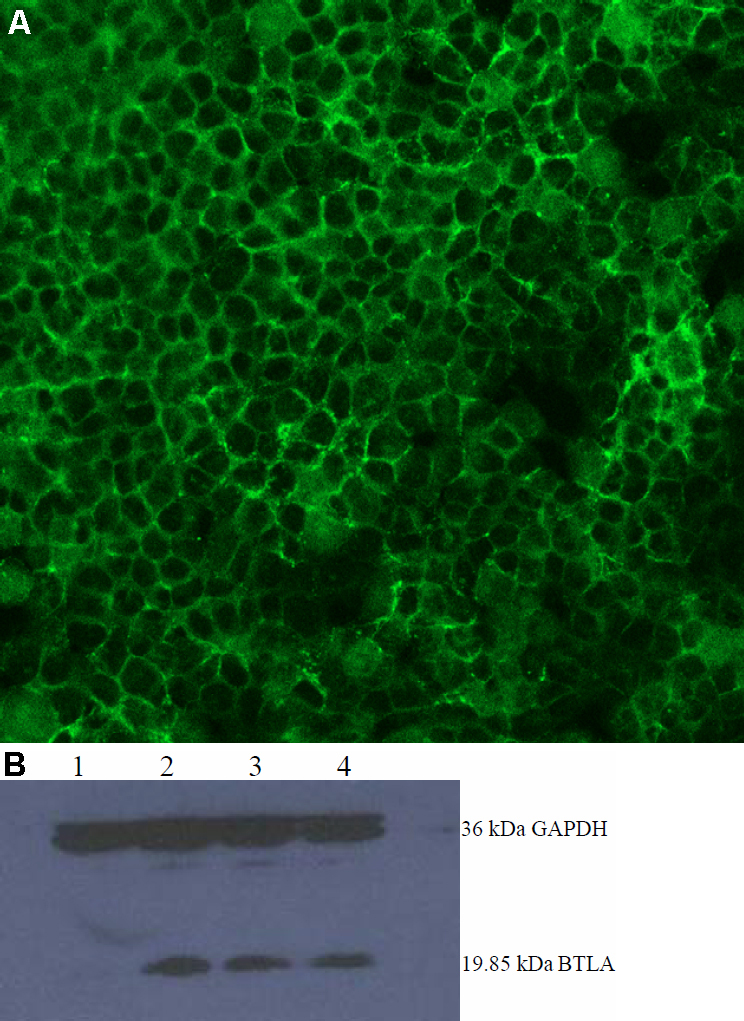
BALB/c mice were infected with the herpes simplex virus type 1 (HSV-1) KOS strain by corneal scarification. The levels of BTLA expression in CD4(+) and CD8(+) T cells in murine peripheral blood were determined by flow cytometry on days 0, 3, 7, 10, 14, and 21 after HSV-1 infection. BTLA expression in the infected cornea was detected by immunohistochemistry. BALB/c mice were injected intraperitoneally with recombinant plasmid DNA encoding BTLA (pBTLA), pcDNA3.1, or PBS on 0 and 7 days before infection and 7 days postinfection. The incidence and severity of stromal disease, tear film virus titers, and the delayed-type hypersensitivity (DTH) reaction were then compared among treated and control groups. The effects of pBTLA on CD4(+) T cells that infiltrated into infected corneas and on type 1 helper T-cell (Th1) cytokines (interferon-gamma [IFN-γ]) were evaluated. The levels of glycoprotein D (gD) mRNA in corneas were tested by real-time PCR. The eyes were examined histologically.
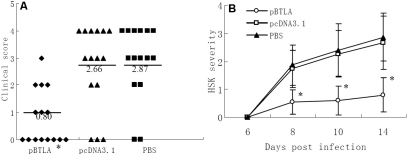
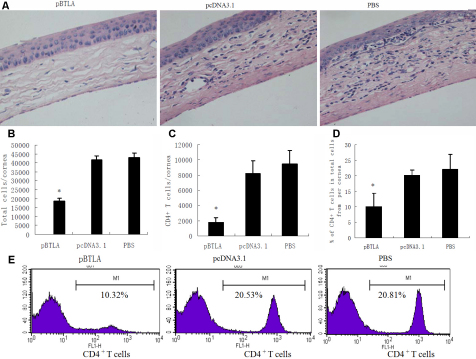
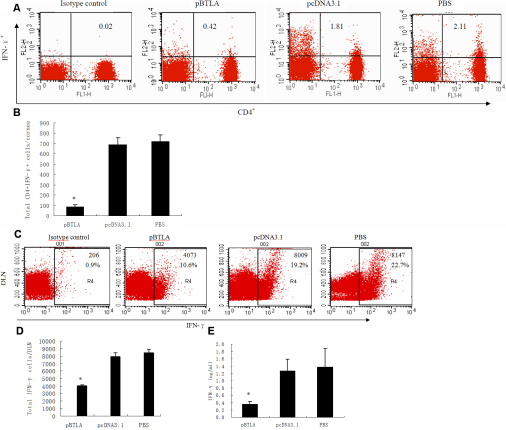
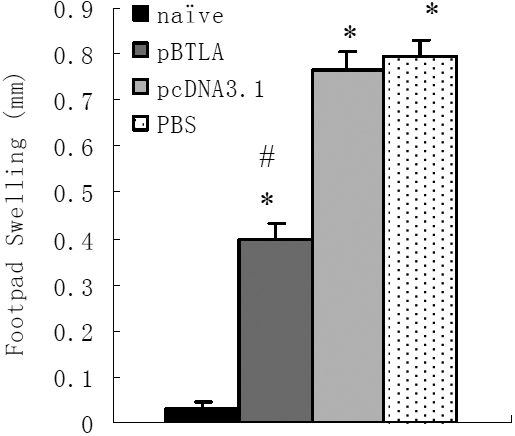
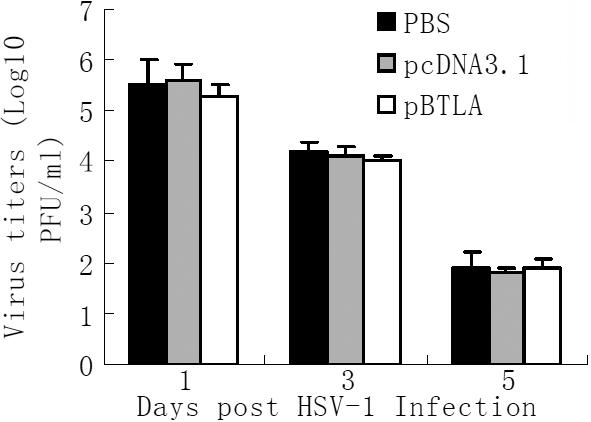
BTLA expression increased both in the corneas of HSV-1 infected mice and in CD4(+) T cells in the murine peripheral blood. Systemic administration of pBTLA resulted in a diminished incidence and severity of corneal lesions compared to controls. Treatment with pBTLA led to a decreased infiltration of CD4(+) T cells into infected corneas, and diminished Th1 responses in murine corneas, draining lymph nodes, and splenocytes. The pBTLA treated mice showed an impaired DTH response two weeks after HSV-1 infection compared to control mice. No differences were noted in tear film virus titers or gD mRNA levels in corneas among the experimental groups.
The results suggest that recombinant pBTLA plays a crucial role in preventing HSV-1 specific responses in CD4(+) Th1 cells in the infected corneas. Thus, BTLA, with immunosuppressive effects, may be a good candidate for treatment of HSK.
研究B和T淋巴细胞衰减器(BTLA;CD272)在小鼠疱疹性基质性角膜炎(HSK)期间对分化簇(CD)4(+) T细胞介导的角膜免疫病理学的影响。
通过角膜划痕法用1型单纯疱疹病毒(HSV-1)KOS株感染BALB/c小鼠。在HSV-1感染后的第0、3、7、10、14和21天,通过流式细胞术测定小鼠外周血中CD4(+)和CD8(+) T细胞中BTLA的表达水平。通过免疫组织化学检测感染角膜中BTLA的表达。在感染前0天和7天以及感染后7天,给BALB/c小鼠腹腔注射编码BTLA的重组质粒DNA(pBTLA)、pcDNA3.1或PBS。然后比较治疗组和对照组之间基质疾病的发生率和严重程度、泪膜病毒滴度以及迟发型超敏反应(DTH)。评估pBTLA对浸润到感染角膜中的CD4(+) T细胞以及对1型辅助性T细胞(Th1)细胞因子(干扰素-γ [IFN-γ])的影响。通过实时PCR检测角膜中糖蛋白D(gD)mRNA的水平。对眼睛进行组织学检查。
HSV-1感染小鼠的角膜以及小鼠外周血中的CD4(+) T细胞中BTLA表达均增加。与对照组相比,全身给予pBTLA导致角膜病变的发生率和严重程度降低。用pBTLA治疗导致CD4(+) T细胞向感染角膜的浸润减少,并且小鼠角膜、引流淋巴结和脾细胞中的Th1反应减弱。与对照小鼠相比,pBTLA治疗的小鼠在HSV-1感染两周后显示DTH反应受损。各实验组之间在泪膜病毒滴度或角膜中gD mRNA水平方面未观察到差异。
结果表明重组pBTLA在预防感染角膜中CD4(+) Th1细胞的HSV-1特异性反应中起关键作用。因此,具有免疫抑制作用的BTLA可能是治疗HSK的良好候选药物。