Department of Biochemistry and Molecular Biology, Tongji Medical College, Huazhong University of Science and Technology, Wuhan 430030, China.
BMC Cancer. 2010 Nov 3;10:601. doi: 10.1186/1471-2407-10-601.
Very low density lipoprotein receptor (VLDLR) has been considered as a multiple function receptor due to binding numerous ligands, causing endocytosis and regulating cellular signaling. Our group previously reported that enhanced activity of type II VLDLR (VLDLR II), one subtype of VLDLR, promotes adenocarcinoma SGC7901 cells proliferation and migration. The aim of this study is to explore the expression levels of VLDLR II in human gastric, breast and lung cancer tissues, and to investigate its relationship with clinical characteristics and β-catenin expression status.
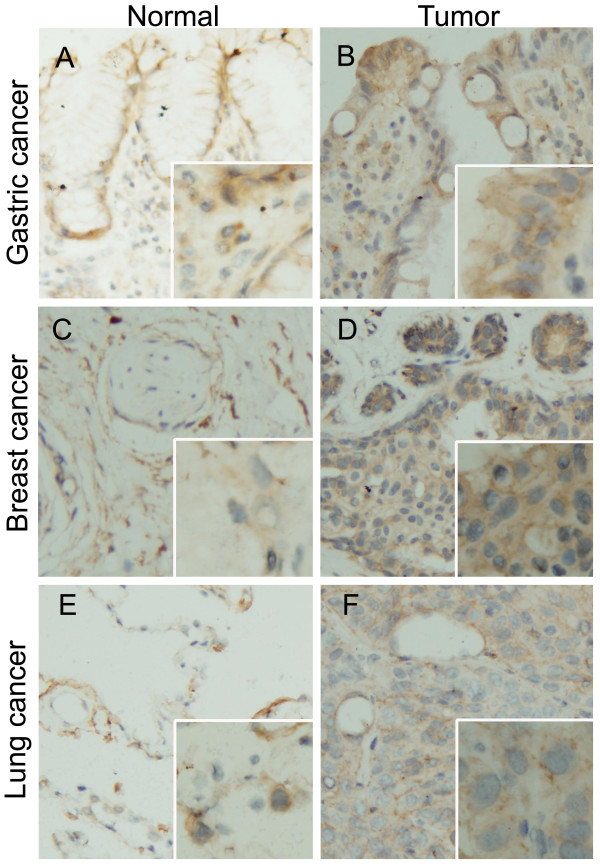
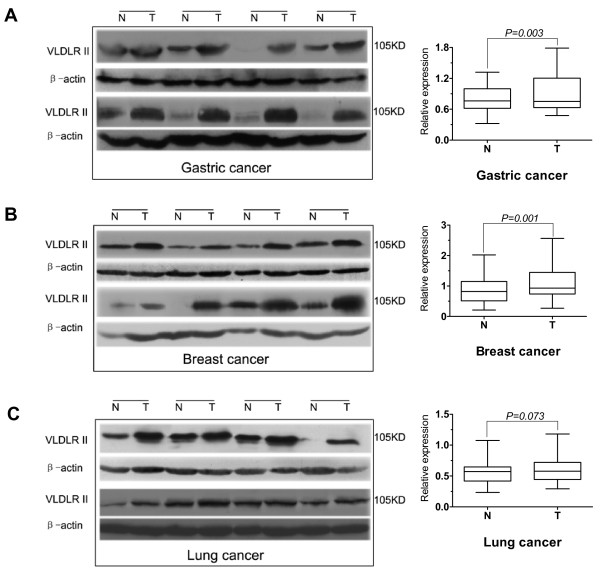
VLDLR II expression was examined using immunohistochemistry (IHC) and Western blot in tumor tissues from 213 gastric, breast and lung cancer patients, tumor adjacent noncancerous tissues by same methods. Correlations between VLDLR II and clinical features, as well as β-catenin expression status were evaluated by statistical analysis.
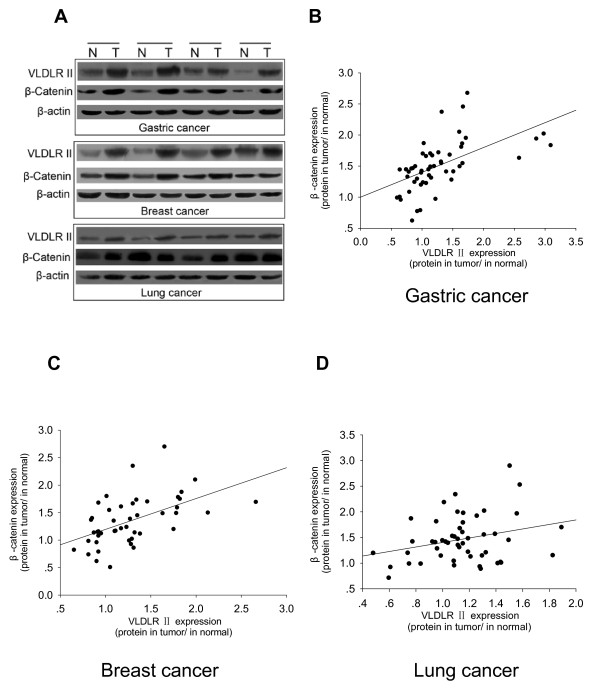
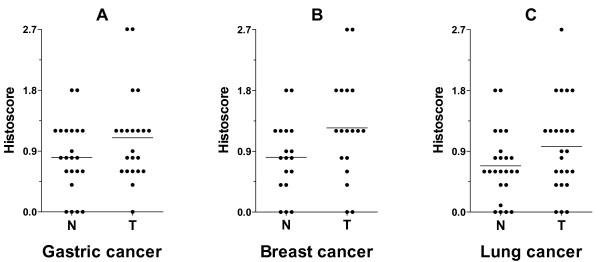
The immunohistochemical staining of VLDLR II showed statistical difference between tumor tissues and tumor adjacent noncancerous tissues in gastric, breast and lung cancers (P = 0.034, 0.018 and 0.043, respectively). Moreover, using Western, we found higher VLDLR II expression levels were associated with lymph node and distant metastasis in gastric and breast cancer (P < 0.05). Furthermore, highly significant positive correlations were found between VLDLR II and β-catenin in gastric cancer (r = 0.689; P < 0.001)breast cancer (r = 0.594; P < 0.001).
According to the results of the current study, high VLDLR II expression is correlated with lymph node and distant metastasis in gastric and breast cancer patients, the data suggest that VLDLR II may be a clinical marker in cancers, and has a potential link with β-catenin signaling pathway. This is the first to reveal the closer relationship of VLDLR II with clinical information.
极低密度脂蛋白受体(VLDLR)由于能结合众多配体,引发内吞作用并调节细胞信号,被认为是一种多功能受体。我们的研究小组曾报道过,增强 II 型 VLDLR(VLDLR II)的活性,即 VLDLR 的一种亚型,可促进腺癌 SGC7901 细胞的增殖和迁移。本研究旨在探讨 VLDLR II 在人胃癌、乳腺癌和肺癌组织中的表达水平,并研究其与临床特征和β-连环蛋白表达状态的关系。
采用免疫组织化学(IHC)和 Western blot 检测 213 例胃癌、乳腺癌和肺癌患者肿瘤组织及肿瘤旁非癌组织中 VLDLR II 的表达情况。采用统计学分析评估 VLDLR II 与临床特征及β-连环蛋白表达状态的相关性。
VLDLR II 的免疫组化染色在胃癌、乳腺癌和肺癌的肿瘤组织和肿瘤旁非癌组织中存在统计学差异(P=0.034、0.018 和 0.043)。此外,Western blot 分析发现,胃癌和乳腺癌中 VLDLR II 的高表达与淋巴结和远处转移有关(P<0.05)。此外,在胃癌(r=0.689;P<0.001)和乳腺癌(r=0.594;P<0.001)中,VLDLR II 与β-连环蛋白之间存在显著的正相关关系。
根据本研究结果,VLDLR II 在胃癌和乳腺癌患者中的高表达与淋巴结和远处转移有关,表明 VLDLR II 可能是癌症的临床标志物,与β-连环蛋白信号通路有潜在联系。这是首次揭示 VLDLR II 与临床信息更密切的关系。