Lexicon Pharmaceuticals, Inc, The Woodlands, Texas, United States of America.
PLoS One. 2010 Oct 27;5(10):e13654. doi: 10.1371/journal.pone.0013654.
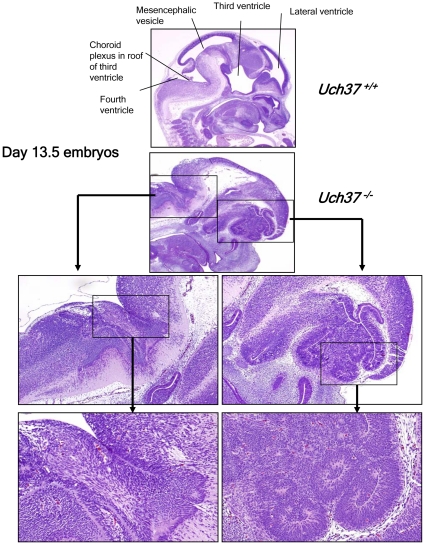
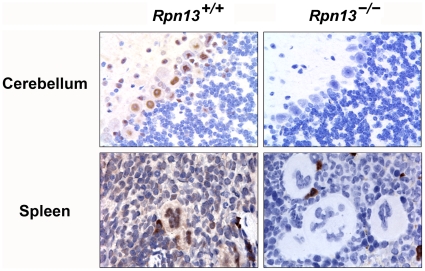
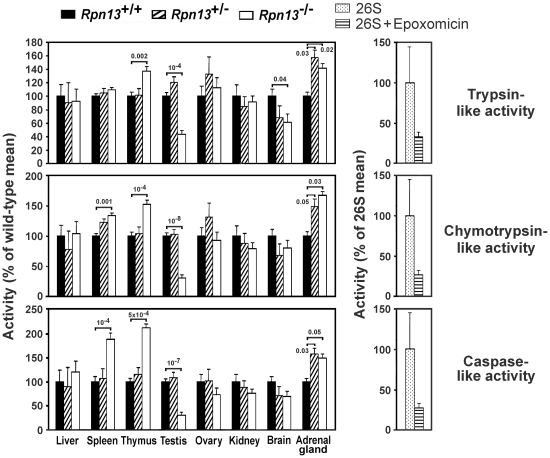
Rpn13 is a novel mammalian proteasomal receptor that has recently been identified as an amplification target in ovarian cancer. It can interact with ubiquitin and activate the deubiquitinating enzyme Uch37 at the 26S proteasome. Since neither Rpn13 nor Uch37 is an integral proteasomal subunit, we explored whether either protein is essential for mammalian development and survival. Deletion of Uch37 resulted in prenatal lethality in mice associated with severe defect in embryonic brain development. In contrast, the majority of Rpn13-deficient mice survived to adulthood, although they were smaller at birth and fewer in number than wild-type littermates. Absence of Rpn13 produced tissue-specific effects on proteasomal function: increased proteasome activity in adrenal gland and lymphoid organs, and decreased activity in testes and brain. Adult Rpn13(-/-) mice reached normal body weight but had increased body fat content and were infertile due to defective gametogenesis. Additionally, Rpn13(-/-) mice showed increased T-cell numbers, resembling growth hormone-mediated effects. Indeed, serum growth hormone and follicular stimulating hormone levels were significantly increased in Rpn13(-/-) mice, while growth hormone receptor expression was reduced in the testes. In conclusion, this is the first report characterizing the physiological roles of Uch37 and Rpn13 in murine development and implicating a non-ATPase proteasomal protein, Rpn13, in the process of gametogenesis.
Rpn13 是一种新型的哺乳动物蛋白酶体受体,最近被鉴定为卵巢癌的扩增靶标。它可以与泛素相互作用,并在 26S 蛋白酶体上激活去泛素化酶 Uch37。由于 Rpn13 和 Uch37 都不是完整的蛋白酶体亚基,我们探讨了这两种蛋白质是否对哺乳动物的发育和生存至关重要。Uch37 的缺失导致小鼠在产前死亡,与胚胎大脑发育的严重缺陷有关。相比之下,大多数 Rpn13 缺陷型小鼠能够存活到成年期,尽管它们出生时比野生型同窝仔小,数量也少。Rpn13 的缺失对蛋白酶体功能具有组织特异性影响:肾上腺和淋巴器官中的蛋白酶体活性增加,而睾丸和大脑中的活性降低。成年 Rpn13(-/-) 小鼠达到正常体重,但体脂含量增加,由于配子发生缺陷而不育。此外,Rpn13(-/-) 小鼠的 T 细胞数量增加,类似于生长激素介导的效应。事实上,Rpn13(-/-) 小鼠的血清生长激素和卵泡刺激素水平显著升高,而睾丸中生长激素受体的表达减少。总之,这是首次描述 Uch37 和 Rpn13 在小鼠发育中的生理作用,并表明非 ATP 酶蛋白酶体蛋白 Rpn13 参与了配子发生过程。