Institute of Cytology, Russian Academy of Sciences, St Petersburg, Russia.
PLoS One. 2010 Oct 29;5(10):e15385. doi: 10.1371/journal.pone.0015385.
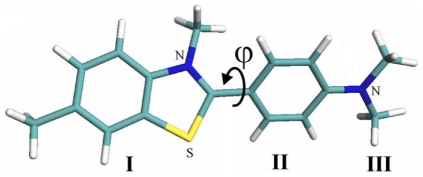
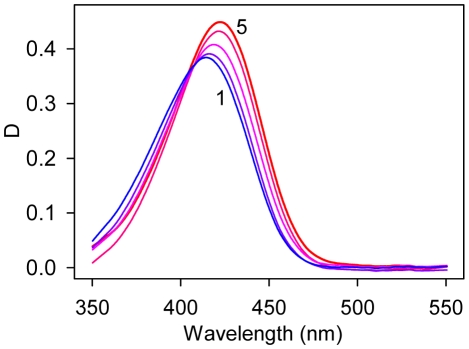
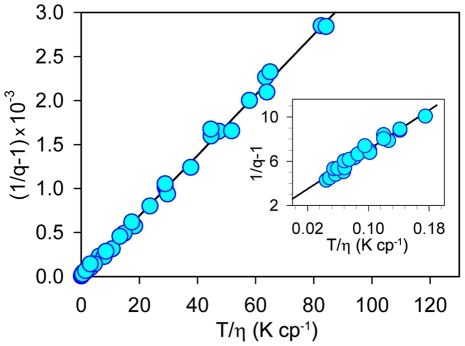
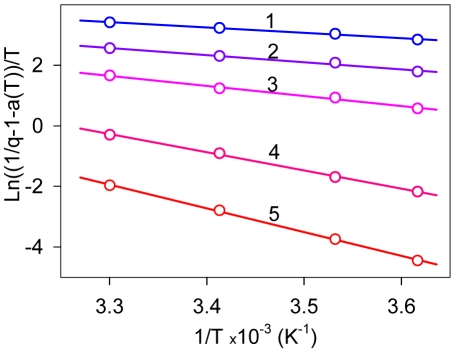
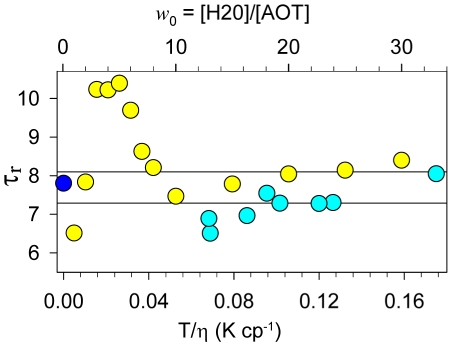
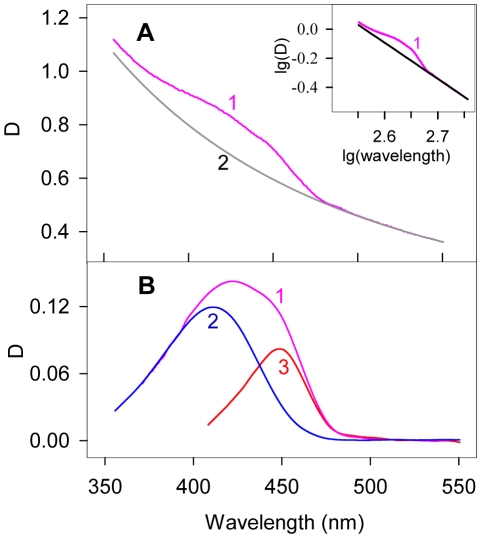
In this work, the fluorescence of thioflavin T (ThT) was studied in a wide range of viscosity and temperature. It was shown that ThT fluorescence quantum yield varies from 0.0001 in water at room temperature to 0.28 in rigid isotropic solution (T/η→0). The deviation of the fluorescence quantum yield from unity in rigid isotropic solution suggests that fluorescence quantum yield depends not only on the ultra-fast oscillation of ThT fragments relative to each other in an excited state as was suggested earlier, but also depends on the molecular configuration in the ground state. This means that the fluorescence quantum yield of the dye incorporated into amyloid fibrils must depend on its conformation, which, in turn, depends on the ThT environment. Therefore, the fluorescence quantum yield of ThT incorporated into amyloid fibrils can differ from that in the rigid isotropic solution. In particular, the fluorescence quantum yield of ThT incorporated into insulin fibrils was determined to be 0.43. Consequently, the ThT fluorescence quantum yield could be used to characterize the peculiarities of the fibrillar structure, which opens some new possibilities in the ThT use for structural characterization of the amyloid fibrils.
在这项工作中,研究了在广泛的粘度和温度范围内硫黄素 T(ThT)的荧光。结果表明,ThT 的荧光量子产率从室温下水的 0.0001 变化到刚性各向同性溶液中的 0.28(T/η→0)。在刚性各向同性溶液中荧光量子产率偏离 unity 表明,荧光量子产率不仅取决于激发态中 ThT 片段相对于彼此的超快振荡,如先前所建议的,还取决于基态中的分子构象。这意味着掺入淀粉样纤维中的染料的荧光量子产率必须取决于其构象,而构象又取决于 ThT 的环境。因此,掺入淀粉样纤维中的 ThT 的荧光量子产率可能与刚性各向同性溶液中的不同。具体而言,胰岛素纤维中掺入的 ThT 的荧光量子产率被确定为 0.43。因此,ThT 的荧光量子产率可用于表征纤维状结构的特性,这为 ThT 在淀粉样纤维的结构表征中的应用开辟了一些新的可能性。