Laboratoire de Microbiologie-Immunologie, UR02SP13, Hôpital Farhat Hached, Sousse, Tunisia.
Virol J. 2010 Nov 4;7:302. doi: 10.1186/1743-422X-7-302.
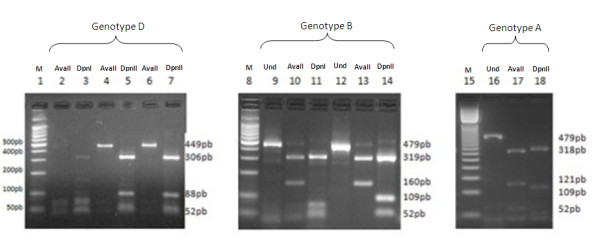
In Tunisia, country of intermediate endemicity for Hepatitis B virus (HBV) infection, most molecular studies on the virus have been carried out in the North of the country and little is known about other regions. The aim of this study was to determine HBV genotype and subgenotypes in Central-East Tunisia. A total of 217 HBs antigen positive patients were enrolled and determination of genotype was investigated in 130 patients with detectable HBV DNA. HBV genotyping methods were: PCR-RFLP on the pre-S region, a PCR using type-specific primers in the S region (TSP-PCR) and partial sequencing in the pre-S region.
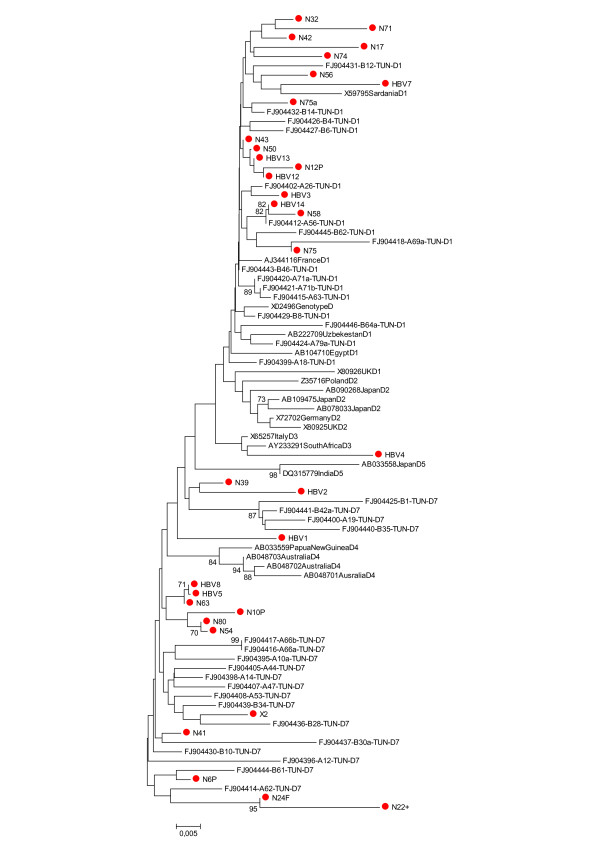
Three genotypes (D, B and A) were detected by the PCR-RFLP method and two (D and A) with the TSP-PCR method, the concordance between the two methods was 93%. Sequencing and phylogenetic analysis of 32 strains, retrieved the same genotype (D and A) for samples with concordant results and genotype D for samples with discordant results. The sequences of discordant genotypes had a restriction site in the pre-S gene which led to erroneous result by the PCR-RFLP method. Thus, prevalence of genotype D and A was 96% and 4%, respectively. Phylogenetic analysis showed the predominance of two subgenotypes D1 (55%) and D7 (41%). Only one strain clustered with D3 subgenotype (3%).
Predominance of subgenotype D7 appears to occur in northern regions of Africa with transition to subgenotype D1 in the East of the continent. HBV genetic variability may lead to wrong results in rapid genotyping methods and sequence analysis is needed to clarify atypical results.
在突尼斯,乙型肝炎病毒(HBV)感染的中度流行国家,大多数有关该病毒的分子研究都在该国北部进行,对其他地区的了解甚少。本研究的目的是确定突尼斯中东部的 HBV 基因型和亚型。共纳入 217 例 HBs 抗原阳性患者,对 130 例可检测到 HBV DNA 的患者进行了基因型确定。HBV 基因分型方法为:前 S 区 PCR-RFLP、S 区使用型特异性引物的 PCR(TSP-PCR)和前 S 区部分测序。
PCR-RFLP 方法检测到三种基因型(D、B 和 A),TSP-PCR 方法检测到两种(D 和 A),两种方法的一致性为 93%。对 32 株进行测序和系统发育分析,对于一致结果的样本,两种方法均检测到相同的基因型(D 和 A),对于不一致结果的样本,检测到基因型 D。不一致基因型的序列在前 S 基因中有一个限制酶切位点,导致 PCR-RFLP 方法出现错误结果。因此,基因型 D 和 A 的流行率分别为 96%和 4%。系统发育分析显示,D1 亚基因型(55%)和 D7 亚基因型(41%)占优势。只有一株与 D3 亚基因型(3%)聚类。
D7 亚基因型的流行似乎发生在非洲北部地区,在该大陆东部过渡到 D1 亚基因型。HBV 遗传变异可能导致快速基因分型方法出现错误结果,需要进行序列分析以澄清非典型结果。