Servicio General de Citometría, Departamento de Medicina and Centro de Investigación del Cáncer (IBMCC-CSIC/USAL), Universidad de Salamanca, Salamanca, Spain.
PLoS One. 2010 Oct 29;5(10):e13752. doi: 10.1371/journal.pone.0013752.
For years, the genetics of metastatic colorectal cancer (CRC) have been studied using a variety of techniques. However, most of the approaches employed so far have a relatively limited resolution which hampers detailed characterization of the common recurrent chromosomal breakpoints as well as the identification of small regions carrying genetic changes and the genes involved in them.
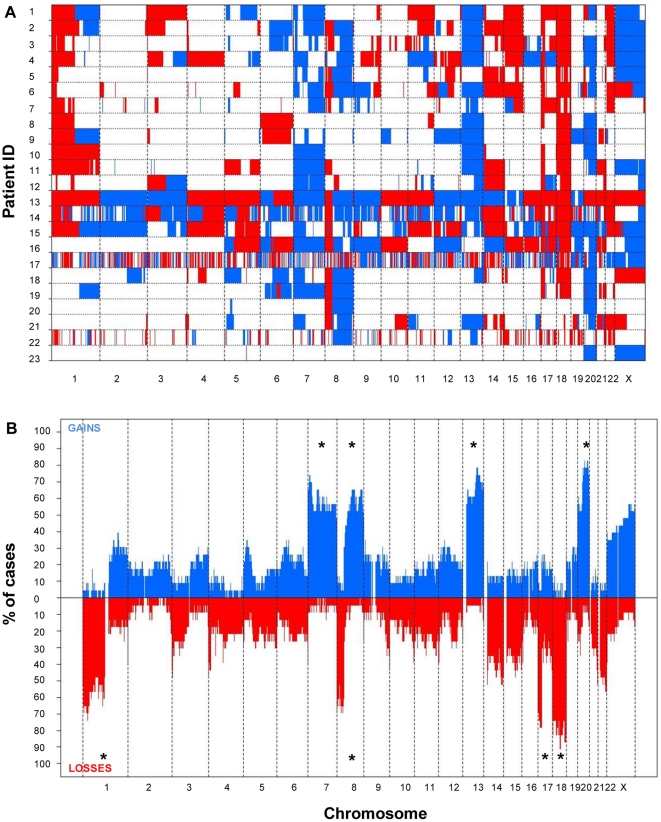
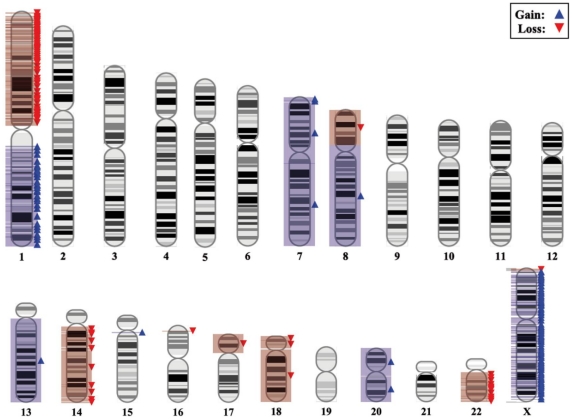
METHODOLOGY/PRINCIPAL FINDINGS: Here we applied 500K SNP arrays to map the most common chromosomal lesions present at diagnosis in a series of 23 primary tumours from sporadic CRC patients who had developed liver metastasis. Overall our results confirm that the genetic profile of metastatic CRC is defined by imbalanced gains of chromosomes 7, 8q, 11q, 13q, 20q and X together with losses of the 1p, 8p, 17p and 18q chromosome regions. In addition, SNP-array studies allowed the identification of small (<1.3 Mb) and extensive/large (>1.5 Mb) altered DNA sequences, many of which contain cancer genes known to be involved in CRC and the metastatic process. Detailed characterization of the breakpoint regions for the altered chromosomes showed four recurrent breakpoints at chromosomes 1p12, 8p12, 17p11.2 and 20p12.1; interestingly, the most frequently observed recurrent chromosomal breakpoint was localized at 17p11.2 and systematically targeted the FAM27L gene, whose role in CRC deserves further investigations.
CONCLUSIONS/SIGNIFICANCE: In summary, in the present study we provide a detailed map of the genetic abnormalities of primary tumours from metastatic CRC patients, which confirm and extend on previous observations as regards the identification of genes potentially involved in development of CRC and the metastatic process.
多年来,转移性结直肠癌(CRC)的遗传学一直使用各种技术进行研究。然而,迄今为止采用的大多数方法分辨率相对较低,这阻碍了对常见复发性染色体断裂点的详细特征描述,以及对携带遗传变化的小区域和其中涉及的基因的鉴定。
方法/主要发现:在这里,我们应用 500K SNP 数组来绘制 23 例散发性 CRC 患者的 23 例原发性肿瘤在诊断时存在的最常见染色体病变的图谱,这些患者已经发生了肝转移。总的来说,我们的结果证实转移性 CRC 的遗传特征由染色体 7、8q、11q、13q、20q 的不平衡增益以及 1p、8p、17p 和 18q 染色体区域的缺失定义。此外,SNP 数组研究允许鉴定小(<1.3 Mb)和广泛/大(>1.5 Mb)的改变 DNA 序列,其中许多包含已知参与 CRC 和转移过程的癌症基因。对改变染色体的断裂点区域的详细特征描述显示在染色体 1p12、8p12、17p11.2 和 20p12.1 处存在四个复发性断裂点;有趣的是,最常观察到的复发性染色体断裂点定位于 17p11.2 处,并系统性地靶向 FAM27L 基因,其在 CRC 中的作用值得进一步研究。
结论/意义:总之,在本研究中,我们提供了转移性 CRC 患者原发性肿瘤遗传异常的详细图谱,这些图谱证实并扩展了先前关于鉴定可能参与 CRC 发展和转移过程的基因的观察结果。