Sundh Henrik, Kvamme Bjørn Olav, Fridell Frode, Olsen Rolf Erik, Ellis Tim, Taranger Geir Lasse, Sundell Kristina
Department of Zoology/Zoophysiology, University of Gothenburg, Sweden.
BMC Physiol. 2010 Nov 9;10:22. doi: 10.1186/1472-6793-10-22.
Fish farmed under high intensity aquaculture conditions are subjected to unnatural environments that may cause stress. Therefore awareness of how to maintain good health and welfare of farmed fish is important. For Atlantic salmon held in sea cages, water flow, dissolved oxygen (DO) levels and temperature will fluctuate over time and the fish can at times be exposed to detrimentally low DO levels and high temperatures. This experimental study investigates primary and secondary stress responses of Atlantic salmon post smolts to long-term exposure to reduced and fluctuating DO levels and high water temperatures, mimicking situations in the sea cages. Plasma cortisol levels and cortisol release to the water were assessed as indicators of the primary stress response and intestinal barrier integrity and physiological functions as indicators of secondary responses to changes in environmental conditions.
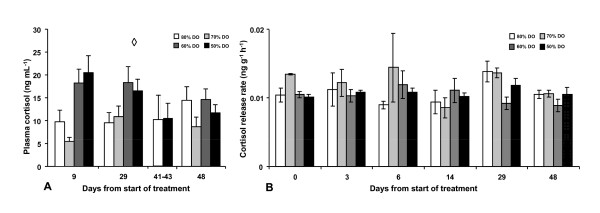
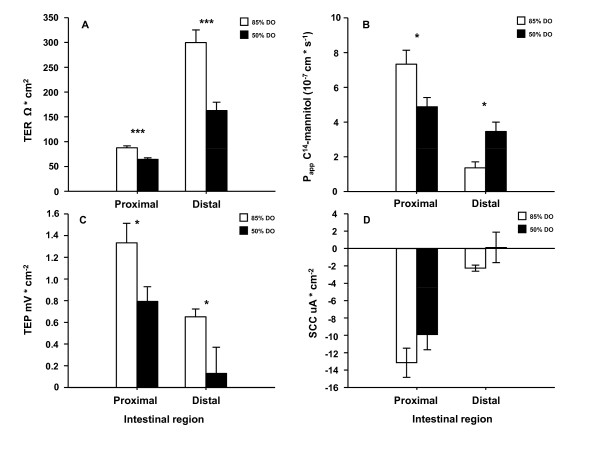
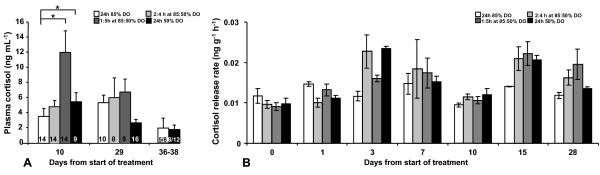
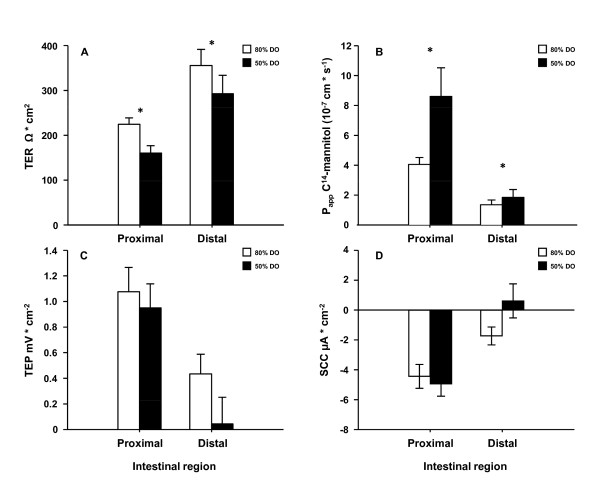
Plasma cortisol levels were elevated in fish exposed to low (50% and 60% saturation) DO levels and low temperature (9°C), at days 9, 29 and 48. The intestinal barrier function, measured as electrical resistance (TER) and permeability of mannitol at the end of the experiment, were reduced at 50% DO, in both proximal and distal intestine. When low DO levels were combined with high temperature (16°C), plasma cortisol levels were elevated in the cyclic 1:5 h at 85%:50% DO group and fixed 50% DO group compared to the control (85% DO) group at day 10 but not at later time points. The intestinal barrier function was clearly disturbed in the 50% DO group; TER was reduced in both intestinal regions concomitant with increased paracellular permeability in the distal region.
This study reveals that adverse environmental conditions (low water flow, low DO levels at low and high temperature), that can occur in sea cages, elicits primary and secondary stress responses in Atlantic salmon post smolts. The intestinal barrier function was significantly affected by prolonged hypoxic stress even when no primary stress response was observed. This suggests that intestinal barrier function is a good experimental marker for evaluation of chronic stress and that it can be a valuable tool to study the impact of various husbandry conditions on health and welfare of farmed Atlantic salmon.
在高强度水产养殖条件下养殖的鱼类会处于可能导致应激的非自然环境中。因此,了解如何维持养殖鱼类的良好健康和福利很重要。对于养殖在海水网箱中的大西洋鲑鱼,水流、溶解氧(DO)水平和温度会随时间波动,鱼类有时会暴露于有害的低溶解氧水平和高温环境中。本实验研究调查了大西洋鲑鱼幼鲑在模拟海水网箱环境下长期暴露于降低和波动的溶解氧水平及高温后的原发性和继发性应激反应。血浆皮质醇水平和皮质醇向水中的释放被评估为原发性应激反应的指标,肠道屏障完整性和生理功能则作为对环境条件变化的继发性反应指标。
在第9天、29天和48天,暴露于低(50%和60%饱和度)溶解氧水平和低温(9°C)的鱼类血浆皮质醇水平升高。在实验结束时,以跨上皮电阻(TER)和甘露醇通透性衡量的肠道屏障功能,在50%溶解氧水平下,近端和远端肠道均降低。当低溶解氧水平与高温(16°C)相结合时,与对照组(85%溶解氧)相比,在第10天,85%:50%溶解氧循环组和固定在50%溶解氧组的血浆皮质醇水平在1:5小时循环中升高,但在随后的时间点未升高。50%溶解氧组的肠道屏障功能明显受到干扰;两个肠道区域的TER均降低,同时远端区域的细胞旁通透性增加。
本研究表明,海水网箱中可能出现的不利环境条件(低水流、低温和高温下的低溶解氧水平)会引发大西洋鲑鱼幼鲑的原发性和继发性应激反应。即使未观察到原发性应激反应,长期缺氧应激也会显著影响肠道屏障功能。这表明肠道屏障功能是评估慢性应激的良好实验指标,并且它可以成为研究各种养殖条件对养殖大西洋鲑鱼健康和福利影响的有价值工具。