Institute for Molecular Bioscience, The University of Queensland, Brisbane, Queensland, Australia.
PLoS One. 2010 Nov 2;5(11):e13809. doi: 10.1371/journal.pone.0013809.
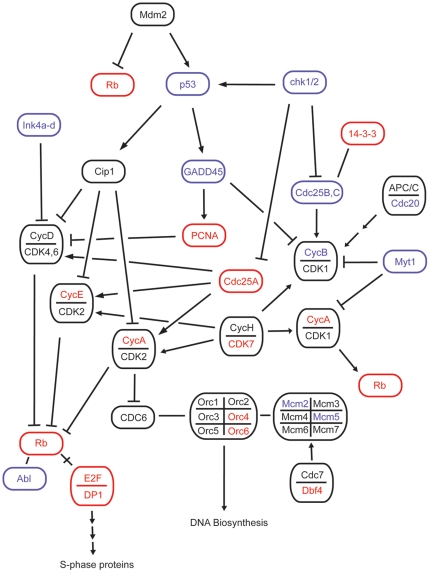
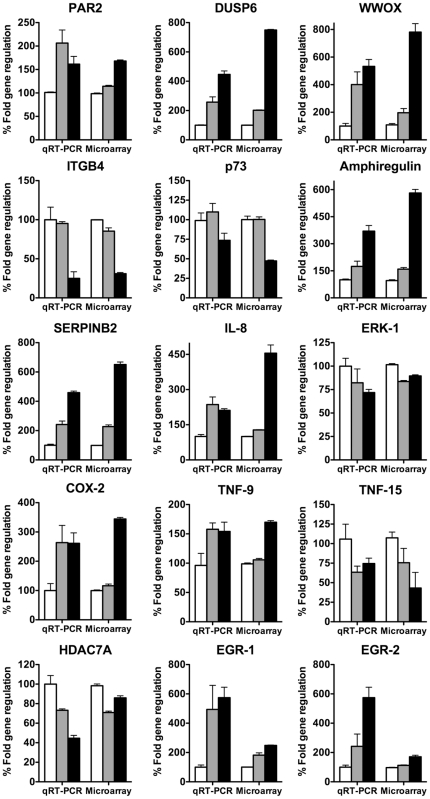
Protease-Activated Receptor-2 (PAR2) has been implicated through genetic knockout mice with cytokine regulation and arthritis development. Many studies have associated PAR2 with inflammatory conditions (arthritis, airways inflammation, IBD) and key events in tumor progression (angiogenesis, metastasis), but they have relied heavily on the use of single agonists to identify physiological roles for PAR2. However such probes are now known not to be highly selective for PAR2, and thus precisely what PAR2 does and what mechanisms of downstream regulation are truly affected remain obscure. Effects of PAR2 activation on gene expression in Human Embryonic Kidney cells (HEK293), a commonly studied cell line in PAR2 research, were investigated here by comparing 19,000 human genes for intersecting up- or down-regulation by both trypsin (an endogenous protease that activates PAR2) and a PAR2 activating hexapeptide (2f-LIGRLO-NH(2)). Among 2,500 human genes regulated similarly by both agonists, there were clear associations between PAR2 activation and cellular metabolism (1,000 genes), the cell cycle, the MAPK pathway, HDAC and sirtuin enzymes, inflammatory cytokines, and anti-complement function. PAR-2 activation up-regulated four genes more than 5 fold (DUSP6, WWOX, AREG, SERPINB2) and down-regulated another six genes more than 3 fold (TXNIP, RARG, ITGB4, CTSD, MSC and TM4SF15). Both PAR2 and PAR1 activation resulted in up-regulated expression of several genes (CD44, FOSL1, TNFRSF12A, RAB3A, COPEB, CORO1C, THBS1, SDC4) known to be important in cancer. This is the first widespread profiling of specific activation of PAR2 and provides a valuable platform for better understanding key mechanistic roles of PAR2 in human physiology. Results clearly support the development of both antagonists and agonists of human PAR2 as potential disease modifying therapeutic agents.
蛋白酶激活受体-2(PAR2)已通过基因敲除小鼠与细胞因子调节和关节炎发展相关联。许多研究将 PAR2 与炎症条件(关节炎、气道炎症、IBD)和肿瘤进展中的关键事件(血管生成、转移)相关联,但它们严重依赖于使用单一激动剂来确定 PAR2 的生理作用。然而,现在已知这些探针对 PAR2 的选择性不高,因此 PAR2 的确切作用以及下游调节的真正机制仍不清楚。本研究通过比较胰蛋白酶(激活 PAR2 的内源性蛋白酶)和 PAR2 激活六肽(2f-LIGRLO-NH(2))对人胚肾细胞(HEK293)中 19000 个人类基因的交叉上调或下调,研究了 PAR2 激活对基因表达的影响。HEK293 是人 PAR2 研究中常用的细胞系。在这两种激动剂调节的 2500 个人类基因中,PAR2 激活与细胞代谢(1000 个基因)、细胞周期、MAPK 途径、HDAC 和 Sirtuin 酶、炎性细胞因子和抗补体功能之间存在明显的关联。PAR-2 激活使 4 个基因的表达上调超过 5 倍(DUSP6、WWOX、AREG、SERPINB2),使另外 6 个基因的表达下调超过 3 倍(TXNIP、RARG、ITGB4、CTSD、MSC 和 TM4SF15)。PAR2 和 PAR1 激活均导致几个基因(CD44、FOSL1、TNFRSF12A、RAB3A、COPEB、CORO1C、THBS1、SDC4)的表达上调,这些基因已知在癌症中很重要。这是首次对 PAR2 特异性激活进行广泛的分析,为更好地理解 PAR2 在人体生理学中的关键机制作用提供了有价值的平台。结果清楚地支持开发 PAR2 的拮抗剂和激动剂作为潜在的疾病修饰治疗剂。