Department of Life Science, Sogang University, Seoul, Republic of Korea.
PLoS One. 2010 Nov 3;5(11):e13818. doi: 10.1371/journal.pone.0013818.
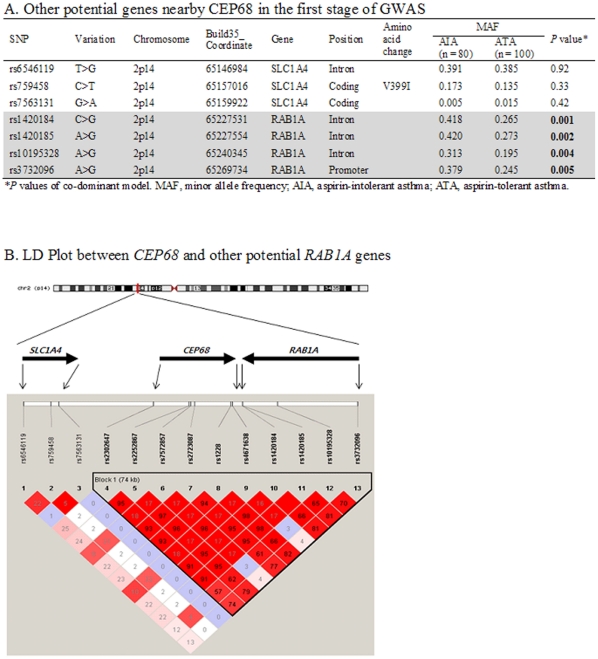
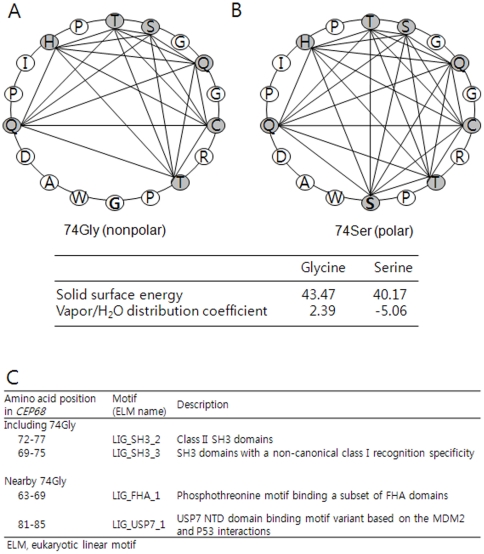
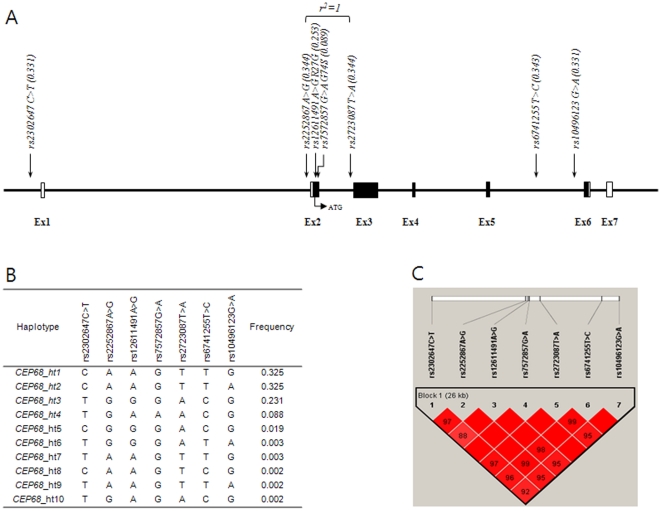
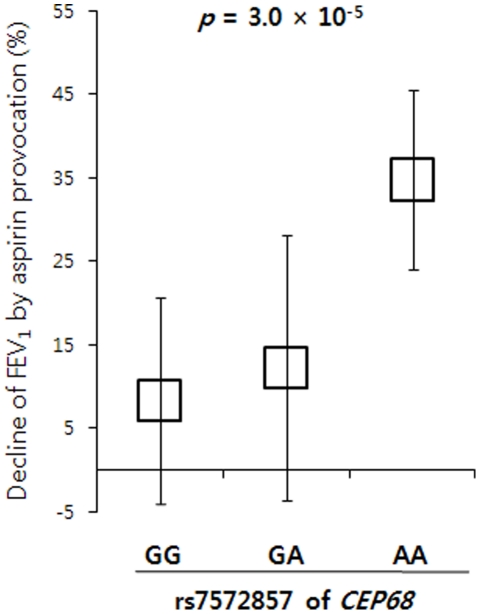
Aspirin-intolerant asthma (AIA) is a rare condition that is characterized by the development of bronchoconstriction in asthmatic patients after ingestion of non-steroidal anti-inflammatory drugs including aspirin. However, the underlying mechanisms of AIA occurrence are still not fully understood. To identify the genetic variations associated with aspirin intolerance in asthmatics, the first stage of genome-wide association study with 109,365 single nucleotide polymorphisms (SNPs) was undertaken in a Korean AIA (n = 80) cohort and aspirin-tolerant asthma (ATA, n = 100) subjects as controls. For the second stage of follow-up study, 150 common SNPs from 11 candidate genes were genotyped in 163 AIA patients including intermediate AIA (AIA-I) subjects and 429 ATA controls. Among 11 candidate genes, multivariate logistic analyses showed that SNPs of CEP68 gene showed the most significant association with aspirin intolerance (P values of co-dominant for CEP68, 6.0×10(-5) to 4.0×10(-5)). All seven SNPs of the CEP68 gene showed linkage disequilibrium (LD), and the haplotype of CEP68_ht4 (T-G-A-A-A-C-G) showed a highly significant association with aspirin intolerance (OR= 2.63; 95% CI= 1.64-4.21; P = 6.0×10(-5)). Moreover, the nonsynonymous CEP68 rs7572857G>A variant that replaces glycine with serine showed a higher decline of forced expiratory volume in 1s (FEV(1)) by aspirin provocation than other variants (P = 3.0×10(-5)). Our findings imply that CEP68 could be a susceptible gene for aspirin intolerance in asthmatics, suggesting that the nonsynonymous Gly74Ser could affect the polarity of the protein structure.
阿司匹林不耐受型哮喘(AIA)是一种罕见的病症,其特征是哮喘患者在摄入包括阿司匹林在内的非甾体抗炎药后会出现支气管收缩。然而,AIA 发生的潜在机制仍未完全阐明。为了确定与哮喘患者阿司匹林不耐受相关的遗传变异,我们在一个韩国 AIA(n = 80)队列和阿司匹林耐受型哮喘(ATA,n = 100)对照组中进行了全基因组关联研究的第一阶段,共涉及 109365 个单核苷酸多态性(SNP)。在第二阶段的随访研究中,对 163 例 AIA 患者(包括中间型 AIA [AIA-I] 患者)和 429 例 ATA 对照组进行了 11 个候选基因的 150 个常见 SNP 基因分型。在 11 个候选基因中,多变量逻辑分析显示 CEP68 基因的 SNP 与阿司匹林不耐受的相关性最为显著(CEP68 共显性的 P 值为 6.0×10(-5)至 4.0×10(-5))。CEP68 基因的所有 7 个 SNP 均显示出连锁不平衡(LD),CEP68_ht4(T-G-A-A-A-C-G)的单倍型与阿司匹林不耐受具有高度显著的相关性(OR=2.63;95%CI=1.64-4.21;P=6.0×10(-5))。此外,CEP68 中替代甘氨酸的丝氨酸的非同义 CEP68 rs7572857G>A 变异在阿司匹林激发后使 1 秒用力呼气容积(FEV(1))下降得更为明显,而非其他变异(P=3.0×10(-5))。我们的研究结果表明 CEP68 可能是哮喘患者阿司匹林不耐受的易感基因,提示非同义 Gly74Ser 可能会影响蛋白质结构的极性。