Samuel Lunenfeld Research Institute, Mount Sinai Hospital, 600 University Avenue, Room 1090, Toronto, Ontario M5G 1X5, Canada.
Curr Opin Struct Biol. 2010 Dec;20(6):772-81. doi: 10.1016/j.sbi.2010.10.001. Epub 2010 Nov 10.
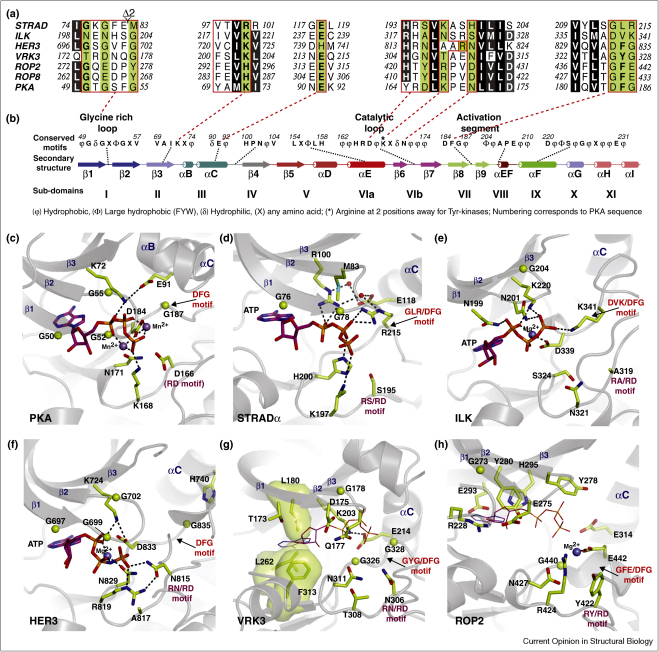
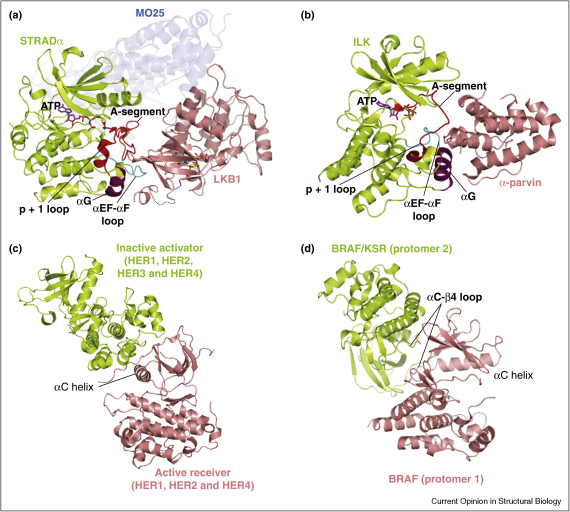
Protein kinases provide a platform for the integration of signal transduction networks. A key feature of transmitting these cellular signals is the ability of protein kinases to activate one another by phosphorylation. A number of kinases are predicted by sequence homology to be incapable of phosphoryl group transfer due to degradation of their catalytic motifs. These are termed pseudokinases and because of the assumed lack of phosphoryltransfer activity their biological role in cellular transduction has been mysterious. Recent structure-function studies have uncovered the molecular determinants for protein kinase inactivity and have shed light to the biological functions and evolution of this enigmatic subset of the human kinome. Pseudokinases act as signal transducers by bringing together components of signalling networks, as well as allosteric activators of active protein kinases.
蛋白激酶为信号转导网络的整合提供了一个平台。传递这些细胞信号的一个关键特征是,蛋白激酶能够通过磷酸化相互激活。有许多激酶通过序列同源性预测,由于其催化基序的降解,而不能进行磷酸基团转移,这些激酶被称为假激酶。由于假定缺乏磷酸转移活性,它们在细胞转导中的生物学作用一直是神秘的。最近的结构-功能研究揭示了蛋白激酶无活性的分子决定因素,并阐明了这个人类激酶组中神秘亚类的生物学功能和进化。假激酶通过将信号网络的组成部分以及活性蛋白激酶的别构激活剂聚集在一起,充当信号转导分子。