Aldana-Masangkay Grace I, Sakamoto Kathleen M
Department of Chemistry and Biochemistry, University of California, Los Angeles, CA 90095, USA.
J Biomed Biotechnol. 2011;2011:875824. doi: 10.1155/2011/875824. Epub 2010 Nov 7.
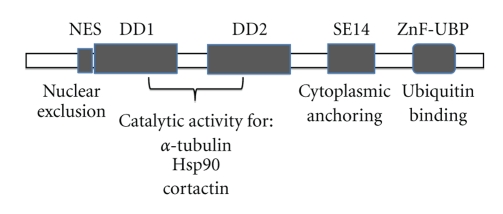
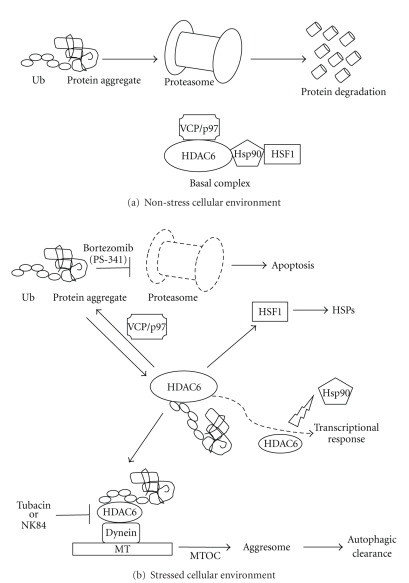
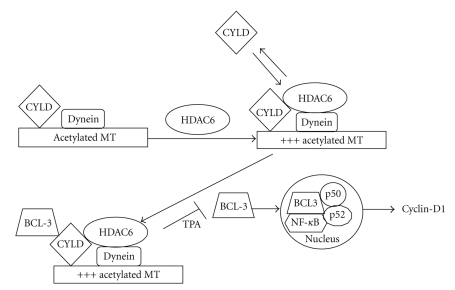
Histone deacetylase 6 (HDAC6), a member of the HDAC family whose major substrate is α-tubulin, has become a target for drug development to treat cancer due to its major contribution in oncogenic cell transformation. Overexpression of HDAC6 correlates with tumorigenesis and improved survival; therefore, HDAC6 may be used as a marker for prognosis. Previous work demonstrated that in multiple myeloma cells, inhibition of HDAC6 results in apoptosis. Furthermore, HDAC6 is required for the activation of heat-shock factor 1 (HSF1), an activator of heat-shock protein encoding genes (HSPs) and CYLD, a cylindromatosis tumor suppressor gene. HDAC6 contributes to cancer metastasis since its upregulation increases cell motility in breast cancer MCF-7 cells and its interaction with cortactin regulates motility. HDAC6 also affects transcription and translation by regulating the heat-shock protein 90 (Hsp90) and stress granules (SGs), respectively. This review will discuss the role of HDAC6 in the pathogenesis and treatment of cancer.
组蛋白去乙酰化酶6(HDAC6)是HDAC家族的成员之一,其主要底物是α-微管蛋白。由于它在致癌细胞转化中起主要作用,已成为癌症治疗药物开发的靶点。HDAC6的过表达与肿瘤发生及生存期延长相关,因此,HDAC6可作为预后标志物。先前的研究表明,在多发性骨髓瘤细胞中,抑制HDAC6会导致细胞凋亡。此外,HDAC6是热休克因子1(HSF1)激活所必需的,HSF1是热休克蛋白编码基因(HSPs)的激活剂,而CYLD是一种圆柱瘤抑癌基因。HDAC6促进癌症转移,因为其上调会增加乳腺癌MCF-7细胞的运动性,并且它与皮层肌动蛋白的相互作用调节细胞运动。HDAC6还分别通过调节热休克蛋白90(Hsp90)和应激颗粒(SGs)来影响转录和翻译。本综述将讨论HDAC6在癌症发病机制和治疗中的作用。