• 文献检索
  • 文档翻译
  • 深度研究
  • 学术资讯
  • Suppr Zotero 插件Zotero 插件
  • 邀请有礼
  • 套餐&价格
  • 历史记录
应用&插件
Suppr Zotero 插件Zotero 插件浏览器插件Mac 客户端Windows 客户端微信小程序
定价
高级版会员购买积分包购买API积分包
服务
文献检索文档翻译深度研究API 文档MCP 服务
关于我们
关于 Suppr公司介绍联系我们用户协议隐私条款
关注我们

Suppr 超能文献

核心技术专利:CN118964589B侵权必究
粤ICP备2023148730 号-1Suppr @ 2026

文献检索

告别复杂PubMed语法,用中文像聊天一样搜索,搜遍4000万医学文献。AI智能推荐,让科研检索更轻松。

立即免费搜索

文件翻译

保留排版,准确专业,支持PDF/Word/PPT等文件格式,支持 12+语言互译。

免费翻译文档

深度研究

AI帮你快速写综述,25分钟生成高质量综述,智能提取关键信息,辅助科研写作。

立即免费体验

陆地棉(Gossypium hirsutum L.)发育纤维中的基因表达在驯化过程中发生了大规模改变。

Gene expression in developing fibres of Upland cotton (Gossypium hirsutum L.) was massively altered by domestication.

机构信息

Department of Ecology, 251 Bessey Hall, Iowa State University, Ames, IA 50011, USA.

出版信息

BMC Biol. 2010 Nov 15;8:139. doi: 10.1186/1741-7007-8-139.

DOI:10.1186/1741-7007-8-139
PMID:21078138
原文链接:https://pmc.ncbi.nlm.nih.gov/articles/PMC2992495/
Abstract

BACKGROUND

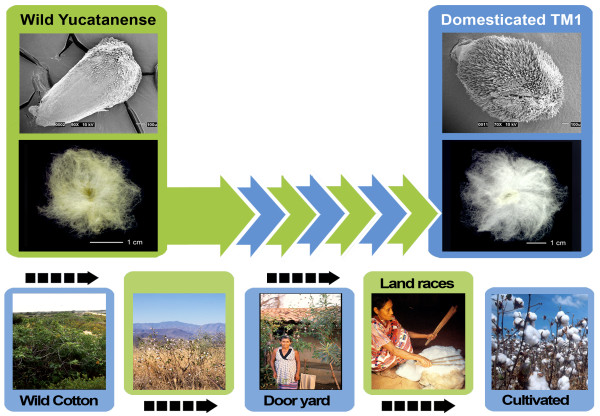
Understanding the evolutionary genetics of modern crop phenotypes has a dual relevance to evolutionary biology and crop improvement. Modern upland cotton (Gossypium hirsutum L.) was developed following thousands of years of artificial selection from a wild form, G. hirsutum var. yucatanense, which bears a shorter, sparser, layer of single-celled, ovular trichomes ('fibre'). In order to gain an insight into the nature of the developmental genetic transformations that accompanied domestication and crop improvement, we studied the transcriptomes of cotton fibres from wild and domesticated accessions over a developmental time course.

RESULTS

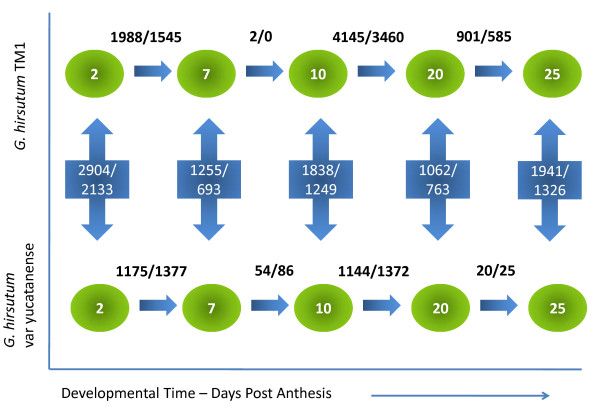
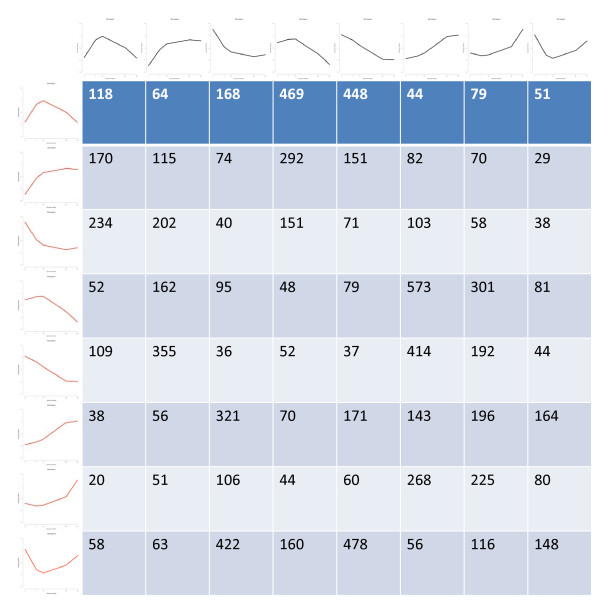
Fibre cells were harvested between 2 and 25 days post-anthesis and encompassed the primary and secondary wall synthesis stages. Using amplified messenger RNA and a custom microarray platform designed to interrogate expression for 40,430 genes, we determined global patterns of expression during fibre development. The fibre transcriptome of domesticated cotton is far more dynamic than that of wild cotton, with over twice as many genes being differentially expressed during development (12,626 versus 5273). Remarkably, a total of 9465 genes were diagnosed as differentially expressed between wild and domesticated fibres when summed across five key developmental time points. Human selection during the initial domestication and subsequent crop improvement has resulted in a biased upregulation of components of the transcriptional network that are important for agronomically advanced fibre, especially in the early stages of development. About 15% of the differentially expressed genes in wild versus domesticated cotton fibre have no homology to the genes in databases.

CONCLUSIONS

We show that artificial selection during crop domestication can radically alter the transcriptional developmental network of even a single-celled structure, affecting nearly a quarter of the genes in the genome. Gene expression during fibre development within accessions and expression alteration arising from evolutionary change appears to be 'modular' - complex genic networks have been simultaneously and similarly transformed, in a coordinated fashion, as a consequence of human-mediated selection. These results highlight the complex alteration of the global gene expression machinery that resulted from human selection for a longer, stronger and finer fibre, as well as other aspects of fibre physiology that were not consciously selected. We illustrate how the data can be mined for genes that were unwittingly targeted by aboriginal and/or modern domesticators during crop improvement and/or which potentially control the improved qualities of domesticated cotton fibre.See Commentary: http://www.biomedcentral.com/1741-7007/8/137.
https://cdn.ncbi.nlm.nih.gov/pmc/blobs/88b2/2992495/fd78de9e4d79/1741-7007-8-139-4.jpg
https://cdn.ncbi.nlm.nih.gov/pmc/blobs/88b2/2992495/d609d68d6933/1741-7007-8-139-1.jpg
https://cdn.ncbi.nlm.nih.gov/pmc/blobs/88b2/2992495/cfdccd875a01/1741-7007-8-139-2.jpg
https://cdn.ncbi.nlm.nih.gov/pmc/blobs/88b2/2992495/e0421d15adfe/1741-7007-8-139-3.jpg
https://cdn.ncbi.nlm.nih.gov/pmc/blobs/88b2/2992495/fd78de9e4d79/1741-7007-8-139-4.jpg
https://cdn.ncbi.nlm.nih.gov/pmc/blobs/88b2/2992495/d609d68d6933/1741-7007-8-139-1.jpg
https://cdn.ncbi.nlm.nih.gov/pmc/blobs/88b2/2992495/cfdccd875a01/1741-7007-8-139-2.jpg
https://cdn.ncbi.nlm.nih.gov/pmc/blobs/88b2/2992495/e0421d15adfe/1741-7007-8-139-3.jpg
https://cdn.ncbi.nlm.nih.gov/pmc/blobs/88b2/2992495/fd78de9e4d79/1741-7007-8-139-4.jpg
摘要

背景

了解现代作物表型的进化遗传学对于进化生物学和作物改良具有双重意义。现代陆地棉(Gossypium hirsutum L.)是经过几千年的人工选择从野生种 G. hirsutum var. yucatanense 发展而来的,后者具有较短、较稀疏、单细胞、卵形的毛状体(“纤维”)。为了深入了解伴随驯化和作物改良的发育遗传转化的本质,我们在发育时间过程中研究了来自野生和驯化品种的棉花纤维的转录组。

结果

纤维细胞在开花后 2 至 25 天收获,涵盖了初生壁和次生壁合成阶段。使用扩增的信使 RNA 和一个定制的微阵列平台,设计用于检测 40,430 个基因的表达,我们确定了纤维发育过程中的全局表达模式。驯化棉花的纤维转录组比野生棉花的转录组要活跃得多,在发育过程中有两倍以上的基因表现出差异表达(12,626 个对 5273 个)。值得注意的是,当汇总五个关键发育时间点时,野生和驯化纤维之间的差异表达基因总数达到 9465 个。人类在最初的驯化和随后的作物改良过程中的选择导致了与农艺上先进纤维重要的转录网络组件的偏上调,特别是在发育的早期阶段。在野生与驯化棉花纤维的差异表达基因中,约有 15%与数据库中的基因没有同源性。

结论

我们表明,作物驯化过程中的人工选择可以彻底改变甚至单细胞结构的转录发育网络,影响基因组中近四分之一的基因。品种内纤维发育过程中的基因表达和进化引起的表达改变似乎是“模块化”的——复杂的基因网络已经以协调的方式同时和类似地发生转变,这是人类介导的选择的结果。这些结果突出了人类选择更长、更强和更细纤维以及其他纤维生理学方面的无意识选择所导致的全球基因表达机制的复杂改变。我们说明了如何从数据中挖掘出在作物改良过程中原始和/或现代驯化者无意中针对的基因,以及可能控制驯化棉花纤维改良品质的基因。

参见评论

http://www.biomedcentral.com/1741-7007/8/137。

相似文献

1
Gene expression in developing fibres of Upland cotton (Gossypium hirsutum L.) was massively altered by domestication.陆地棉(Gossypium hirsutum L.)发育纤维中的基因表达在驯化过程中发生了大规模改变。
BMC Biol. 2010 Nov 15;8:139. doi: 10.1186/1741-7007-8-139.
2
Comparative evolutionary and developmental dynamics of the cotton (Gossypium hirsutum) fiber transcriptome.棉纤维转录组的比较进化和发育动态。
PLoS Genet. 2014 Jan;10(1):e1004073. doi: 10.1371/journal.pgen.1004073. Epub 2014 Jan 2.
3
Global analysis of gene expression in cotton fibers from wild and domesticated Gossypium barbadense.野生和驯化的海岛棉棉纤维中基因表达的全局分析。
Evol Dev. 2008 Sep-Oct;10(5):567-82. doi: 10.1111/j.1525-142X.2008.00272.x.
4
Evolutionary Conservation and Divergence of Gene Coexpression Networks in Gossypium (Cotton) Seeds.棉花种子中基因共表达网络的进化保守性和分化。
Genome Biol Evol. 2016 Dec 1;8(12):3765-3783. doi: 10.1093/gbe/evw280.
5
Proteomic profiling of developing cotton fibers from wild and domesticated Gossypium barbadense.野生和栽培种棉纤维发育过程的蛋白质组学分析。
New Phytol. 2013 Oct;200(2):570-582. doi: 10.1111/nph.12381. Epub 2013 Jun 25.
6
Parallel domestication, convergent evolution and duplicated gene recruitment in allopolyploid cotton.异源多倍体棉花中的平行驯化、趋同进化和重复基因招募
Genetics. 2008 Jul;179(3):1725-33. doi: 10.1534/genetics.108.089656. Epub 2008 Jun 18.
7
Domestication over Speciation in Allopolyploid Cotton Species: A Stronger Transcriptomic Pull.种间杂交种的驯化超过物种形成:更强的转录组拉力。
Genes (Basel). 2023 Jun 20;14(6):1301. doi: 10.3390/genes14061301.
8
Proteomics profiling of fiber development and domestication in upland cotton (Gossypium hirsutum L.).陆地棉(Gossypium hirsutum L.)纤维发育与驯化的蛋白质组学分析
Planta. 2014 Dec;240(6):1237-51. doi: 10.1007/s00425-014-2146-7. Epub 2014 Aug 26.
9
Fibre elongation requires normal redox homeostasis modulated by cytosolic ascorbate peroxidase in cotton (Gossypium hirsutum).纤维伸长需要由棉花(陆地棉)中的胞质抗坏血酸过氧化物酶调节的正常氧化还原稳态。
J Exp Bot. 2016 May;67(11):3289-301. doi: 10.1093/jxb/erw146. Epub 2016 Apr 17.
10
Gene expression profile analysis of Ligon lintless-1 (Li1) mutant reveals important genes and pathways in cotton leaf and fiber development.Ligon lintless-1 (Li1) 突变体的基因表达谱分析揭示了棉花叶片和纤维发育中的重要基因和途径。
Gene. 2014 Feb 10;535(2):273-85. doi: 10.1016/j.gene.2013.11.017. Epub 2013 Nov 23.

引用本文的文献

1
The origins and spread of the opium poppy ( L.) revealed by genomics and seed morphometrics.基因组学和种子形态计量学揭示的罂粟(L.)的起源与传播
Philos Trans R Soc Lond B Biol Sci. 2025 May;380(1926):20240198. doi: 10.1098/rstb.2024.0198. Epub 2025 May 15.
2
A high-resolution model of gene expression during Gossypium hirsutum (cotton) fiber development.陆地棉(棉花)纤维发育过程中基因表达的高分辨率模型。
BMC Genomics. 2025 Mar 6;26(1):221. doi: 10.1186/s12864-025-11360-z.
3
A cell fractionation and quantitative proteomics pipeline to enable functional analyses of cotton fiber development.

本文引用的文献

1
Molecular insights into the evolution of crop plants.作物进化的分子解析
Am J Bot. 2008 Feb;95(2):113-22. doi: 10.3732/ajb.95.2.113.
2
Evolutionary conservation of the transcriptional network regulating secondary cell wall biosynthesis.调控次生细胞壁生物合成的转录网络的进化保守性。
Trends Plant Sci. 2010 Nov;15(11):625-32. doi: 10.1016/j.tplants.2010.08.007. Epub 2010 Sep 15.
3
Arabidopsis CYP72C1 is an atypical cytochrome P450 that inactivates brassinosteroids.拟南芥 CYP72C1 是一种非典型细胞色素 P450,可使油菜素内酯失活。
一种用于实现棉花纤维发育功能分析的细胞分级分离和定量蛋白质组学流程。
Plant J. 2025 Feb;121(4):e17246. doi: 10.1111/tpj.17246.
4
Engineering Plant Cell Fates and Functions for Agriculture and Industry.工程植物细胞命运和功能,用于农业和工业。
ACS Synth Biol. 2024 Apr 19;13(4):998-1005. doi: 10.1021/acssynbio.4c00047. Epub 2024 Apr 4.
5
Intergrative metabolomic and transcriptomic analyses reveal the potential regulatory mechanism of unique dihydroxy fatty acid biosynthesis in the seeds of an industrial oilseed crop Orychophragmus violaceus.整合代谢组学和转录组学分析揭示了工业油料作物菘蓝种子中独特二羟基脂肪酸生物合成的潜在调控机制。
BMC Genomics. 2024 Jan 3;25(1):29. doi: 10.1186/s12864-023-09906-0.
6
Cotton fiber as a model for understanding shifts in cell development under domestication.棉花纤维作为理解驯化过程中细胞发育变化的模型。
Front Plant Sci. 2023 Mar 2;14:1146802. doi: 10.3389/fpls.2023.1146802. eCollection 2023.
7
Dual Domestication, Diversity, and Differential Introgression in Old World Cotton Diploids.新旧世界棉属二倍体的双重驯化、多样性和差异渐渗。
Genome Biol Evol. 2022 Dec 7;14(12). doi: 10.1093/gbe/evac170.
8
Single-cell RNA-seq reveals fate determination control of an individual fibre cell initiation in cotton (Gossypium hirsutum).单细胞 RNA 测序揭示了棉花(Gossypium hirsutum)单个纤维细胞起始的命运决定控制。
Plant Biotechnol J. 2022 Dec;20(12):2372-2388. doi: 10.1111/pbi.13918. Epub 2022 Oct 2.
9
Gene network simulations provide testable predictions for the molecular domestication syndrome.基因网络模拟为分子驯化综合征提供了可测试的预测。
Genetics. 2022 Feb 4;220(2). doi: 10.1093/genetics/iyab214.
10
Transformation and Overexpression of Primary Cell Wall Synthesis-Related Zinc Finger Gene to Improve Fiber Length in Cotton.转化和过表达与初生细胞壁合成相关的锌指基因以改善棉花纤维长度
Front Plant Sci. 2021 Nov 5;12:777794. doi: 10.3389/fpls.2021.777794. eCollection 2021.
Plant Mol Biol. 2010 Sep;74(1-2):167-81. doi: 10.1007/s11103-010-9663-y. Epub 2010 Jul 30.
4
Insights into lignin primary structure and deconstruction from Arabidopsis thaliana COMT (caffeic acid O-methyl transferase) mutant Atomt1.从拟南芥 COMT(咖啡酸 O-甲基转移酶)突变体 Atomt1 中洞察木质素的一级结构和解构。
Org Biomol Chem. 2010 Sep 7;8(17):3928-46. doi: 10.1039/c004817h. Epub 2010 Jul 22.
5
An ABA-responsive element in the AtSUC1 promoter is involved in the regulation of AtSUC1 expression.ABA 响应元件参与调控 AtSUC1 表达。
Planta. 2010 Sep;232(4):911-23. doi: 10.1007/s00425-010-1228-4. Epub 2010 Jul 16.
6
Overexpression of a profilin (GhPFN2) promotes the progression of developmental phases in cotton fibers.过表达丝切蛋白(GhPFN2)促进棉花纤维发育阶段的进程。
Plant Cell Physiol. 2010 Aug;51(8):1276-90. doi: 10.1093/pcp/pcq086. Epub 2010 Jun 17.
7
Regulation of plant biomass production.植物生物量生产的调节。
Curr Opin Plant Biol. 2010 Jun;13(3):299-304. doi: 10.1016/j.pbi.2010.03.002. Epub 2010 Apr 8.
8
Phylogenetically distinct cellulose synthase genes support secondary wall thickening in arabidopsis shoot trichomes and cotton fiber.在拟南芥茎毛和棉花纤维中,系统发育上不同的纤维素合酶基因支持次生壁的加厚。
J Integr Plant Biol. 2010 Feb;52(2):205-20. doi: 10.1111/j.1744-7909.2010.00934.x.
9
Transcriptomic changes following recent natural hybridization and allopolyploidy in the salt marsh species Spartina x townsendii and Spartina anglica (Poaceae).盐沼物种互花米草杂种(Spartina x townsendii)和大米草(Spartina anglica)(禾本科)近期自然杂交和异源多倍体形成后的转录组变化。
New Phytol. 2010 Apr;186(1):161-74. doi: 10.1111/j.1469-8137.2010.03179.x. Epub 2010 Feb 8.
10
SIZ1 controls cell growth and plant development in Arabidopsis through salicylic acid.SIZ1 通过水杨酸控制拟南芥的细胞生长和植物发育。
Plant Cell Physiol. 2010 Jan;51(1):103-13. doi: 10.1093/pcp/pcp171. Epub 2009 Dec 10.