Department of HIV/AIDS, World Health Organisation, Geneva, Switzerland.
PLoS One. 2010 Nov 10;5(11):e13899. doi: 10.1371/journal.pone.0013899.
Retention of patients on antiretroviral therapy (ART) over time is a proxy for quality of care and an outcome indicator to monitor ART programs. Using existing databases (Antiretroviral in Lower Income Countries of the International Databases to Evaluate AIDS and Médecins Sans Frontières), we evaluated three sampling approaches to simplify the generation of outcome indicators.
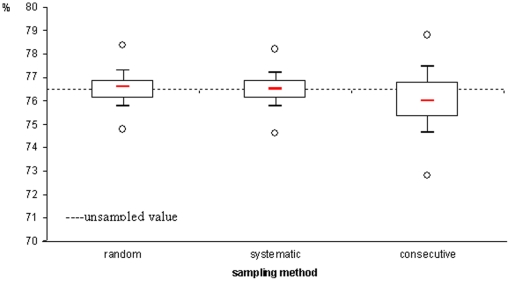
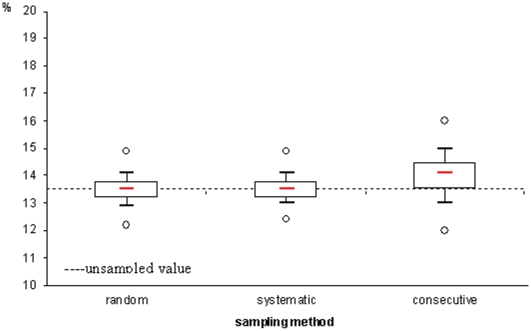
We used individual patient data from 27 ART sites and included 27,201 ART-naive adults (≥15 years) who initiated ART in 2005. For each site, we generated two outcome indicators at 12 months, retention on ART and proportion of patients lost to follow-up (LFU), first using all patient data and then within a smaller group of patients selected using three sampling methods (random, systematic and consecutive sampling). For each method and each site, 500 samples were generated, and the average result was compared with the unsampled value. The 95% sampling distribution (SD) was expressed as the 2.5(th) and 97.5(th) percentile values from the 500 samples. Overall, retention on ART was 76.5% (range 58.9-88.6) and the proportion of patients LFU, 13.5% (range 0.8-31.9). Estimates of retention from sampling (n = 5696) were 76.5% (SD 75.4-77.7) for random, 76.5% (75.3-77.5) for systematic and 76.0% (74.1-78.2) for the consecutive method. Estimates for the proportion of patients LFU were 13.5% (12.6-14.5), 13.5% (12.6-14.3) and 14.0% (12.5-15.5), respectively. With consecutive sampling, 50% of sites had SD within ±5% of the unsampled site value.
Our results suggest that random, systematic or consecutive sampling methods are feasible for monitoring ART indicators at national level. However, sampling may not produce precise estimates in some sites.
随着时间的推移,患者对抗逆转录病毒疗法(ART)的保留率是护理质量的一个指标,也是监测 ART 项目的一个结果指标。我们利用现有的数据库(低收入国家的抗逆转录病毒治疗国际数据库和无国界医生组织),评估了三种抽样方法,以简化结果指标的生成。
我们使用了来自 27 个 ART 地点的个体患者数据,纳入了 2005 年首次接受 ART 的 27201 名成年(≥15 岁)ART 初治患者。对于每个地点,我们首先使用所有患者的数据,然后在使用三种抽样方法(随机、系统和连续抽样)选择的较小患者组中生成两个 12 个月的结果指标,即 ART 保留率和失访(LFU)患者比例。对于每种方法和每个地点,生成了 500 个样本,并将平均结果与未抽样值进行了比较。95%的抽样分布(SD)表示从 500 个样本中得到的第 2.5(th)和第 97.5(th)百分位数的值。总体而言,ART 保留率为 76.5%(范围 58.9-88.6),失访患者比例为 13.5%(范围 0.8-31.9)。抽样(n=5696)估计的保留率分别为随机抽样 76.5%(SD 75.4-77.7)、系统抽样 76.5%(75.3-77.5)和连续抽样 76.0%(74.1-78.2)。失访患者比例的估计值分别为 13.5%(12.6-14.5)、13.5%(12.6-14.3)和 14.0%(12.5-15.5)。连续抽样中,50%的地点的 SD 在未抽样地点值的±5%范围内。
我们的研究结果表明,随机、系统或连续抽样方法可用于监测国家一级的 ART 指标。然而,在某些地点,抽样可能无法产生精确的估计值。