Section of Pharmacology, Department of Clinical and Experimental Medicine, and Neuroscience Center, University of Ferrara, Italy.
J Neuroinflammation. 2010 Nov 18;7:81. doi: 10.1186/1742-2094-7-81.
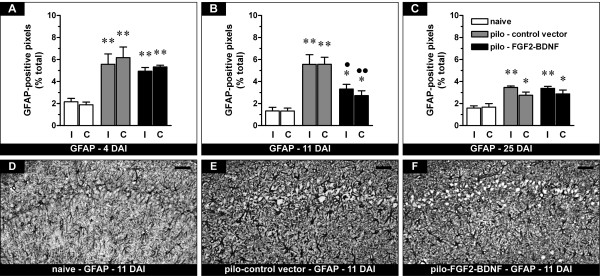
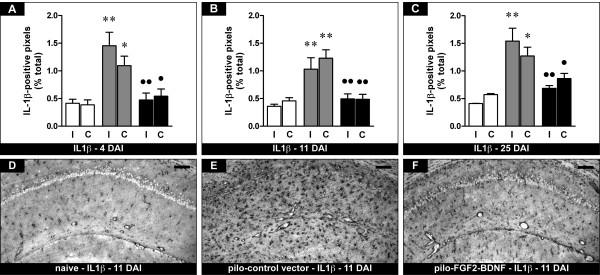
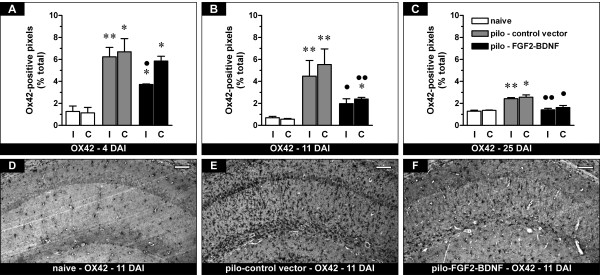
Under certain experimental conditions, neurotrophic factors may reduce epileptogenesis. We have previously reported that local, intrahippocampal supplementation of fibroblast growth factor-2 (FGF-2) and brain-derived neurotrophic factor (BDNF) increases neurogenesis, reduces neuronal loss, and reduces the occurrence of spontaneous seizures in a model of damage-associated epilepsy. Here, we asked if these possibly anti-epileptogenic effects might involve anti-inflammatory mechanisms. Thus, we used a Herpes-based vector to supplement FGF-2 and BDNF in rat hippocampus after pilocarpine-induced status epilepticus that established an epileptogenic lesion. This model causes intense neuroinflammation, especially in the phase that precedes the occurrence of spontaneous seizures. The supplementation of FGF-2 and BDNF attenuated various parameters of inflammation, including astrocytosis, microcytosis and IL-1β expression. The effect appeared to be most prominent on IL-1β, whose expression was almost completely prevented. Further studies will be needed to elucidate the molecular mechanism(s) for these effects, and for that on IL-1β in particular. Nonetheless, the concept that neurotrophic factors affect neuroinflammation in vivo may be highly relevant for the understanding of the epileptogenic process.
在某些实验条件下,神经营养因子可能会减少癫痫发生。我们之前曾报道过,局部、海马内补充成纤维细胞生长因子-2(FGF-2)和脑源性神经营养因子(BDNF)可增加神经发生、减少神经元丢失,并减少与损伤相关的癫痫模型中自发性癫痫发作的发生。在这里,我们想知道这些可能的抗癫痫作用是否可能涉及抗炎机制。因此,我们在匹罗卡品诱导的癫痫持续状态后使用基于疱疹的载体在大鼠海马中补充 FGF-2 和 BDNF,建立了致痫性损伤。该模型引起强烈的神经炎症,特别是在自发性癫痫发作发生之前的阶段。FGF-2 和 BDNF 的补充减轻了炎症的各种参数,包括星形胶质细胞增生、小细胞症和 IL-1β表达。这种作用在 IL-1β上似乎最为明显,其表达几乎完全被阻止。需要进一步的研究来阐明这些作用的分子机制,特别是对 IL-1β的作用机制。尽管如此,神经营养因子在体内影响神经炎症的概念对于理解致痫过程可能具有重要意义。