Department of Pathology, University of Pittsburgh School of Medicine, Pittsburgh, PA 15261, United States.
J Hepatol. 2011 Mar;54(3):506-12. doi: 10.1016/j.jhep.2010.07.020. Epub 2010 Oct 29.
BACKGROUND & AIMS: Pegylated-Interferon-α2a (peg-IFN), a first line therapy for Hepatitis C virus (HCV) patients, also impacts the recurrence of hepatocellular carcinoma (HCC). The activation of the Wnt pathway due to β-catenin gene mutations contributes to the development of a significant subset of HCC. Herein, we explored the effect of peg-IFN on Wnt/β-catenin signaling in vitro and in vivo.
Multiple human hepatoma cell lines were treated with Peg-IFN to assess its effect on the Wnt pathway and the mechanisms involved. Transgenic (TG) mice expressing stable β-catenin mutant in the liver were exposed to diethylnitrosamine (DEN) and treated with peg-IFN.
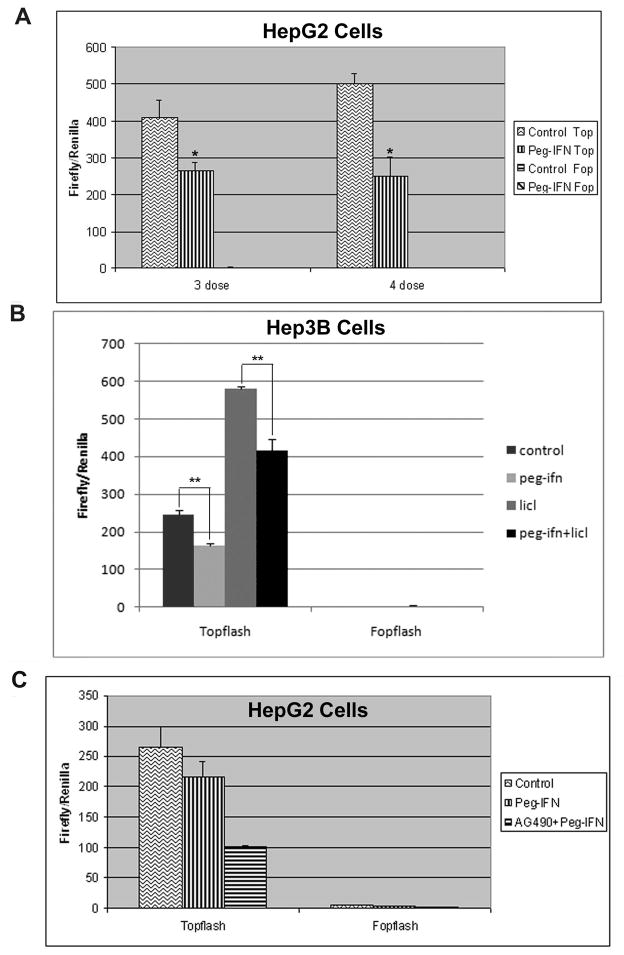
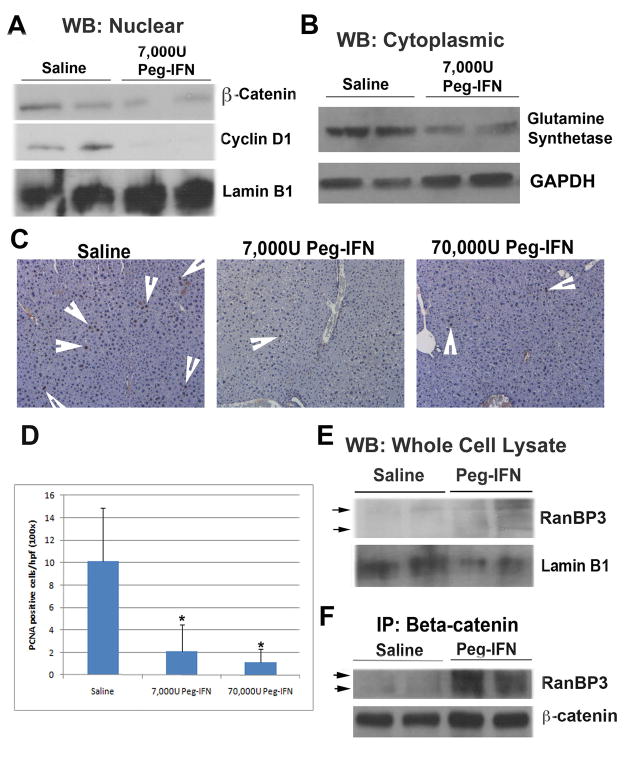
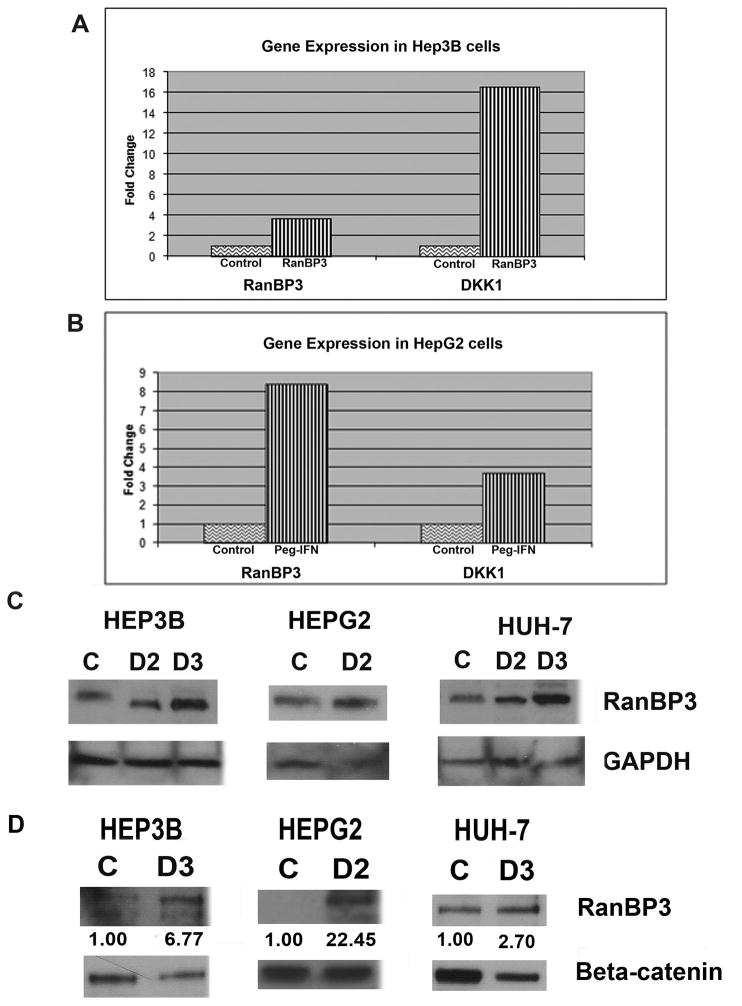
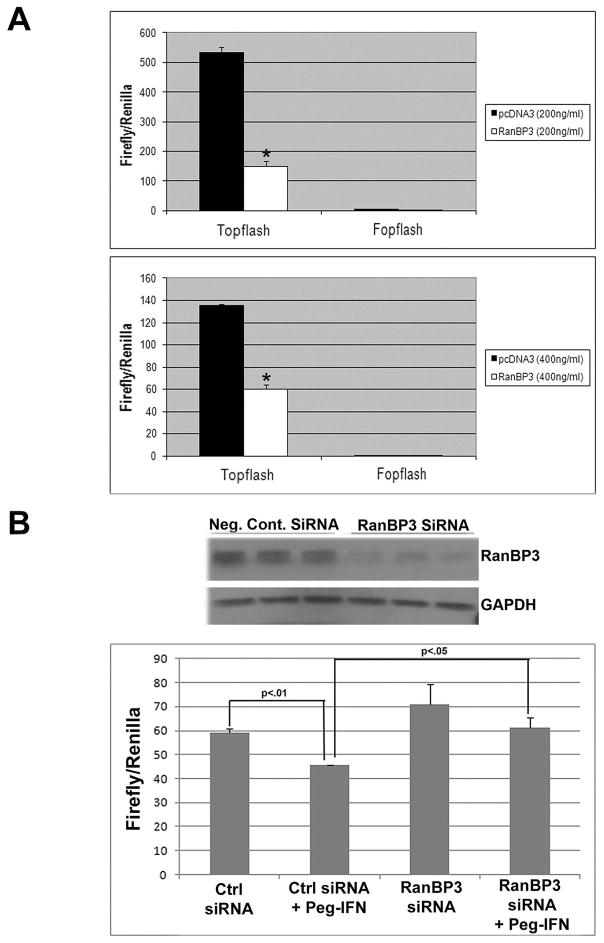
In vitro, peg-IFN decreased the transcriptional activity of β-catenin/Tcf and did so independently of JAK/Stat signaling. Peg-IFN treatment led to increased mRNA and protein expression of RanBP3, a known β-catenin nuclear export factor, in all hepatoma cells. Co-precipitation studies showed an increased association between RanBP3 and β-catenin after peg-IFN treatment. The siRNA-mediated RanBP3 knockdown abrogated Peg-IFN-induced decrease in TOPFlash reporter activity. In vivo, Peg-IFN treatment led to increased nuclear RanBP3, decreased nuclear β-catenin and cyclin D1, and decreased cytoplasmic glutamine synthetase. Increased association of RanBP3 and β-catenin was also observed in vivo in response to Peg-IFN that led to decreased hepatocyte proliferation.
Peg-IFN inhibits β-catenin signaling through the up-regulation of RanBP3, which may be a contributory mechanism for the delayed HCC and improved survival in treated HCV patients. This observation might have chemo-preventive or chemo-therapeutic implications in tumor with aberrant Wnt pathway activation.
聚乙二醇干扰素-α2a(peg-IFN)是丙型肝炎病毒(HCV)患者的一线治疗药物,也会影响肝细胞癌(HCC)的复发。由于β-连环蛋白基因突变导致 Wnt 通路的激活,促进了相当一部分 HCC 的发展。在此,我们探讨了 peg-IFN 在体外和体内对 Wnt/β-连环蛋白信号通路的影响。
用 Peg-IFN 处理多种人肝癌细胞系,以评估其对 Wnt 通路的影响及其涉及的机制。在肝脏中稳定表达β-连环蛋白突变的转基因(TG)小鼠暴露于二乙基亚硝胺(DEN)并接受 peg-IFN 治疗。
体外,peg-IFN 降低了β-连环蛋白/Tcf 的转录活性,且与 JAK/Stat 信号通路无关。peg-IFN 处理导致所有肝癌细胞中 RanBP3(已知的β-连环蛋白核输出因子)的 mRNA 和蛋白表达增加。共沉淀研究表明,peg-IFN 处理后 RanBP3 与β-连环蛋白的结合增加。RanBP3 的 siRNA 介导的敲低消除了 Peg-IFN 诱导的 TOPFlash 报告基因活性的降低。在体内,peg-IFN 治疗导致核内 RanBP3 增加,核内β-连环蛋白和细胞周期蛋白 D1 减少,细胞质谷氨酰胺合成酶减少。体内也观察到 RanBP3 和β-连环蛋白的增加与 Peg-IFN 反应相关,导致肝细胞增殖减少。
peg-IFN 通过上调 RanBP3 抑制β-连环蛋白信号通路,这可能是治疗 HCV 患者延迟 HCC 发生和提高生存率的一个贡献机制。这一观察结果可能对 Wnt 通路异常激活的肿瘤具有化学预防或化学治疗意义。