School of Biological and Biomedical Sciences, Durham University, Durham DH1 3LE, United Kingdom.
J Biol Chem. 2011 Feb 18;286(7):5484-93. doi: 10.1074/jbc.M110.187658. Epub 2010 Nov 29.
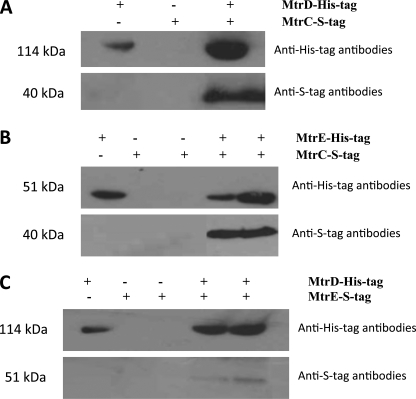
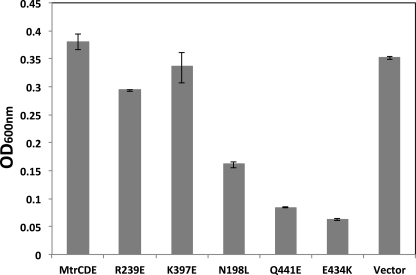
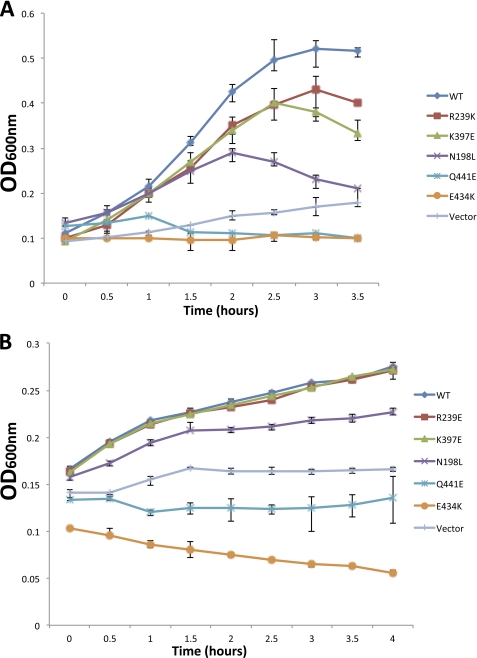
The multiple transferable resistance (MTR) pump, from Neisseria gonorrhoeae, is typical of the specialized machinery used to translocate drugs across the inner and outer membranes of Gram-negative bacteria. It consists of a tripartite complex composed of an inner-membrane transporter, MtrD, a periplasmic membrane fusion protein, MtrC, and an outer-membrane channel, MtrE. We have expressed the components of the pump in Escherichia coli and used the antibiotic vancomycin, which is too large to cross the outer-membrane by passive diffusion, to test for opening of the MtrE channel. Cells expressing MtrCDE are not susceptible to vancomycin, indicating that the channel is closed; but become susceptible to vancomycin in the presence of transported substrates, consistent with drug-induced opening of the MtrE channel. A mutational analysis identified residues Asn-198, Glu-434, and Gln-441, lining an intraprotomer groove on the surface of MtrE, to be important for pump function; mutation of these residues yielded cells that were sensitive to vancomycin. Pull-down assays and micro-calorimetry measurements indicated that this functional impairment is not due to the inability of MtrC to interact with the MtrE mutants; nor was it due to the MtrE mutants adopting an open conformation, because cells expressing these MtrE mutants alone are relatively insensitive to vancomycin. However, cells expressing the MtrE mutants with MtrC are sensitive to vancomycin, indicating that residues lining the intra-protomer groove control opening of the MtrE channel in response to binding of MtrC.
淋病奈瑟菌的多重耐药性 (MTR) 泵是革兰氏阴性菌将药物转运穿过内外膜的专用机械的典型代表。它由三部分组成:一个内膜转运蛋白 MtrD、一个周质膜融合蛋白 MtrC 和一个外膜通道 MtrE。我们在大肠杆菌中表达了泵的组件,并使用抗生素万古霉素来测试 MtrE 通道的开放情况,万古霉素太大,无法通过被动扩散穿过外膜。表达 MtrCDE 的细胞对万古霉素不敏感,表明通道关闭;但在有转运底物存在的情况下对万古霉素敏感,这与药物诱导的 MtrE 通道开放一致。突变分析确定了位于 MtrE 表面的跨蛋白沟槽的残基 Asn-198、Glu-434 和 Gln-441 对于泵功能很重要;这些残基的突变导致细胞对万古霉素敏感。下拉测定和微量热法测量表明,这种功能障碍不是由于 MtrC 无法与 MtrE 突变体相互作用所致;也不是由于 MtrE 突变体采用开放构象所致,因为单独表达这些 MtrE 突变体的细胞对万古霉素相对不敏感。然而,表达 MtrE 突变体和 MtrC 的细胞对万古霉素敏感,表明沟槽内的残基控制着 MtrE 通道的开放,以响应 MtrC 的结合。