Wajcberg Estela, Amarah Amatur
Premier Nephrology and Hypertension, Internal Medicine Department, Trinitas Regional Medical Center, Elizabeth, New Jersey 07202, USA.
Drug Des Devel Ther. 2010 Oct 22;4:279-90. doi: 10.2147/DDDT.S10180.
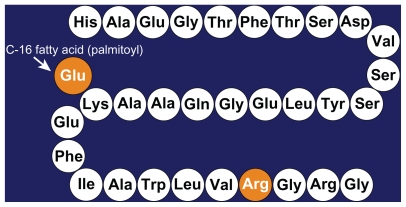
The pathophysiology of type 2 diabetes has been attributed to the classic triad of decreased insulin secretion, increased insulin resistance, and elevated hepatic glucose production. Research has shown additional mechanisms, including incretin deficiency or resistance in the gastrointestinal tract. Liraglutide is a modified form of human glucagon-like peptide-1. Liraglutide was obtained by substitution of lysine 34 for arginine near the NH2 terminus, and by addition of a C16 fatty acid at the ɛ-amino group of lysine (at position 26) using a γ-glutamic acid spacer. Liraglutide has demonstrated glucose-dependent insulin secretion, improvements in β-cell function, deceleration of gastric emptying, and promotion of early satiety leading to weight loss. Liraglutide has the potential to acquire an important role, not only in the treatment of type 2 diabetes, but also in preservation of β-cell function, weight loss, and prevention of chronic diabetic complications.
2型糖尿病的病理生理学归因于胰岛素分泌减少、胰岛素抵抗增加和肝糖生成增加这一经典三联征。研究已表明存在其他机制,包括胃肠道中肠促胰岛素缺乏或抵抗。利拉鲁肽是一种人胰高血糖素样肽-1的修饰形式。利拉鲁肽是通过在NH2末端附近用精氨酸取代赖氨酸34,并使用γ-谷氨酸间隔物在赖氨酸(第26位)的ε-氨基上添加C16脂肪酸而获得的。利拉鲁肽已显示出葡萄糖依赖性胰岛素分泌、β细胞功能改善、胃排空减慢以及促进早期饱腹感导致体重减轻。利拉鲁肽不仅在2型糖尿病的治疗中,而且在保护β细胞功能、减轻体重和预防慢性糖尿病并发症方面都有可能发挥重要作用。