Institute for Prevention of Cardiovascular Diseases, University of Munich, Munich, Germany.
J Transl Med. 2010 Dec 6;8:128. doi: 10.1186/1479-5876-8-128.
Platelet activation requires rapid remodeling of the actin cytoskeleton which is regulated by small GTP-binding proteins. By using the Rac1-specific inhibitor NSC23766, we have recently found that Rac1 is a central component of a signaling pathway that regulates dephosphorylation and activation of the actin-dynamising protein cofilin, dense and α-granule secretion, and subsequent aggregation of thrombin-stimulated washed platelets.
To study whether NSC23766 inhibits stimulus-induced platelet secretion and aggregation in blood.
Human platelet aggregation and ATP-secretion were measured in hirudin-anticoagulated blood and platelet-rich plasma (PRP) by using multiple electrode aggregometry and the Lumi-aggregometer. Platelet P-selectin expression was quantified by flow cytometry.
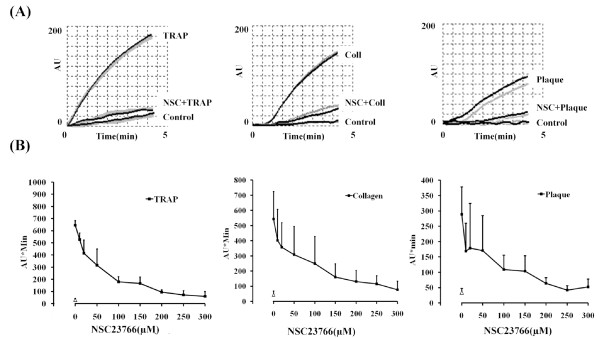
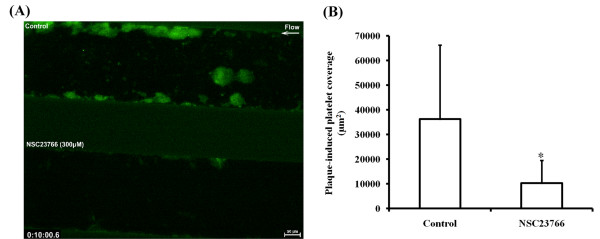
NSC23766 (300 μM) inhibited TRAP-, collagen-, atherosclerotic plaque-, and ADP-induced platelet aggregation in blood by 95.1%, 93.4%, 92.6%, and 70%, respectively. The IC50 values for inhibition of TRAP-, collagen-, and atherosclerotic plaque-, were 50 ± 18 μM, 64 ± 35 μM, and 50 ± 30 μM NSC23766 (mean ± SD, n = 3-7), respectively. In blood containing RGDS to block integrin αIIbβ3-mediated platelet aggregation, NSC23766 (300 μM) completely inhibited P-selectin expression and reduced ATP-secretion after TRAP and collagen stimulation by 73% and 85%, respectively. In ADP-stimulated PRP, NSC23766 almost completely inhibited P-selectin expression, in contrast to aspirin, which was ineffective. Moreover, NSC23766 (300 μM) decreased plaque-stimulated platelet adhesion/aggregate formation under arterial flow conditions (1500s-1) by 72%.
Rac1-mediated signaling plays a central role in secretion-dependent platelet aggregation in blood stimulated by a wide array of platelet agonists including atherosclerotic plaque. By specifically inhibiting platelet secretion, the pharmacological targeting of Rac1 could be an interesting approach in the development of future antiplatelet drugs.
血小板激活需要快速重塑肌动蛋白细胞骨架,这由小 GTP 结合蛋白调节。通过使用 Rac1 特异性抑制剂 NSC23766,我们最近发现 Rac1 是调节磷酸化和肌动蛋白调节蛋白 cofilin 激活、致密和 α 颗粒分泌以及随后凝血酶刺激的洗涤血小板聚集的信号通路的核心组成部分。
研究 NSC23766 是否抑制血液中刺激诱导的血小板分泌和聚集。
使用多电极聚集仪和 Lumi-聚集仪,用人凝血酶抗凝血剂和富含血小板的血浆(PRP)测量人血小板聚集和 ATP 分泌。通过流式细胞术定量血小板 P-选择素表达。
NSC23766(300μM)抑制 TRAP、胶原、动脉粥样硬化斑块和 ADP 诱导的血液中血小板聚集分别为 95.1%、93.4%、92.6%和 70%。抑制 TRAP、胶原和动脉粥样硬化斑块诱导的 NSC23766 的 IC50 值分别为 50±18μM、64±35μM 和 50±30μM(平均值±SD,n=3-7)。在含有 RGDS 以阻断整合素 αIIbβ3 介导的血小板聚集的血液中,NSC23766(300μM)完全抑制 TRAP 和胶原刺激后的 P-选择素表达,并分别减少 73%和 85%的 ATP 分泌。在 ADP 刺激的 PRP 中,与阿司匹林无效相比,NSC23766 几乎完全抑制 P-选择素表达。此外,NSC23766(300μM)在动脉血流条件(1500s-1)下降低斑块刺激的血小板黏附/聚集形成 72%。
Rac1 介导的信号转导在血液中受多种血小板激动剂(包括动脉粥样硬化斑块)刺激的依赖分泌的血小板聚集中起核心作用。通过特异性抑制血小板分泌,Rac1 的药理学靶向可能是开发未来抗血小板药物的一种有趣方法。