Department of Biostatistics, University of Liverpool.
BMJ. 2010 Dec 7;341:c6477. doi: 10.1136/bmj.c6477.
To determine for how long after a first unprovoked seizure a driver must be seizure-free before the risk of recurrence in the next 12 months falls below 20%, enabling them to regain their driving licence.
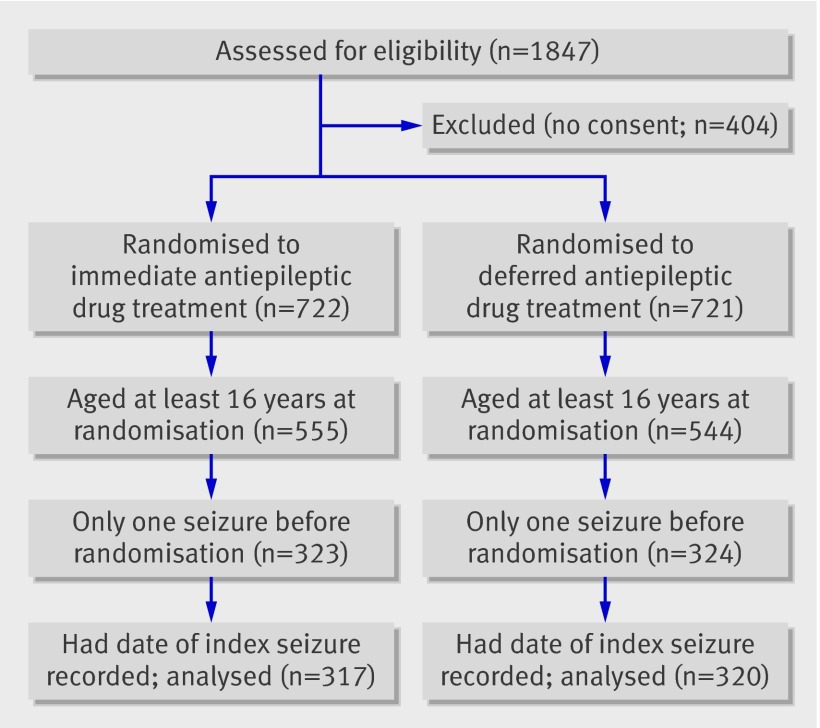
Randomised controlled trial: Multicentre study of early Epilepsy and Single Seizures (MESS).
UK hospital outpatient clinics from 1 January 1993 to 31 December 2000.
People entered MESS if they had had one or more unprovoked seizures and both the participant and the clinician were uncertain about the need to start antiepileptic drug treatment. The subset of people used for this analysis comprised participants aged at least 16 years with a single unprovoked seizure.
Risk of seizure recurrence in the 12 months after a seizure-free period of 6, 12, 18, or 24 months from the date of the first (index) seizure. Regression modelling was used to investigate how antiepileptic treatment and several clinical factors influence the risk of seizure recurrence.
At six months after the index seizure the risk of recurrence in the next 12 months for those who start antiepileptic drugs was significantly below 20% (unadjusted risk 14%, 95% confidence interval 10% to 18%). For patients who did not start treatment the risk estimate was less than 20% but the upper limit of the confidence interval was greater than 20% (18%, 13% to 23%). Multivariable analyses identified subgroups with a significantly greater than 20% risk of seizure recurrence in the 12 months after a six month seizure-free period, such as those with a remote symptomatic seizure with abnormal electroencephalogram results.
After a single unprovoked seizure this reanalysis of MESS provides estimates of seizure recurrence risks that will inform policy and guidance about regaining an ordinary driving licence. Further guidance is needed as to how such data should be utilised; in particular, whether a population approach should be taken with a focus on the unadjusted results or whether attempts should be made to individualise risk. Guidance is also required as to whether the focus should be on risk estimates only or on the confidence interval as well. If the focus is on the estimate only our unadjusted estimates suggest that treated and untreated patients are eligible to drive after being seizure-free for six months. If the focus is also on confidence intervals, direction is needed as to whether a conservative or liberal approach should be taken.
Current Controlled Trials ISRCTN98767960.
确定首次无诱因癫痫发作后,驾驶员需要多长时间无癫痫发作,才能使下一个 12 个月内的复发风险低于 20%,从而恢复驾驶执照。
随机对照试验:早期癫痫和单次发作的多中心研究(MESS)。
英国医院门诊,1993 年 1 月 1 日至 2000 年 12 月 31 日。
MESS 纳入的参与者如果有一次或多次无诱因癫痫发作,且参与者和临床医生都不确定是否需要开始抗癫痫药物治疗。本分析所用的亚组包括年龄至少 16 岁、有一次无诱因癫痫发作的参与者。
首次(索引)癫痫发作后 6、12、18 或 24 个月无癫痫发作期间,12 个月内癫痫发作的复发风险。回归模型用于研究抗癫痫治疗和几种临床因素如何影响癫痫发作的复发风险。
在索引癫痫发作后 6 个月,开始抗癫痫药物治疗者下一个 12 个月内复发的风险显著低于 20%(未调整风险 14%,95%置信区间 10%至 18%)。未开始治疗者的风险估计值低于 20%,但置信区间上限大于 20%(18%,13%至 23%)。多变量分析确定了在 6 个月无癫痫发作后 12 个月内癫痫复发风险显著大于 20%的亚组,例如伴有异常脑电图结果的远因症状性癫痫发作。
在单次无诱因癫痫发作后,对 MESS 的重新分析提供了有关恢复普通驾驶执照的癫痫复发风险的估计值,这将为政策和指导提供信息。需要进一步指导如何利用这些数据;特别是,是否应该采用以人群为基础的方法,侧重于未经调整的结果,还是应该尝试对风险进行个体化评估。还需要指导是否应该只关注风险估计值,还是也应该关注置信区间。如果重点是估计值,我们未经调整的估计值表明,在无癫痫发作 6 个月后,治疗和未治疗的患者有资格驾驶。如果重点也在置信区间上,则需要指明是采取保守还是宽松的方法。
当前对照试验 ISRCTN98767960。