
基于 MK-0457、GSK1070916 和 SNS-314 衍生物的 3D-QSAR 和分子对接研究,作为 Aurora B 激酶抑制剂。
3D-QSAR and molecular docking studies on derivatives of MK-0457, GSK1070916 and SNS-314 as inhibitors against Aurora B kinase.
机构信息
School of Chemical Engineering, Dalian University of Technology, Dalian, Liaoning, 116012, China; E-Mail:
出版信息
Int J Mol Sci. 2010 Nov 2;11(11):4326-47. doi: 10.3390/ijms11114326.
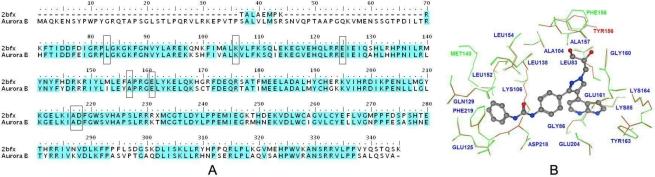
Development of anticancer drugs targeting Aurora B, an important member of the serine/threonine kinases family, has been extensively focused on in recent years. In this work, by applying an integrated computational method, including comparative molecular field analysis (CoMFA), comparative molecular similarity indices analysis (CoMSIA), homology modeling and molecular docking, we investigated the structural determinants of Aurora B inhibitors based on three different series of derivatives of 108 molecules. The resultant optimum 3D-QSAR models exhibited (q(2) = 0.605, r(2) (pred) = 0.826), (q(2) = 0.52, r(2) (pred) = 0.798) and (q(2) = 0.582, r(2) (pred) = 0.971) for MK-0457, GSK1070916 and SNS-314 classes, respectively, and the 3D contour maps generated from these models were analyzed individually. The contour map analysis for the MK-0457 model revealed the relative importance of steric and electrostatic effects for Aurora B inhibition, whereas, the electronegative groups with hydrogen bond donating capacity showed a great impact on the inhibitory activity for the derivatives of GSK1070916. Additionally, the predictive model of the SNS-314 class revealed the great importance of hydrophobic favorable contour, since hydrophobic favorable substituents added to this region bind to a deep and narrow hydrophobic pocket composed of residues that are hydrophobic in nature and thus enhanced the inhibitory activity. Moreover, based on the docking study, a further comparison of the binding modes was accomplished to identify a set of critical residues that play a key role in stabilizing the drug-target interactions. Overall, the high level of consistency between the 3D contour maps and the topographical features of binding sites led to our identification of several key structural requirements for more potency inhibitors. Taken together, the results will serve as a basis for future drug development of inhibitors against Aurora B kinase for various tumors.
近年来,针对丝氨酸/苏氨酸激酶家族的重要成员 Aurora B 的抗癌药物的开发受到了广泛关注。在这项工作中,我们应用了一种综合计算方法,包括比较分子场分析(CoMFA)、比较分子相似性指数分析(CoMSIA)、同源建模和分子对接,研究了基于三种不同系列的 108 个分子衍生物的 Aurora B 抑制剂的结构决定因素。所得最佳的 3D-QSAR 模型分别显示了(q(2) = 0.605,r(2)(预测)= 0.826)、(q(2) = 0.52,r(2)(预测)= 0.798)和(q(2) = 0.582,r(2)(预测)= 0.971),分别适用于 MK-0457、GSK1070916 和 SNS-314 类,并且单独分析了从这些模型生成的 3D 等高线图。MK-0457 模型的等高线图分析揭示了立体和静电效应对 Aurora B 抑制的相对重要性,而具有氢键供体能力的电负性基团对 GSK1070916 衍生物的抑制活性有很大影响。此外,SNS-314 类的预测模型揭示了疏水性有利等高线的重要性,因为添加到该区域的疏水性有利取代基与由本质上疏水性的残基组成的深而窄的疏水性口袋结合,从而增强了抑制活性。此外,基于对接研究,进一步比较了结合模式,以确定一组关键残基,这些残基在稳定药物-靶标相互作用中起着关键作用。总体而言,3D 等高线图和结合位点的地形特征之间的高度一致性导致我们确定了一些关键的结构要求,以获得更有效的抑制剂。总之,这些结果将为未来针对各种肿瘤的 Aurora B 激酶抑制剂的药物开发提供基础。




 Zotero 插件