Kuchiki Megumi, Hosoya Takaaki, Fukao Akira
Department of Public Health and.
Breast Cancer (Auckl). 2010 Nov 17;4:57-64. doi: 10.4137/BCBCR.S5248.
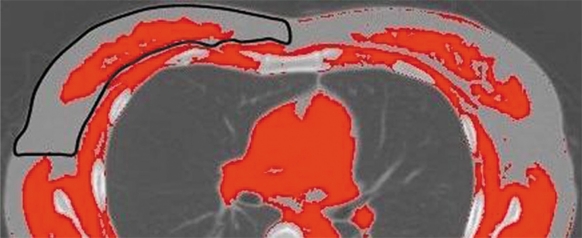
We investigated the relationship between mammary gland volume (MGV) of the breast as measured with three-dimensional chest computed tomography (CT) and breast cancer risk. Univariate analysis was used to assess the relationship between MGV and known risk factors in 427 healthy women. A case control study (97 cases and 194 controls) was conducted to assess breast cancer risk. MGV was significantly smaller for postmenopausal women than for premenopausal women, and was significantly larger for women with a family history of breast cancer than for women without. MGV, body mass index (BMI), and rate of family history of breast cancer were significantly higher among breast cancer patients than among healthy women, and number of deliveries was significantly lower among breast cancer patients. In postmenopausal women, age at menarche was significantly younger for breast cancer patients. MGV correlated well with breast cancer risk factors. The highest odds ratio was 4.9 for premenopausal women with the largest MGV. Regardless of menopausal status, the greater the MGV, the higher the odds ratio. Our results constitute the first reliable data on the relationship between MGV and breast cancer obtained through exact volume analysis.
我们研究了通过三维胸部计算机断层扫描(CT)测量的乳房腺体体积(MGV)与乳腺癌风险之间的关系。采用单因素分析评估427名健康女性中MGV与已知风险因素之间的关系。进行了一项病例对照研究(97例病例和194例对照)以评估乳腺癌风险。绝经后女性的MGV明显小于绝经前女性,有乳腺癌家族史的女性的MGV明显大于无家族史的女性。乳腺癌患者的MGV、体重指数(BMI)和乳腺癌家族史发生率显著高于健康女性,而乳腺癌患者的分娩次数显著低于健康女性。在绝经后女性中,乳腺癌患者的初潮年龄明显更小。MGV与乳腺癌风险因素密切相关。MGV最大的绝经前女性的最高优势比为4.9。无论绝经状态如何,MGV越大,优势比越高。我们的结果构成了通过精确体积分析获得的关于MGV与乳腺癌之间关系的首批可靠数据。