Department of Neurology, University of Würzburg, Würzburg, Germany.
PLoS One. 2010 Dec 3;5(12):e15106. doi: 10.1371/journal.pone.0015106.
Stroke-induced brain edema formation is a frequent cause of secondary infarct growth and deterioration of neurological function. The molecular mechanisms underlying edema formation after stroke are largely unknown. Vasodilator-stimulated phosphoprotein (VASP) is an important regulator of actin dynamics and stabilizes endothelial barriers through interaction with cell-cell contacts and focal adhesion sites. Hypoxia has been shown to foster vascular leakage by downregulation of VASP in vitro but the significance of VASP for regulating vascular permeability in the hypoxic brain in vivo awaits clarification.
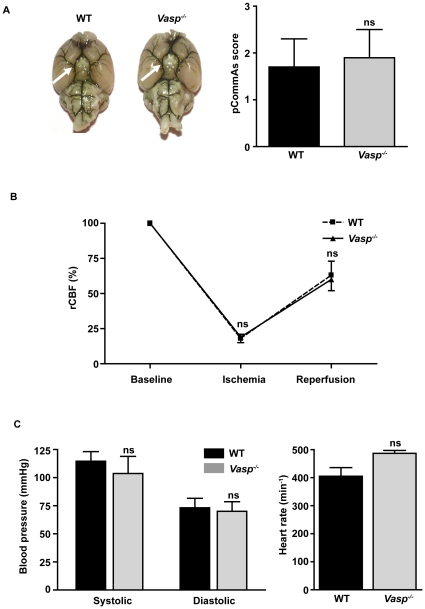
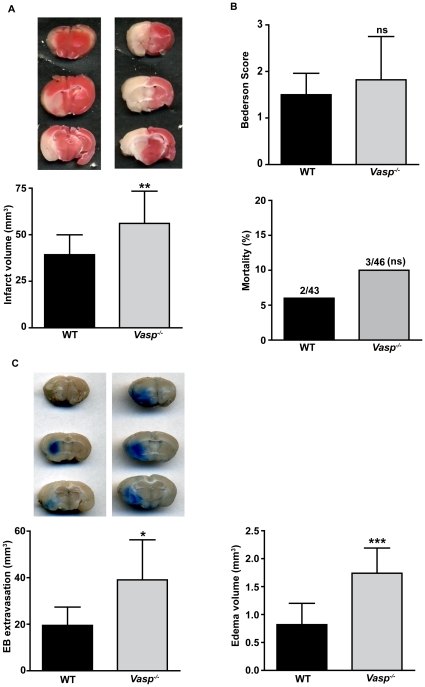
METHODOLOGY/PRINCIPAL FINDINGS: Focal cerebral ischemia was induced in Vasp(-/-) mice and wild-type (WT) littermates by transient middle cerebral artery occlusion (tMCAO). Evan's Blue tracer was applied to visualize the extent of blood-brain-barrier (BBB) damage. Brain edema formation and infarct volumes were calculated from 2,3,5-triphenyltetrazolium chloride (TTC)-stained brain slices. Both mouse groups were carefully controlled for anatomical and physiological parameters relevant for edema formation and stroke outcome. BBB damage (p<0.05) and edema volumes (1.7 mm(3)±0.5 mm(3) versus 0.8 mm(3)±0.4 mm(3); p<0.0001) were significantly enhanced in Vasp(-/-) mice compared to controls on day 1 after tMCAO. This was accompanied by a significant increase in infarct size (56.1 mm(3)±17.3 mm(3) versus 39.3 mm(3)±10.7 mm(3), respectively; p<0.01) and a non significant trend (p>0.05) towards worse neurological outcomes.
Our study identifies VASP as critical regulator of BBB maintenance during acute ischemic stroke. Therapeutic modulation of VASP or VASP-dependent signalling pathways could become a novel strategy to combat excessive edema formation in ischemic brain damage.
中风引起的脑水肿形成是继发性梗死扩大和神经功能恶化的常见原因。中风后水肿形成的分子机制在很大程度上尚不清楚。血管扩张刺激磷蛋白(VASP)是肌动蛋白动态的重要调节剂,通过与细胞-细胞接触和黏附斑位点相互作用稳定内皮屏障。体外研究表明,缺氧通过下调 VASP 促进血管渗漏,但 VASP 在体内缺氧大脑中调节血管通透性的意义仍有待阐明。
方法/主要发现:通过短暂性大脑中动脉闭塞(tMCAO)在 Vasp(-/-)小鼠和野生型(WT)同窝仔鼠中诱导局灶性脑缺血。应用伊文思蓝示踪剂可视化血脑屏障(BBB)损伤的程度。从 2,3,5-三苯基氯化四氮唑(TTC)染色脑切片中计算脑水肿形成和梗死体积。两组小鼠均仔细控制与水肿形成和中风结果相关的解剖学和生理学参数。与对照组相比,tMCAO 后第 1 天,Vasp(-/-)小鼠的 BBB 损伤(p<0.05)和脑水肿体积(1.7 mm(3)±0.5 mm(3)与 0.8 mm(3)±0.4 mm(3);p<0.0001)显著增加。这伴随着梗死体积的显著增加(56.1 mm(3)±17.3 mm(3)与 39.3 mm(3)±10.7 mm(3),分别;p<0.01)和神经功能结局的非显著趋势(p>0.05)。
我们的研究将 VASP 确定为急性缺血性中风期间 BBB 维持的关键调节剂。VASP 或 VASP 依赖性信号通路的治疗调节可能成为对抗缺血性脑损伤中过度水肿形成的新策略。