Primate Research Institute, Kyoto University, Inuyama, Japan.
PLoS One. 2010 Nov 30;5(11):e15122. doi: 10.1371/journal.pone.0015122.
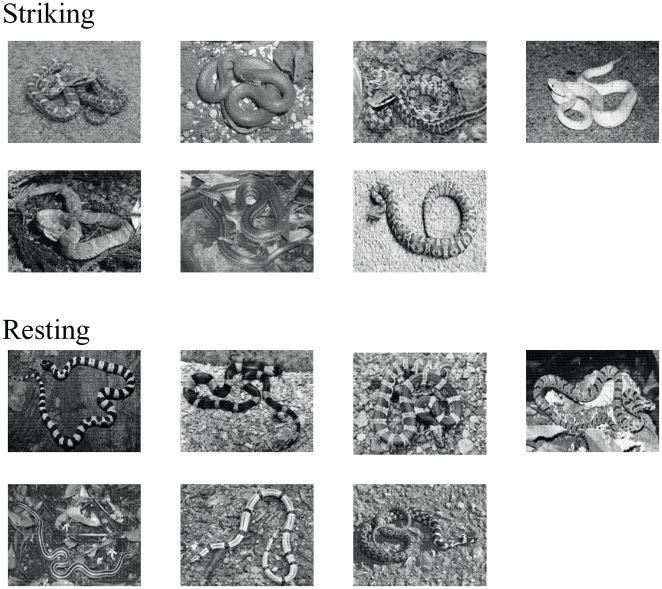
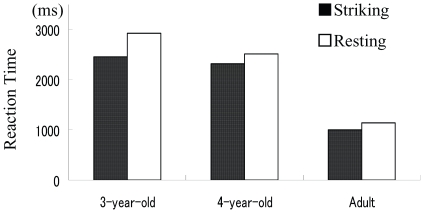
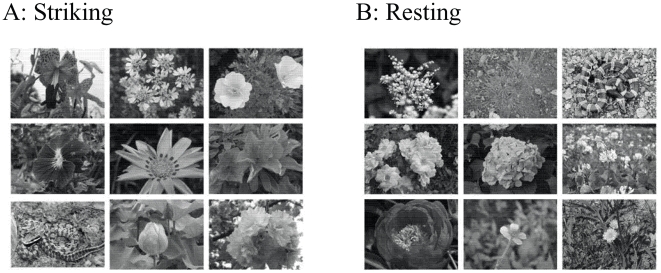
Humans as well as some nonhuman primates have an evolved predisposition to associate snakes with fear by detecting their presence as fear-relevant stimuli more rapidly than fear-irrelevant ones. In the present experiment, a total of 74 of 3- to 4-year-old children and adults were asked to find a single target black-and-white photo of a snake among an array of eight black-and-white photos of flowers as distracters. As target stimuli, we prepared two groups of snake photos, one in which a typical striking posture was displayed by a snake and the other in which a resting snake was shown. When reaction time to find the snake photo was compared between these two types of the stimuli, its mean value was found to be significantly smaller for the photos of snakes displaying striking posture than for the photos of resting snakes in both the adults and children. These findings suggest the possibility that the human perceptual bias for snakes per se could be differentiated according to the difference of the degree to which their presence acts as a fear-relevant stimulus.
人类和一些非人类灵长类动物有一种进化的倾向,即通过更快地检测到蛇的存在作为与恐惧相关的刺激,而不是与恐惧无关的刺激,从而将蛇与恐惧联系起来。在本实验中,共有 74 名 3 至 4 岁的儿童和成人被要求在八张黑白花朵图片的干扰中找到一张单一的目标黑白蛇的图片。作为目标刺激,我们准备了两组蛇的图片,一组显示了蛇的典型攻击姿势,另一组则显示了正在休息的蛇。当比较这两种类型的刺激时,发现对显示攻击姿势的蛇的图片的反应时间明显小于对显示静止蛇的图片的反应时间,无论是在成年人还是儿童中都是如此。这些发现表明,人类对蛇的感知偏见本身可能根据其作为恐惧相关刺激的程度的差异而有所不同。