Program in Translational NeuroPsychiatric Genomics, Department of Neurology, Brigham and Women's Hospital, Boston, Massachusetts, United States of America.
PLoS One. 2010 Nov 30;5(11):e14169. doi: 10.1371/journal.pone.0014169.
Brain atrophy and cognitive dysfunction are neurodegenerative features of Multiple Sclerosis (MS). We used a candidate gene approach to address whether genetic variants implicated in susceptibility to late onset Alzheimer's Disease (AD) influence brain volume and cognition in MS patients.
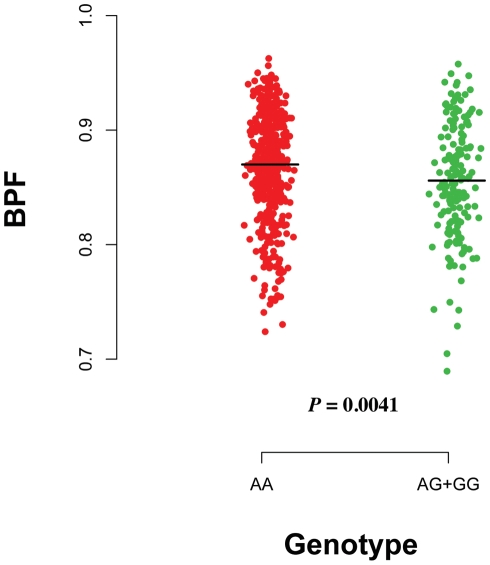
METHODS/PRINCIPAL FINDINGS: MS subjects were genotyped for five single nucleotide polymorphisms (snps) associated with susceptibility to AD: PICALM, CR1, CLU, PCK1, and ZNF224. We assessed brain volume using Brain Parenchymal Fraction (BPF) measurements obtained from Magnetic Resonance Imaging (MRI) data and cognitive function using the Symbol Digit Modalities Test (SDMT). Genotypes were correlated with cross-sectional BPF and SDMT scores using linear regression after adjusting for sex, age at symptom onset, and disease duration. 722 MS patients with a mean (±SD) age at enrollment of 41 (±10) years were followed for 44 (±28) months. The AD risk-associated allele of a non-synonymous SNP in the PCK1 locus (rs8192708G) is associated with a smaller average brain volume (P=0.0047) at the baseline MRI, but it does not impact our baseline estimate of cognition. PCK1 is additionally associated with higher baseline T2-hyperintense lesion volume (P=0.0088). Finally, we provide technical validation of our observation in a subset of 641 subjects that have more than one MRI study, demonstrating the same association between PCK1 and smaller average brain volume (P=0.0089) at the last MRI visit.
CONCLUSION/SIGNIFICANCE: Our study provides suggestive evidence for greater brain atrophy in MS patients bearing the PCK1 allele associated with AD-susceptibility, yielding new insights into potentially shared neurodegenerative process between MS and late onset AD.
脑萎缩和认知功能障碍是多发性硬化症(MS)的神经退行性特征。我们采用候选基因方法来研究是否与晚发性阿尔茨海默病(AD)易感性相关的遗传变异会影响 MS 患者的脑容量和认知功能。
方法/主要发现:对 MS 患者进行了与 AD 易感性相关的五个单核苷酸多态性(SNP)的基因分型:PICALM、CR1、CLU、PCK1 和 ZNF224。我们使用磁共振成像(MRI)数据获得的脑实质分数(BPF)测量值评估脑容量,使用符号数字模态测试(SDMT)评估认知功能。在调整性别、发病年龄和疾病持续时间后,使用线性回归将基因型与横断面 BPF 和 SDMT 评分相关联。共纳入 722 名 MS 患者,平均(±SD)年龄为 41(±10)岁,随访 44(±28)个月。PCK1 基因座(rs8192708G)的非 synonymous SNP 的 AD 风险相关等位基因与基线 MRI 时的平均脑容量较小相关(P=0.0047),但不影响我们对认知功能的基线估计。PCK1 还与更高的基线 T2 高信号病变体积相关(P=0.0088)。最后,我们在一组具有多个 MRI 研究的 641 名受试者中提供了我们观察结果的技术验证,证明了 PCK1 与最后一次 MRI 检查时平均脑容量较小之间存在相同的关联(P=0.0089)。
结论/意义:我们的研究提供了提示性证据,表明携带与 AD 易感性相关的 PCK1 等位基因的 MS 患者脑萎缩更严重,这为 MS 和晚发性 AD 之间可能存在的共同神经退行性过程提供了新的见解。