Department of Haematology, Peter MacCallum Cancer Centre, St Andrew's Place, East Melbourne, VIC, 3002, Australia.
Invest New Drugs. 2010 Dec;28 Suppl 1(Suppl 1):S3-20. doi: 10.1007/s10637-010-9596-y. Epub 2010 Dec 14.
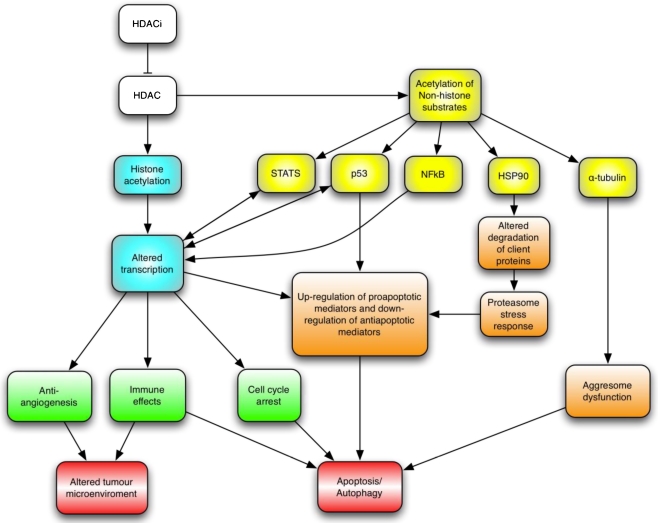
The histone deacetylase inhibitors (HDACi) have demonstrated anticancer efficacy across a range of malignancies, most impressively in the hematological cancers. It is uncertain whether this clinical efficacy is attributable predominantly to their ability to induce apoptosis and differentiation in the cancer cell, or to their ability to prime the cell to other pro-death stimuli such as those from the immune system. HDACi-induced apoptosis occurs through altered expression of genes encoding proteins in both intrinsic and extrinsic apoptotic pathways; through effects on the proteasome/aggresome systems; through the production of reactive oxygen species, possibly by directly inducing DNA damage; and through alterations in the tumor microenvironment. In addition HDACi increase the immunogenicity of tumor cells and modulate cytokine signaling and potentially T-cell polarization in ways that may contribute the anti-cancer effect in vivo. Here, we provide an overview of current thinking on the mechanisms of HDACi activity, with attention given to the hematological malignancies as well as scientific observations arising from the clinical trials. We also focus on the immune effects of these agents.
组蛋白去乙酰化酶抑制剂(HDACi)在多种恶性肿瘤中表现出抗癌疗效,在血液系统恶性肿瘤中最为显著。目前尚不清楚这种临床疗效主要归因于它们诱导癌细胞凋亡和分化的能力,还是归因于它们使细胞对其他促死亡刺激(如来自免疫系统的刺激)产生敏感性的能力。HDACi 诱导的细胞凋亡是通过改变编码内在和外在凋亡途径中蛋白质的基因的表达来实现的;通过对蛋白酶体/聚集体系统的影响;通过产生活性氧,可能通过直接诱导 DNA 损伤;以及通过改变肿瘤微环境。此外,HDACi 增加了肿瘤细胞的免疫原性,并通过可能有助于体内抗癌作用的方式调节细胞因子信号转导和潜在的 T 细胞极化。在这里,我们提供了对 HDACi 活性机制的最新思考的概述,同时也关注了血液系统恶性肿瘤以及临床试验中产生的科学观察。我们还重点关注这些药物的免疫作用。