Seaver Autism Center for Research and Treatment, Mount Sinai School of Medicine, New York, NY 10029, USA.
Department of Psychiatry, Mount Sinai School of Medicine, New York, NY 10029, USA.
Mol Autism. 2010 Dec 17;1(1):15. doi: 10.1186/2040-2392-1-15.
SHANK3 is a protein in the core of the postsynaptic density (PSD) and has a critical role in recruiting many key functional elements to the PSD and to the synapse, including components of α-amino-3-hydroxyl-5-methyl-4-isoxazole-propionic acid (AMPA), metabotropic glutamate (mGlu) and N-methyl-D-aspartic acid (NMDA) glutamate receptors, as well as cytoskeletal elements. Loss of a functional copy of the SHANK3 gene leads to the neurobehavioral manifestations of 22q13 deletion syndrome and/or to autism spectrum disorders. The goal of this study was to examine the effects of haploinsufficiency of full-length Shank3 in mice, focusing on synaptic development, transmission and plasticity, as well as on social behaviors, as a model for understanding SHANK3 haploinsufficiency in humans.
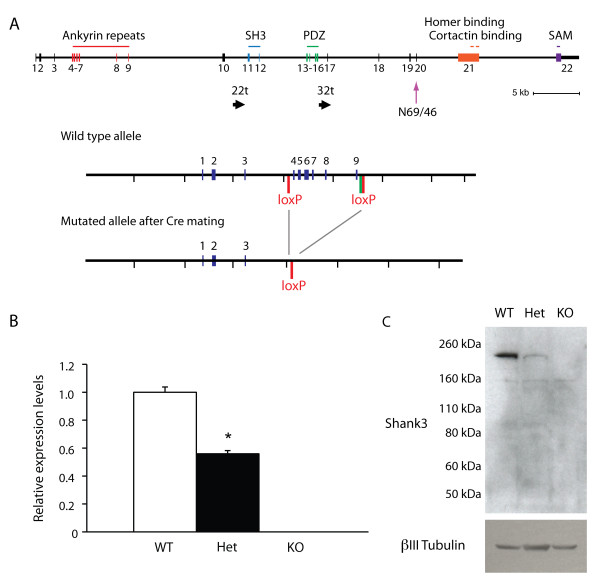
We used mice with a targeted disruption of Shank3 in which exons coding for the ankyrin repeat domain were deleted and expression of full-length Shank3 was disrupted. We studied synaptic transmission and plasticity by multiple methods, including patch-clamp whole cell recording, two-photon time-lapse imaging and extracellular recordings of field excitatory postsynaptic potentials. We also studied the density of GluR1-immunoreactive puncta in the CA1 stratum radiatum and carried out assessments of social behaviors.
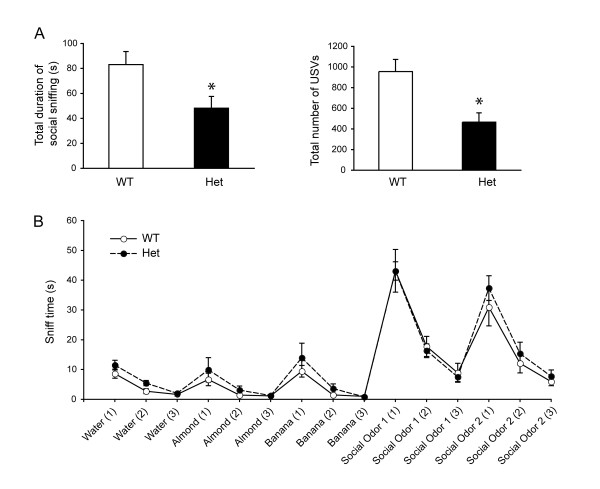
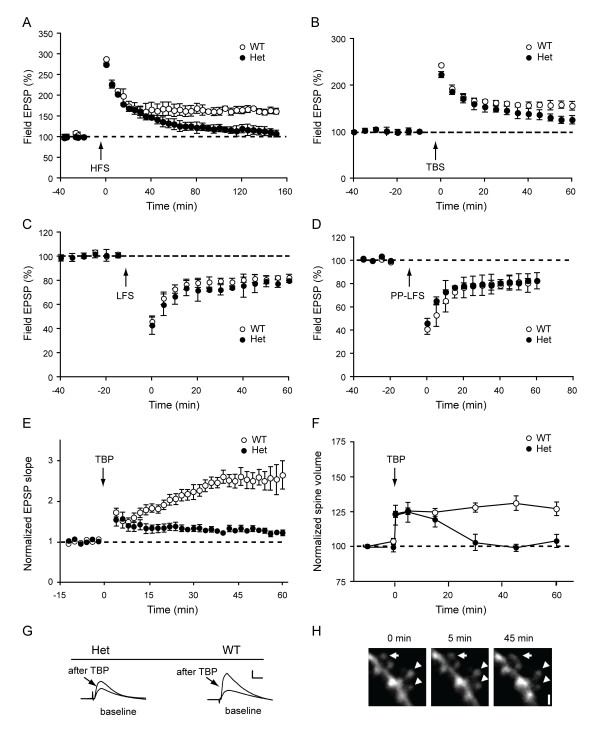
In Shank3 heterozygous mice, there was reduced amplitude of miniature excitatory postsynaptic currents from hippocampal CA1 pyramidal neurons and the input-output (I/O) relationship at Schaffer collateral-CA1 synapses in acute hippocampal slices was significantly depressed; both of these findings indicate a reduction in basal neurotransmission. Studies with specific inhibitors demonstrated that the decrease in basal transmission reflected reduced AMPA receptor-mediated transmission. This was further supported by the observation of reduced numbers of GluR1-immunoreactive puncta in the stratum radiatum. Long-term potentiation (LTP), induced either with θ-burst pairing (TBP) or high-frequency stimulation, was impaired in Shank3 heterozygous mice, with no significant change in long-term depression (LTD). In concordance with the LTP results, persistent expansion of spines was observed in control mice after TBP-induced LTP; however, only transient spine expansion was observed in Shank3 heterozygous mice. Male Shank3 heterozygotes displayed less social sniffing and emitted fewer ultrasonic vocalizations during interactions with estrus female mice, as compared to wild-type littermate controls.
We documented specific deficits in synaptic function and plasticity, along with reduced reciprocal social interactions in Shank3 heterozygous mice. Our results are consistent with altered synaptic development and function in Shank3 haploinsufficiency, highlighting the importance of Shank3 in synaptic function and supporting a link between deficits in synapse function and neurodevelopmental disorders. The reduced glutamatergic transmission that we observed in the Shank3 heterozygous mice represents an interesting therapeutic target in Shank3-haploinsufficiency syndromes.
SHANK3 是突触后密度(PSD)核心中的一种蛋白质,在将许多关键功能元件募集到 PSD 和突触中起着关键作用,包括 α-氨基-3-羟基-5-甲基-4-异恶唑丙酸(AMPA)、代谢型谷氨酸(mGlu)和 N-甲基-D-天冬氨酸(NMDA)谷氨酸受体以及细胞骨架元件的组成部分。SHANK3 基因功能丧失导致 22q13 缺失综合征和/或自闭症谱系障碍的神经行为表现。本研究的目的是研究 Shank3 全长单倍不足对小鼠的影响,重点研究突触发育、传递和可塑性以及社交行为,以了解 SHANK3 单倍不足对人类的影响。
我们使用 Shank3 靶向敲除小鼠,其中删除了编码锚蛋白重复结构域的外显子,并且破坏了全长 Shank3 的表达。我们通过多种方法研究了突触传递和可塑性,包括膜片钳全细胞记录、双光子延时成像和场兴奋性突触后电位的细胞外记录。我们还研究了 CA1 辐射状层中 GluR1-免疫反应性斑点的密度,并进行了社交行为评估。
在 Shank3 杂合子小鼠中,海马 CA1 锥体神经元的微小兴奋性突触后电流幅度降低,Schaffer 侧枝-CA1 突触的输入-输出(I/O)关系明显降低;这两种发现都表明基础神经传递减少。使用特定抑制剂的研究表明,基础传递的减少反映了 AMPA 受体介导的传递减少。这进一步得到了在辐射状层中 GluR1-免疫反应性斑点数量减少的观察结果的支持。长时程增强(LTP),无论是通过θ爆发配对(TBP)还是高频刺激诱导,在 Shank3 杂合子小鼠中均受损,而长时程抑制(LTD)没有明显变化。与 LTP 结果一致,在 TBP 诱导的 LTP 后,控制小鼠中的棘突持久扩张;然而,在 Shank3 杂合子小鼠中仅观察到短暂的棘突扩张。与野生型同窝对照相比,雄性 Shank3 杂合子在与发情雌性小鼠相互作用时,社交嗅探行为较少,发出的超声波发声较少。
我们记录了 Shank3 杂合子小鼠在突触功能和可塑性方面的特定缺陷,以及相互社交互动减少。我们的结果与 Shank3 单倍不足时的突触发育和功能改变一致,突出了 Shank3 在突触功能中的重要性,并支持突触功能缺陷与神经发育障碍之间的联系。我们在 Shank3 杂合子小鼠中观察到的谷氨酸能传递减少是 Shank3 单倍不足综合征中一个有趣的治疗靶点。