Université Paris-Descartes and Hôpital Necker-Enfants Malades, Assistance Publique Hôpitaux de Paris, Paris, France.
Ann Rheum Dis. 2011 May;70(5):747-54. doi: 10.1136/ard.2010.134254. Epub 2010 Dec 20.
To assess the efficacy of the interleukin 1 receptor antagonist anakinra in systemic-onset juvenile idiopathic arthritis (SJIA).
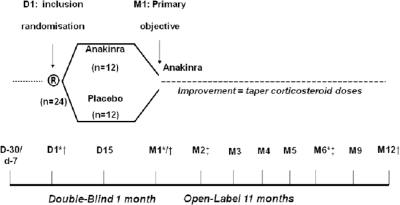
A multicentre, randomised, double-blind, placebo-controlled trial was conducted. The primary objective was to compare the efficacy of a 1-month treatment with anakinra (2 mg/kg subcutaneous daily, maximum 100 mg) with a placebo between two groups each with 12 patients with SJIA. Response was defined by a 30% improvement of the paediatric American College of Rheumatology criteria for JIA, resolution of systemic symptoms and a decrease of at least 50% of both C-reactive protein and erythrocyte sedimentation rate compared with baseline. After month 1 (M1), patients taking placebo were switched to anakinra. Secondary objectives included tolerance and efficacy assessment for 12 months, and analyses of treatment effect on blood gene expression profiling.
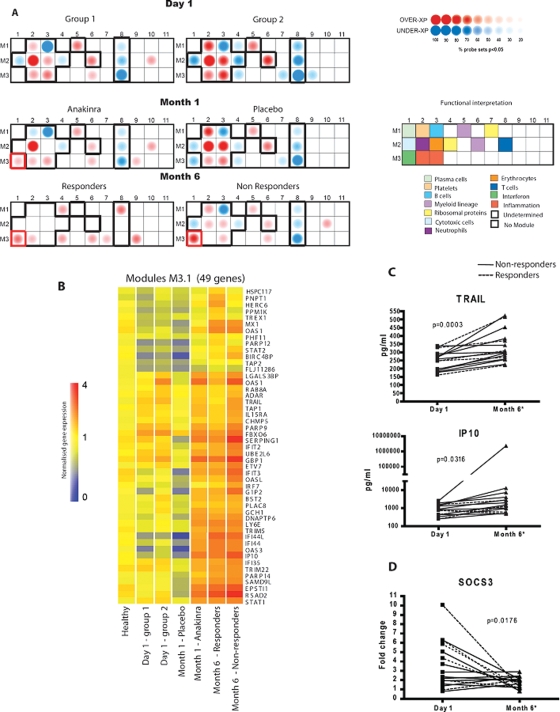
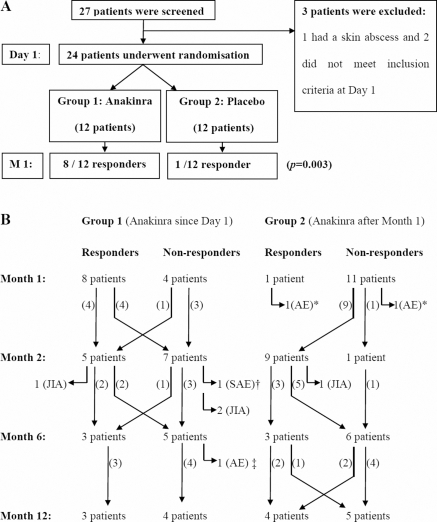
At M1, 8/12 responders were receiving anakinra and 1 responder receiving placebo (p=0.003). Ten patients from the placebo group switched to anakinra; nine were responders at M2. Between M1 and M12, six patients stopped treatment owing to an adverse event (n=2), lack of efficacy (n=2) or a disease flare (n=2). Blood gene expression profiling at enrollment and at 6 months' follow-up showed one set of dysregulated genes that reverted to normal values in the clinical responders and a different set, including interferon (IFN)-inducible genes, that was induced by anakinra.
Anakinra treatment is effective in SJIA, at least in the short term. It is associated with normalisation of blood gene expression profiles in clinical responders and induces a de novo IFN signature.
NCT00339157.
评估白细胞介素 1 受体拮抗剂阿那白滞素治疗全身型幼年特发性关节炎(SJIA)的疗效。
进行了一项多中心、随机、双盲、安慰剂对照试验。主要目的是比较两组各 12 例 SJIA 患者接受阿那白滞素(2 mg/kg 皮下每日,最大剂量 100 mg)与安慰剂治疗 1 个月的疗效。疗效定义为:与基线相比,儿科风湿病学会(ACR)JIA 标准的 30%改善,全身症状缓解,C 反应蛋白和红细胞沉降率至少降低 50%。第 1 个月(M1)后,接受安慰剂的患者转为阿那白滞素治疗。次要目标包括 12 个月的耐受性和疗效评估,以及治疗对血液基因表达谱的影响分析。
在 M1 时,12 名应答者中有 8 名接受阿那白滞素治疗,1 名接受安慰剂治疗(p=0.003)。安慰剂组有 10 名患者转为阿那白滞素治疗,其中 9 名在 M2 时为应答者。在 M1 至 M12 期间,有 6 名患者因不良事件(n=2)、疗效不佳(n=2)或疾病发作(n=2)停止治疗。在入组时和 6 个月随访时的血液基因表达谱分析显示,一组失调基因在临床应答者中恢复正常,另一组包括干扰素(IFN)诱导基因,则被阿那白滞素诱导。
阿那白滞素治疗 SJIA 至少在短期内是有效的。它与临床应答者的血液基因表达谱正常化相关,并诱导新的 IFN 特征。
NCT00339157。