Division of Genetics, Department of Pediatrics, Faculty of Medicine and Health Sciences, Université de Sherbrooke, Sherbrooke, QC J1H 5N4, Canada.
Nucleic Acids Res. 2011 Apr;39(8):3053-63. doi: 10.1093/nar/gkq1209. Epub 2010 Dec 21.
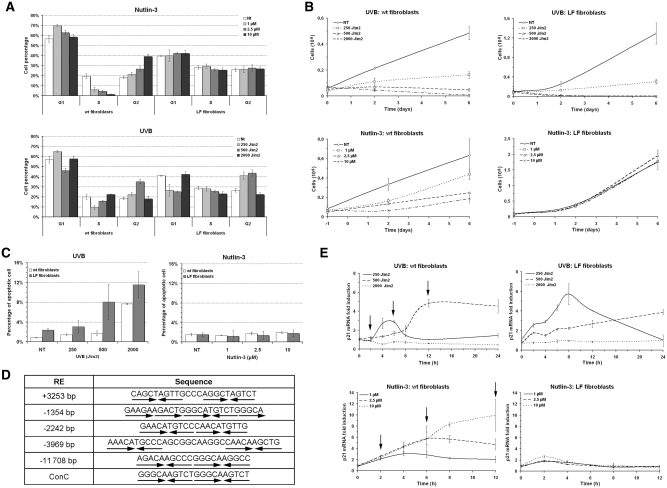
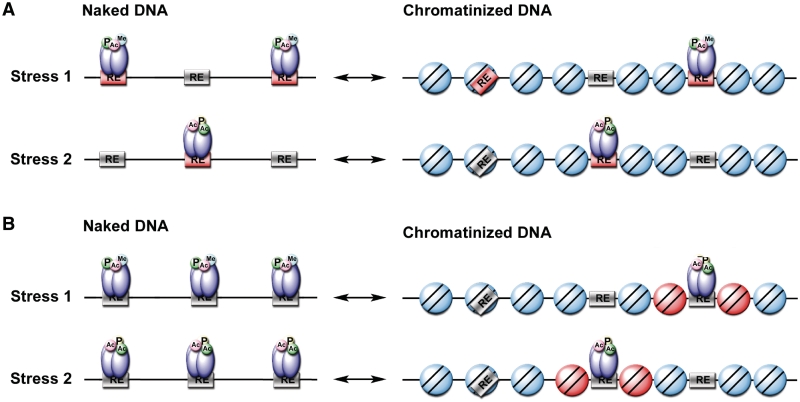
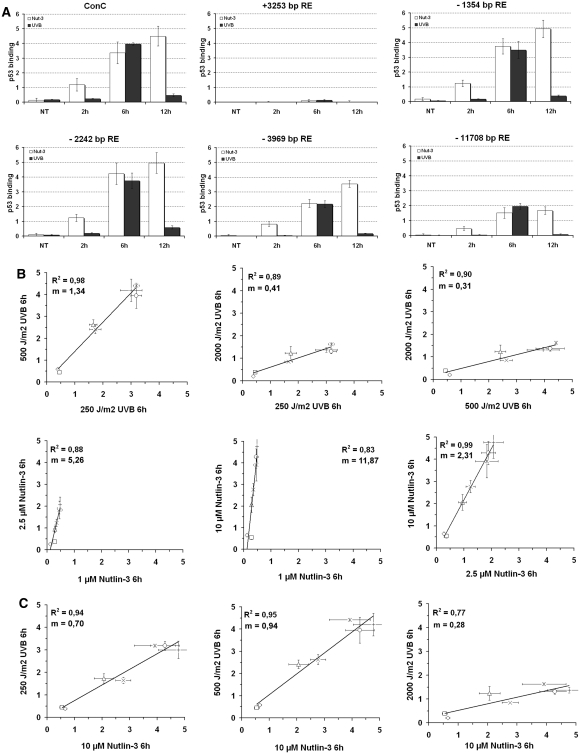
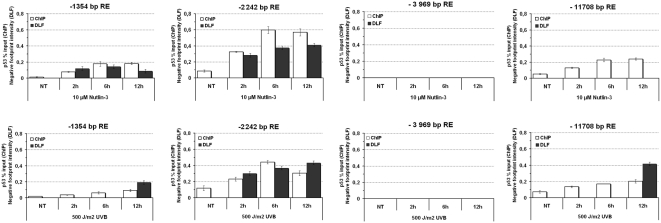
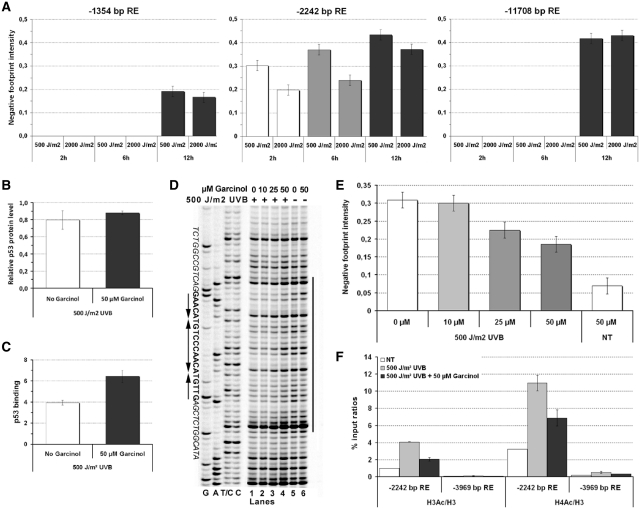
The p53 protein is crucial for adapting programs of gene expression in response to stress. Recently, we revealed that this occurs partly through the formation of stress-specific p53 binding patterns. However, the mechanisms that generate these binding patterns remain largely unknown. It is not established whether the selective binding of p53 is achieved through modulation of its binding affinity to certain response elements (REs) or via a chromatin-dependent mechanism. To shed light on this issue, we used a microsphere assay for protein-DNA binding to measure p53 binding patterns on naked DNA. In parallel, we measured p53 binding patterns within chromatin using chromatin immunoprecipitation and DNase I coupled to ligation-mediated polymerase chain reaction footprinting. Through this experimental approach, we revealed that UVB and Nutlin-3 doses, which lead to different cellular outcomes, induce similar p53 binding patterns on naked DNA. Conversely, the same treatments lead to stress-specific p53 binding patterns on chromatin. We show further that altering chromatin remodeling using an histone acetyltransferase inhibitor reduces p53 binding to REs. Altogether, our results reveal that the formation of p53 binding patterns is not due to the modulation of sequence-specific p53 binding affinity. Rather, we propose that chromatin and chromatin remodeling are required in this process.
p53 蛋白对于适应应激条件下的基因表达程序至关重要。最近,我们揭示了这一过程部分是通过形成应激特异性的 p53 结合模式来实现的。然而,产生这些结合模式的机制在很大程度上仍然未知。目前尚不清楚 p53 的选择性结合是通过调节其与某些反应元件(REs)的结合亲和力还是通过依赖染色质的机制来实现的。为了解决这个问题,我们使用了一种用于蛋白质-DNA 结合的微球测定法来测量裸露 DNA 上的 p53 结合模式。同时,我们使用染色质免疫沉淀和与连接介导的聚合酶链反应足迹法偶联的 DNA 酶 I 来测量染色质内的 p53 结合模式。通过这种实验方法,我们揭示了导致不同细胞结果的 UVB 和 Nutlin-3 剂量会在裸露 DNA 上诱导相似的 p53 结合模式。相反,相同的处理会导致染色质上的应激特异性 p53 结合模式。我们进一步表明,使用组蛋白乙酰转移酶抑制剂改变染色质重塑会降低 p53 与 REs 的结合。总之,我们的结果表明,p53 结合模式的形成不是由于序列特异性 p53 结合亲和力的调节。相反,我们提出染色质和染色质重塑是这个过程所必需的。