Department of Cell and Neurobiology, University of Southern California Keck School of Medicine, Los Angeles, California, United States of America.
PLoS One. 2010 Dec 13;5(12):e15657. doi: 10.1371/journal.pone.0015657.
Galanin is a neuropeptide with a wide distribution in the central and peripheral nervous systems and whose physiological effects are mediated through three G protein-coupled receptor subtypes, GalR1, GalR2, and GalR3. Several lines of evidence indicate that galanin, as well as activation of the GalR1 receptor, is a potent and effective modulator of neuronal excitability in the hippocampus.
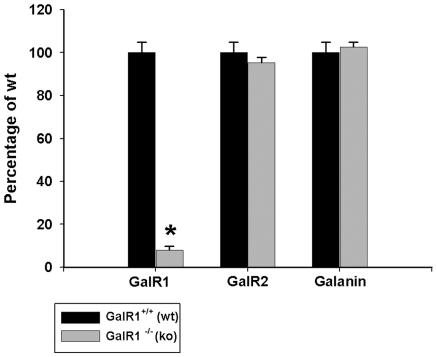
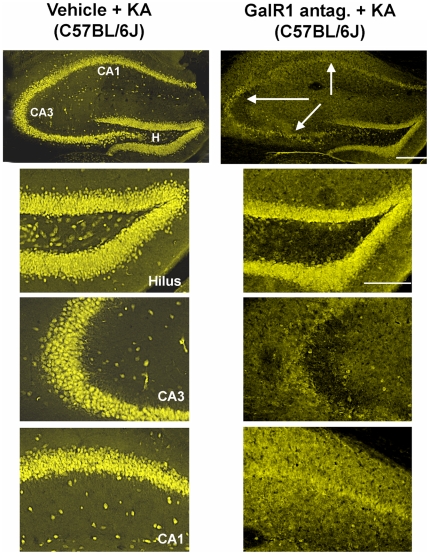
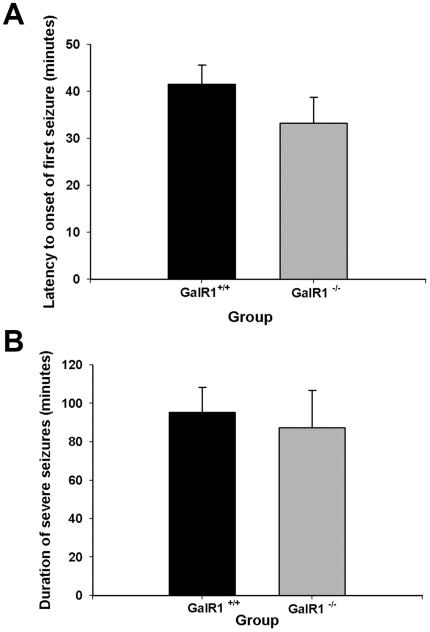
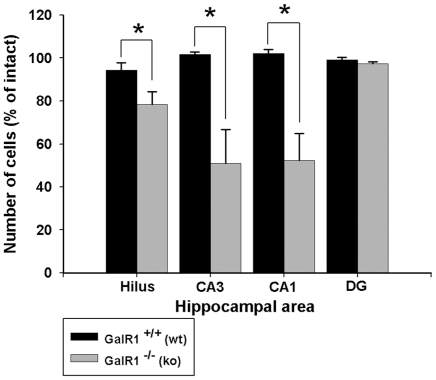
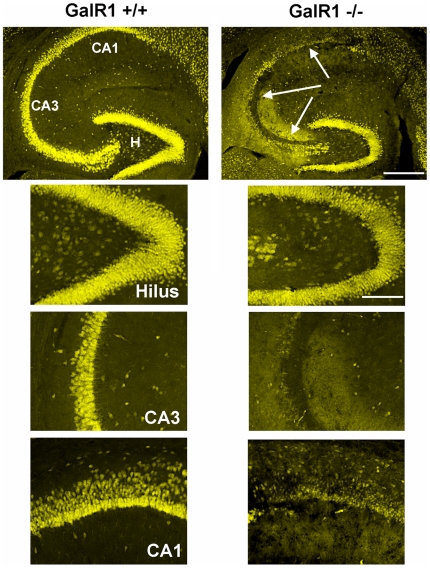
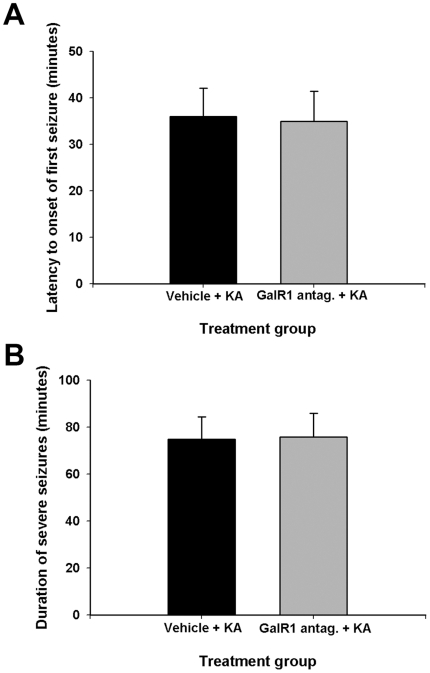
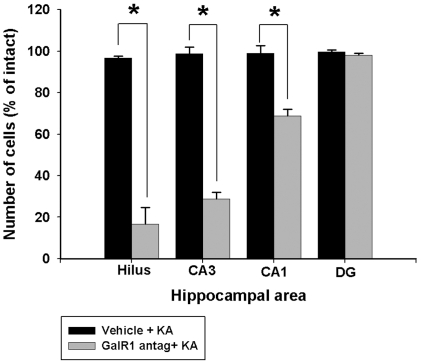
METHODOLOGY/PRINCIPAL FINDINGS: In order to test more formally the potential influence of GalR1 on seizure-induced excitotoxic cell death, we conducted functional complementation tests in which transgenic mice that exhibit decreased expression of the GalR1 candidate mRNA underwent kainate-induced status epilepticus to determine if the quantitative trait of susceptibility to seizure-induced cell death is determined by the activity of GalR1. In the present study, we report that reduction of GalR1 mRNA via null mutation or injection of the GalR1 antagonist, galantide, prior to kainate-induced status epilepticus induces hippocampal damage in a mouse strain known to be highly resistant to kainate-induced neuronal injury. Wild-type and GalR1 knockout mice were subjected to systemic kainate administration. Seven days later, Nissl and NeuN immune- staining demonstrated that hippocampal cell death was significantly increased in GalR1 knockout strains and in animals injected with the GalR1 antagonist. Compared to GalR1-expressing mice, GalR1-deficient mice had significantly larger hippocampal lesions after status epilepticus.
CONCLUSIONS/SIGNIFICANCE: Our results suggest that a reduction of GalR1 expression in the C57BL/6J mouse strain renders them susceptible to excitotoxic injury following systemic kainate administration. From these results, GalR1 protein emerges as a new molecular target that may have a potential therapeutic value in modulating seizure-induced cell death.
甘丙肽是一种在中枢和外周神经系统中广泛分布的神经肽,其生理作用通过三种 G 蛋白偶联受体亚型 GalR1、Galar2 和 GalR3 介导。有几条证据表明,甘丙肽以及 GalR1 受体的激活,是海马神经元兴奋性的有效调节剂。
方法/主要发现:为了更正式地测试 GalR1 对癫痫诱导的兴奋性细胞死亡的潜在影响,我们进行了功能互补测试,其中表达 GalR1 候选 mRNA 减少的转基因小鼠经历海人酸诱导的癫痫持续状态,以确定对癫痫诱导的细胞死亡的易感性的数量性状是否由 GalR1 的活性决定。在本研究中,我们报告说,通过 null 突变或注射 GalR1 拮抗剂甘丙肽,降低 GalR1 mRNA,可在一种已知对海人酸诱导的神经元损伤具有高度抗性的小鼠品系中引起海马损伤。野生型和 GalR1 敲除小鼠接受系统海人酸给药。7 天后,Nissl 和 NeuN 免疫染色表明,GalR1 敲除品系和注射 GalR1 拮抗剂的动物中海马细胞死亡显著增加。与 GalR1 表达小鼠相比,癫痫持续状态后 GalR1 缺陷型小鼠的海马损伤明显更大。
结论/意义:我们的结果表明,在 C57BL/6J 小鼠品系中降低 GalR1 表达使它们在系统海人酸给药后易发生兴奋性损伤。从这些结果中,GalR1 蛋白成为一种新的分子靶点,可能在调节癫痫诱导的细胞死亡方面具有潜在的治疗价值。