Klinge Uwe, Binnebösel Marcel, Rosch Raphael, Mertens Peter
Department of Surgery, University Hospital of the RWTH Aachen, Aachen, Germany.
J Minim Access Surg. 2006 Sep;2(3):151-4. doi: 10.4103/0972-9941.27729.
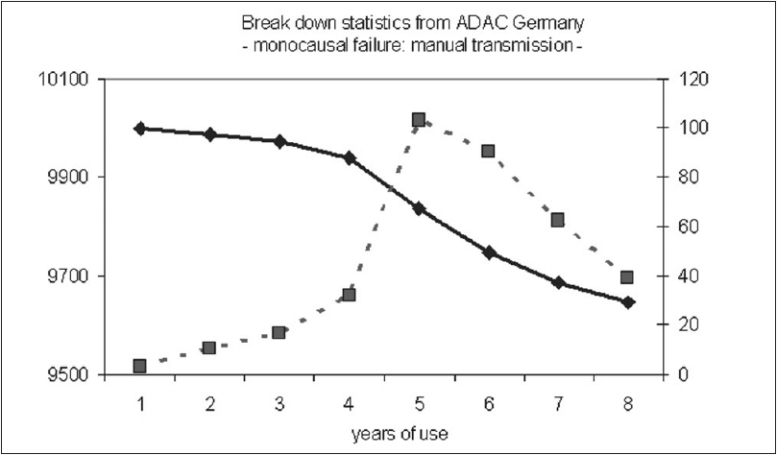
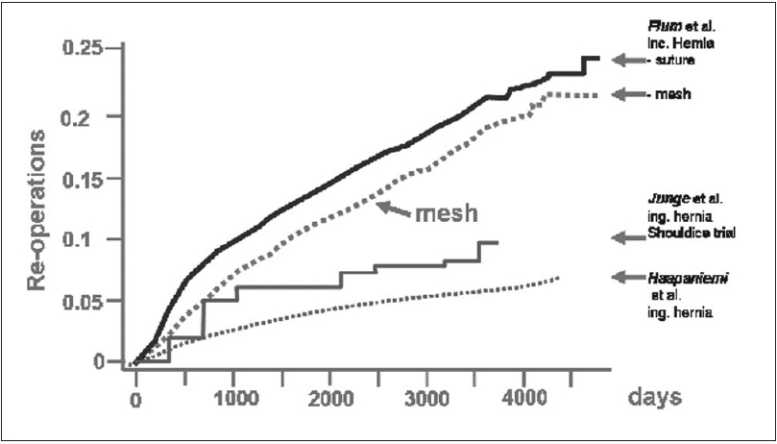
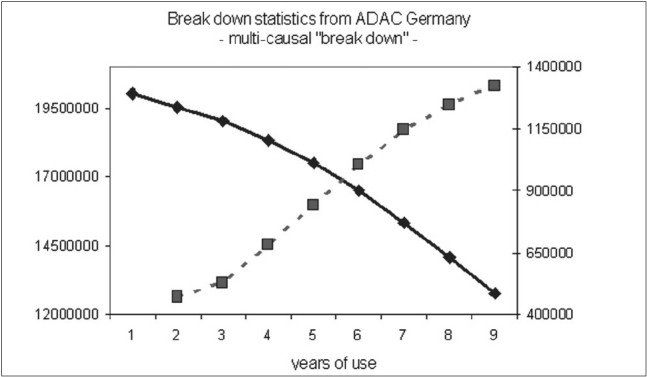
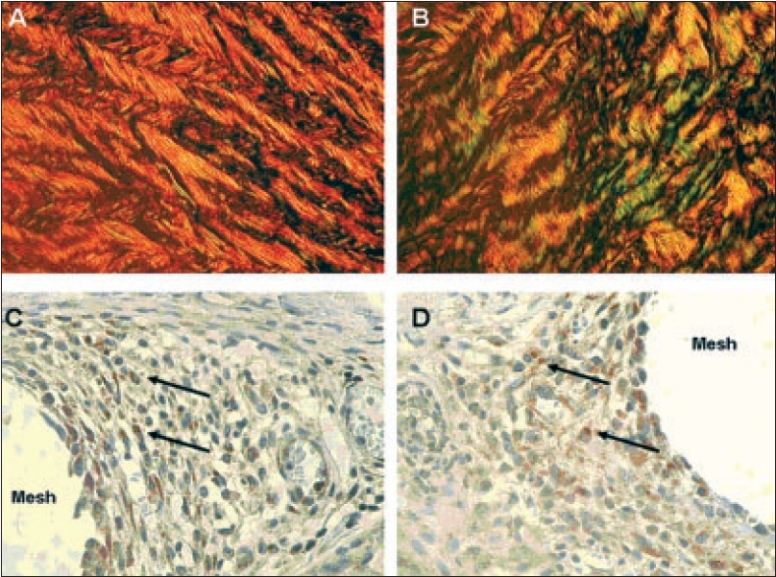
Usually an abdominal wall hernia is regarded as a mechanical problem with a local defect which has to be closed by technical means. Despite the introduction of several therapeutic improvements, recurrent hernias still appear in 10-15%. Therefore, reasons for a recurrence are discussed in a more fundamental way. It is assumed that a failure mainly depends on the quality of the repair. Correspondingly, in principle, the close causal relationship between the technical component and its failure during time is reflected by an s-shaped outcome curve. In contrast, the configuration of the outcome curve changes markedly if a breakdown is caused by numerous components. Then, the superposition of all incidence curves inevitably leads to a linear decline of the outcome curve without any s-shaped deformation. Regarding outcome curves after hernia repair, the cumulative incidences for recurrences of both incisional and inguinal hernia show a linear rise over years. Considering the configuration of outcome curves of patients with hernia disease, it may therefore be insufficient to explain a recurrence just by a failing technical repair. Rather, biological reasons should be suspected, such as a defective wound healing with impaired scarring process. Recent molecular-biological findings provide increasing evidence of underlying biochemical alterations in patients with recurrent hernia. Until predicting markers to identify patients with an impaired wound healing are available and considering the formation of insufficient scar as the underlying disease, the consequences for every surgical repair should be a supplementary reinforcement with nonabsorbable alloplastic nets as flat meshes with an extensive overlap.
通常,腹壁疝被视为一种存在局部缺损的机械性问题,必须通过技术手段进行修复。尽管在治疗方面有了多项改进,但复发疝仍有10% - 15%的发生率。因此,人们从更根本的角度探讨复发的原因。据推测,复发主要取决于修复的质量。相应地,原则上,技术因素与其随时间出现的失败之间的紧密因果关系由一条S形的结果曲线体现。相比之下,如果失败是由众多因素导致的,结果曲线的形态会显著改变。此时,所有发生率曲线的叠加必然导致结果曲线呈线性下降,而不会出现任何S形变形。关于疝修补术后的结果曲线,切口疝和腹股沟疝复发的累积发生率多年来呈线性上升。考虑到疝病患者结果曲线的形态,因此仅用技术修复失败来解释复发可能是不够的。相反,应怀疑存在生物学原因,比如伤口愈合缺陷以及瘢痕形成过程受损。最近的分子生物学研究结果越来越多地证明复发疝患者存在潜在的生化改变。在能够预测识别伤口愈合受损患者的标志物并将形成不足的瘢痕视为潜在疾病之前,每次手术修复的后果都应该是使用不可吸收的异体网片作为具有广泛重叠的扁平网片进行补充加强。