Department of Pediatrics, Oncology, Hematology and Diabetology, Medical University of Lodz, 36/50 Sporna St, 91-738 Lodz, Poland.
Diabetologia. 2011 Apr;54(4):749-56. doi: 10.1007/s00125-010-2013-4. Epub 2010 Dec 25.
AIMS/HYPOTHESIS: We evaluated seasonal HbA(1c) changes in children with type 1 diabetes and its relation with measures of weather conditions.
HbA(1c) changes over more than 3 years were evaluated in type 1 diabetic patients who were younger than 18 years and had diabetes duration of more than 12 months, and correlated with measures of weather conditions (ambient temperature, hours of sunshine and solar irradiance). After comparison of autocorrelation patterns, patterns of metabolic control and meteorological data were evaluated using Spearman rank correlation.
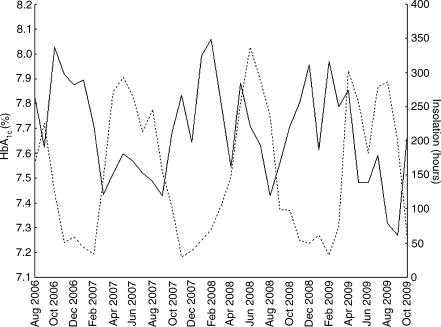
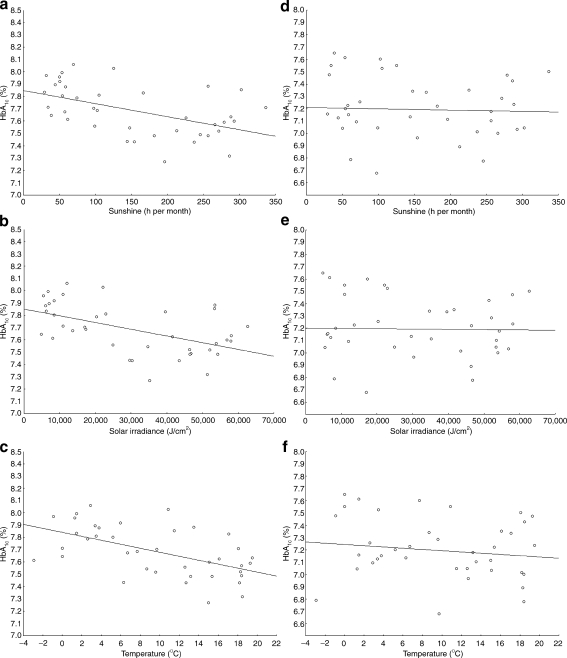
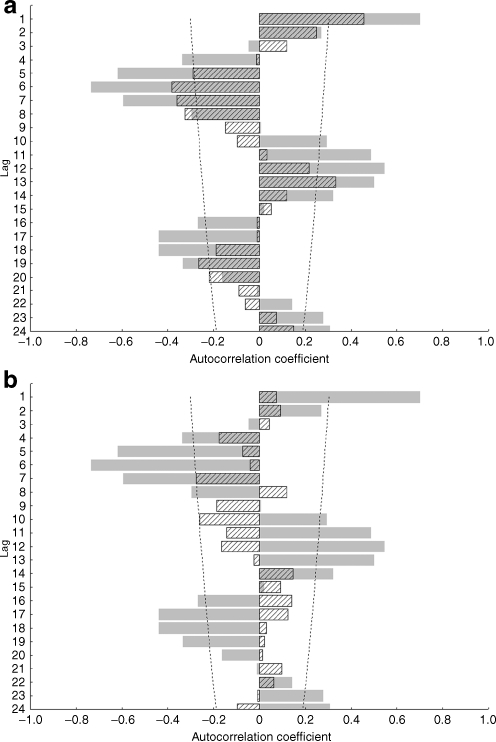
A total of 3,935 HbA(1c) measurements in 589 school (≥ 7 years) and 88 preschool (<7 years) children were analysed. Mean (± SD) HbA(1c) level for the whole study period was 7.65 ± 1.12%. The lowest HbA(1c) levels were observed in late summer and the highest in winter months, with differences consistently exceeding 0.44%. Autocorrelation analysis of HbA(1c) levels in schoolchildren showed a sine-wave pattern with a cycle length of roughly 12 months, which mirrored changes in ambient temperature. Strong negative correlations of HbA(1c) with ambient temperature (R = -0.56; p = 0.0002), hours of sunshine (R= -0.52; p = 0.0007) and solar irradiance (R = -0.52; p = 0.0006) were present in schoolchildren, but not in preschoolers (p ≥ 0.29 for each correlation).
CONCLUSIONS/INTERPRETATION: Seasonal changes of HbA(1c) levels in schoolchildren with type 1 diabetes are a significant phenomenon and should be considered in patient education and diabetes management. They may potentially affect the results of clinical trials using HbA(1c) levels as their primary outcome, as well as HbA(1c)-based diagnosis of diabetes.
目的/假设:我们评估了 1 型糖尿病患儿的季节性 HbA1c 变化及其与气象条件测量值的关系。
我们评估了年龄小于 18 岁且糖尿病病程超过 12 个月的 1 型糖尿病患儿超过 3 年的 HbA1c 变化,并将其与气象条件(环境温度、日照时间和太阳辐射)的测量值相关联。在比较自相关模式后,使用 Spearman 秩相关评估代谢控制和气象数据的模式。
共分析了 589 名学龄(≥ 7 岁)和 88 名学龄前(<7 岁)儿童的 3935 次 HbA1c 测量值。整个研究期间的平均(± SD)HbA1c 水平为 7.65 ± 1.12%。HbA1c 水平最低的是夏末,最高的是冬季,差异始终超过 0.44%。学龄儿童 HbA1c 水平的自相关分析显示出正弦波模式,其周期长度约为 12 个月,与环境温度的变化相吻合。HbA1c 与环境温度(R =-0.56;p = 0.0002)、日照时间(R=-0.52;p = 0.0007)和太阳辐射(R=-0.52;p = 0.0006)呈强烈负相关,而学龄前儿童则没有这种相关性(每种相关性的 p ≥ 0.29)。
结论/解释:1 型糖尿病学龄儿童 HbA1c 水平的季节性变化是一个显著现象,应在患者教育和糖尿病管理中加以考虑。它们可能会影响以 HbA1c 水平为主要结局指标的临床试验结果,以及基于 HbA1c 的糖尿病诊断。