Appalachian Laboratory, University of Maryland Center for Environmental Science, Frostburg, Maryland, United States of America.
PLoS One. 2010 Dec 29;5(12):e15897. doi: 10.1371/journal.pone.0015897.
Archaea are important to the carbon and nitrogen cycles, but it remains uncertain how rising atmospheric carbon dioxide concentrations ([CO(2)]) will influence the structure and function of soil archaeal communities.
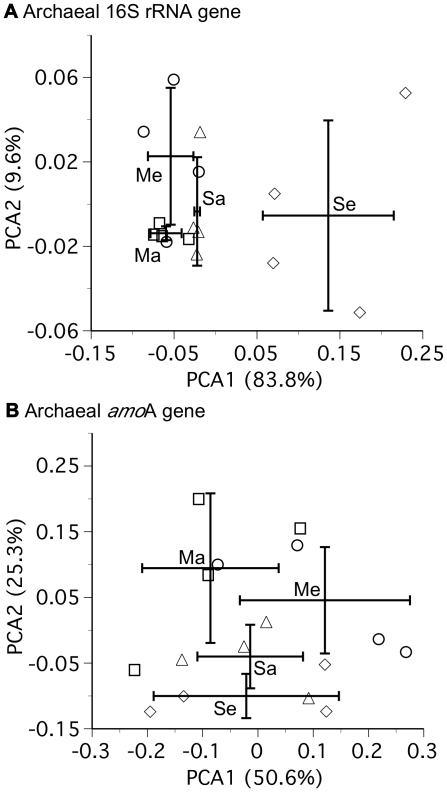
METHODOLOGY/PRINCIPAL FINDINGS: We measured abundances of archaeal and bacterial 16S rRNA and amoA genes, phylogenies of archaeal 16S rRNA and amoA genes, concentrations of KCl-extractable soil ammonium and nitrite, and potential ammonia oxidation rates in rhizosphere soil samples from maize and soybean exposed to ambient (∼385 ppm) and elevated (550 ppm) [CO(2)] in a replicated and field-based study. There was no influence of elevated [CO(2)] on copy numbers of archaeal or bacterial 16S rRNA or amoA genes, archaeal community composition, KCl-extractable soil ammonium or nitrite, or potential ammonia oxidation rates for samples from maize, a model C(4) plant. Phylogenetic evidence indicated decreased relative abundance of crenarchaeal sequences in the rhizosphere of soybean, a model leguminous-C(3) plant, at elevated [CO(2)], whereas quantitative PCR data indicated no changes in the absolute abundance of archaea. There were no changes in potential ammonia oxidation rates at elevated [CO(2)] for soybean. Ammonia oxidation rates were lower in the rhizosphere of maize than soybean, likely because of lower soil pH and/or abundance of archaea. KCl-extractable ammonium and nitrite concentrations were lower at elevated than ambient [CO(2)] for soybean.
Plant-driven shifts in soil biogeochemical processes in response to elevated [CO(2)] affected archaeal community composition, but not copy numbers of archaeal genes, in the rhizosphere of soybean. The lack of a treatment effect for maize is consistent with the fact that the photosynthesis and productivity of maize are not stimulated by elevated [CO(2)] in the absence of drought.
古菌对碳氮循环很重要,但目前尚不清楚大气二氧化碳浓度([CO2])升高将如何影响土壤古菌群落的结构和功能。
方法/主要发现:我们测量了在玉米和大豆根际土壤样本中,古菌和细菌 16S rRNA 基因和 amoA 基因的丰度、古菌 16S rRNA 和 amoA 基因的系统发育、KCl 可提取的土壤铵和亚硝酸盐浓度以及潜在氨氧化速率,这些样本是在一个重复和基于田间的研究中,暴露于大气(约 385 ppm)和升高(550 ppm)[CO2]下的。升高的[CO2]对玉米样本的古菌或细菌 16S rRNA 或 amoA 基因的拷贝数、古菌群落组成、KCl 可提取的土壤铵或亚硝酸盐或潜在氨氧化速率均没有影响,玉米是 C4 模式植物。系统发育证据表明,在升高的[CO2]下,豆科植物大豆的根际中,泉古菌的相对丰度减少,而定量 PCR 数据表明古菌的绝对丰度没有变化。大豆的潜在氨氧化速率在升高的[CO2]下没有变化。在根际中,玉米的氨氧化速率低于大豆,这可能是由于土壤 pH 值较低和/或古菌丰度较低所致。与大气 CO2 相比,KCl 可提取的铵和亚硝酸盐浓度在升高的 CO2 下较低。
由于升高的[CO2],植物驱动的土壤生物地球化学过程的变化影响了大豆根际古菌群落的组成,但没有影响古菌基因的拷贝数。对于玉米没有处理效应是一致的,因为在没有干旱的情况下,玉米的光合作用和生产力不受升高的[CO2]的刺激。