Department of Pharmacology and Toxicology, Brody School of Medicine, East Carolina University, Greenville, NC 27834, USA.
BMC Neurosci. 2011 Jan 6;12:3. doi: 10.1186/1471-2202-12-3.
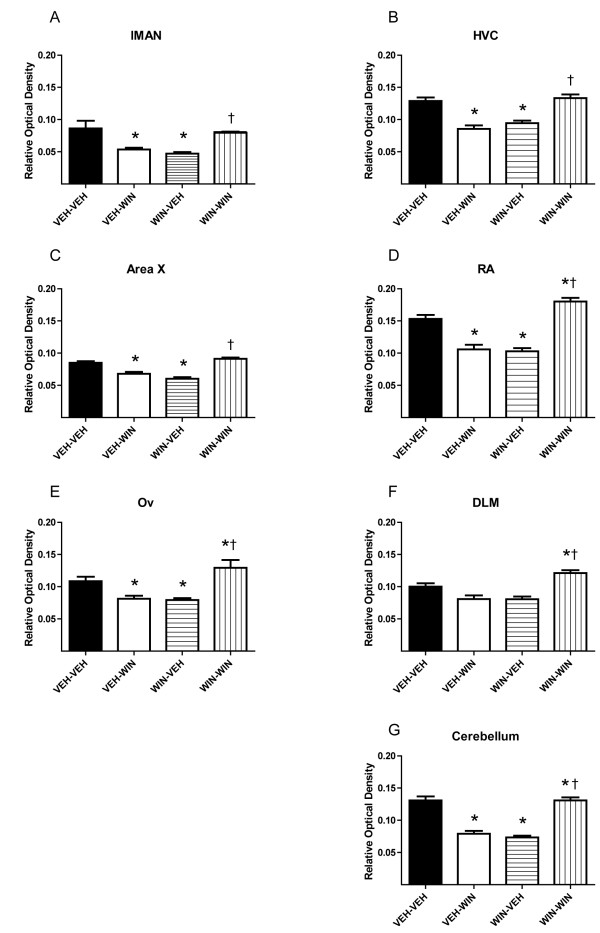
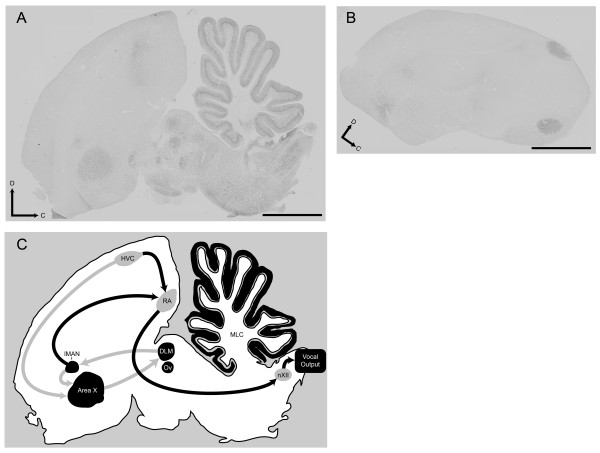
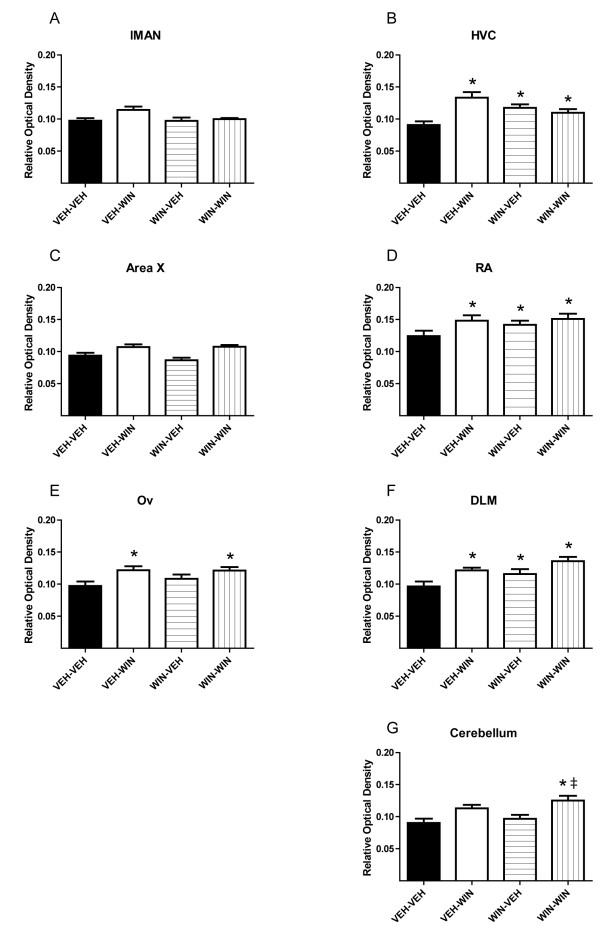
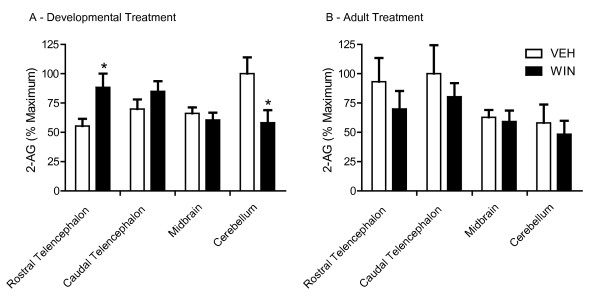
Previously we have found that cannabinoid treatment of zebra finches during sensorimotor stages of vocal development alters song patterns produced in adulthood. Such persistently altered behavior must be attributable to changes in physiological substrates responsible for song. We are currently working to identify the nature of such physiological changes, and to understand how they contribute to altered vocal learning. One possibility is that developmental agonist exposure results in altered expression of elements of endocannabinoid signaling systems. To test this hypothesis we have studied effects of the potent cannabinoid receptor agonist WIN55212-2 (WIN) on endocannabinoid levels and densities of CB1 immunostaining in zebra finch brain.
We found that late postnatal WIN treatment caused a long-term global disregulation of both levels of the endocannabinoid, 2-arachidonyl glycerol (2-AG) and densities of CB1 immunostaining across brain regions, while repeated cannabinoid treatment in adults produced few long-term changes in the endogenous cannabinoid system.
Our findings indicate that the zebra finch endocannabinoid system is particularly sensitive to exogenous agonist exposure during the critical period of song learning and provide insight into susceptible brain areas.
此前,我们发现大麻素处理在发声发育的感觉运动阶段的斑马雀会改变成年后产生的鸣叫声模式。这种持续改变的行为必须归因于负责歌唱的生理基质的变化。我们目前正在努力确定这种生理变化的性质,并了解它们如何促成改变的声乐学习。一种可能性是,发育性激动剂暴露导致内源性大麻素信号系统的元素表达发生改变。为了验证这一假说,我们研究了强效大麻素受体激动剂 WIN55212-2(WIN)对斑马雀脑中内源性大麻素水平和 CB1 免疫染色密度的影响。
我们发现,新生后晚期 WIN 处理导致内源性大麻素 2-花生四烯酸甘油(2-AG)的水平和 CB1 免疫染色密度在整个大脑区域的长期普遍失调,而成年期重复的大麻素处理在内源性大麻素系统中产生的长期变化很少。
我们的发现表明,斑马雀内源性大麻素系统对外源性激动剂暴露在歌唱学习的关键时期特别敏感,并为易受影响的大脑区域提供了深入了解。