Ugalde Alejandro P, Mariño Guillermo, López-Otín Carlos
Departamento de Bioquímica y Biología Molecular, Facultad de Medicina, Instituto Universitario de Oncología, Universidad de Oviedo, 33006-Oviedo, Spain.
Aging (Albany NY). 2010 Dec;2(12):1017-22. doi: 10.18632/aging.100262.
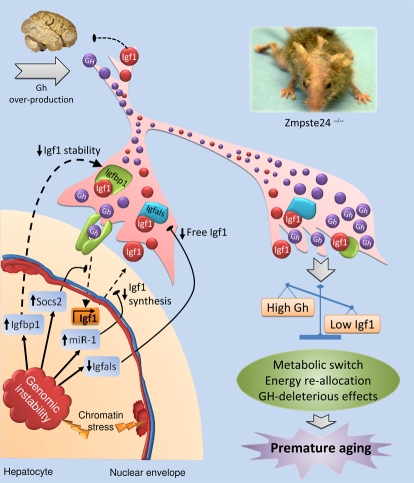
We have recently reported that progeroid Zmpste24-/- mice, which exhibit multiple defects that phenocopy Hutchinson-Gilford progeria syndrome, show a profound dysregulation of somatotropic axis, mainly characterized by the occurrence of very high circulating levels of growth hormone (GH) and a drastic reduction in insulin-like growth factor-1 (IGF-1). We have also shown that restoration of the proper GH/IGF-1 balance in Zmpste24-/- mice by treatment with recombinant IGF-1 delays the onset of many progeroid features in these animals and significantly extends their lifespan. Here, we summarize these observations and discuss the importance of GH/IGF-1 balance in longevity as well as its modulation as a putative therapeutic strategy for the treatment of human progeroid syndromes.
我们最近报道,早衰样Zmpste24基因敲除小鼠表现出多种类似于哈钦森-吉尔福德早衰综合征的缺陷,其生长激素轴存在严重失调,主要表现为循环生长激素(GH)水平极高,而胰岛素样生长因子-1(IGF-1)大幅降低。我们还表明,通过重组IGF-1治疗恢复Zmpste24基因敲除小鼠中适当的GH/IGF-1平衡,可延迟这些动物许多早衰样特征的出现,并显著延长其寿命。在此,我们总结这些观察结果,并讨论GH/IGF-1平衡在长寿中的重要性以及将其调节作为治疗人类早衰综合征的一种潜在治疗策略。