Van der Meulen J, Haslam R J
Department of Pediatrics, McMaster University, Hamilton, Ontario, Canada.
Biochem J. 1990 Nov 1;271(3):693-700. doi: 10.1042/bj2710693.
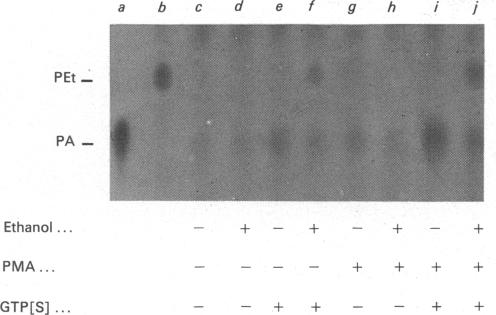
Rabbit platelets were labelled with [3H]glycerol and incubated with or without phorbol 12-myristate 13-acetate (PMA). Membranes were then isolated and assayed for phospholipase D (PLD) activity by monitoring [3H]phosphatidylethanol formation in the presence of 300 mM-ethanol. At a [Ca2+free] of 1 microM, PLD activity was detected in control membranes, but was 5.4 +/- 0.8-fold (mean +/- S.E.M.) greater in membranes from PMA-treated platelets. Under the same conditions, 10 microM-guanosine 5'-[gamma-thio]triphosphate (GTP[S]) stimulated PLD by 18 +/- 3-fold in control membranes, whereas PMA treatment and GTP[S] interacted synergistically to increase PLD activity by 62 +/- 12-fold. GTP[S]-stimulated PLD activity was observed in the absence of Ca2+, but was increased by 1 microM-Ca2+ (3.5 +/- 0.2-fold and 1.8 +/- 0.1-fold in membranes from control and PMA-treated platelets respectively). GTP exerted effects almost as great as those of GTP[S], but 20-30-fold higher concentrations were required. Guanosine 5'-[beta-thio]diphosphate inhibited the effects of GTP[S] or GTP, suggesting a role for a GTP-binding protein in activation of PLD. Thrombin (2 units/ml) stimulated the PLD activity of platelet membranes only very weakly and in a GTP-independent manner. The actions of PMA and analogues on PLD activity correlated with their ability to stimulate protein kinase C in intact platelets. Staurosporine, a potent protein kinase inhibitor, had both inhibitory and, at higher concentrations, stimulatory effects on the activation of PLD by PMA. The results suggest that PMA not only stimulates PLD via activation of protein kinase C but can also activate the enzyme by a phosphorylation-independent mechanism in the presence of staurosporine. However, under physiological conditions, full activation of platelet PLD may require the interplay of protein kinase C, increased Ca2+ and a GTP-binding protein, and may occur as a secondary effect of the activation of phospholipase C.
用[3H]甘油标记兔血小板,并在有或没有佛波醇12 -肉豆蔻酸酯13 -乙酸酯(PMA)的情况下进行孵育。然后分离膜,并通过监测在300 mM乙醇存在下[3H]磷脂酰乙醇的形成来测定磷脂酶D(PLD)活性。在游离Ca2+浓度为1 microM时,在对照膜中检测到PLD活性,但在PMA处理的血小板膜中活性高5.4±0.8倍(平均值±标准误)。在相同条件下,10 microM鸟苷5'-[γ-硫代]三磷酸(GTP[S])在对照膜中刺激PLD活性18±3倍,而PMA处理和GTP[S]协同作用使PLD活性增加62±十二倍。在没有Ca2+的情况下观察到GTP[S]刺激的PLD活性,但1 microM Ca2+使其增加(对照和PMA处理的血小板膜中分别增加3.5±0.2倍和1.8±0.1倍)。GTP产生的作用几乎与GTP[S]相同,但所需浓度高20 - 30倍。鸟苷5'-[β-硫代]二磷酸抑制GTP[S]或GTP的作用,表明GTP结合蛋白在PLD激活中起作用。凝血酶(2单位/毫升)仅非常微弱地刺激血小板膜的PLD活性,且不依赖GTP。PMA及其类似物对PLD活性的作用与其在完整血小板中刺激蛋白激酶C的能力相关。星形孢菌素是一种有效的蛋白激酶抑制剂,对PMA激活PLD具有抑制作用,在较高浓度时还有刺激作用。结果表明,PMA不仅通过激活蛋白激酶C刺激PLD,而且在存在星形孢菌素的情况下还可通过非磷酸化机制激活该酶。然而,在生理条件下,血小板PLD的完全激活可能需要蛋白激酶C、增加的Ca2+和GTP结合蛋白的相互作用,并且可能作为磷脂酶C激活的次级效应而发生。