School of Public Health, National Defense Medical Center, Taipei, ROC.
BMC Cancer. 2011 Jan 18;11:20. doi: 10.1186/1471-2407-11-20.
Metformin protection against cancer risk in Orientals is uncertain. We examined the possible metformin effect on total, esophageal, gastric, colorectal (CRC), hepatocellular (HCC) and pancreatic cancers in a Taiwanese cohort.
A representative sample of 800,000 was drawn from the Taiwanese National Health Insurance data of 2000. A cohort of 480,984 participants 20 years or older, diabetes-cancer-free on 1st January 2000 was formed and categorized as four groups by DM and metformin usage status. Eligible incident cancer events had to occur one year after the index date until the end of 2007. The Cox proportional-hazards model evaluated relative risk of cancer for treated DM patients with or without metformin. The covariates included age, gender, other oral anti-hyperglycemic medication, Charlson comorbidity index (CCI) score and metformin exposure dosage and duration.
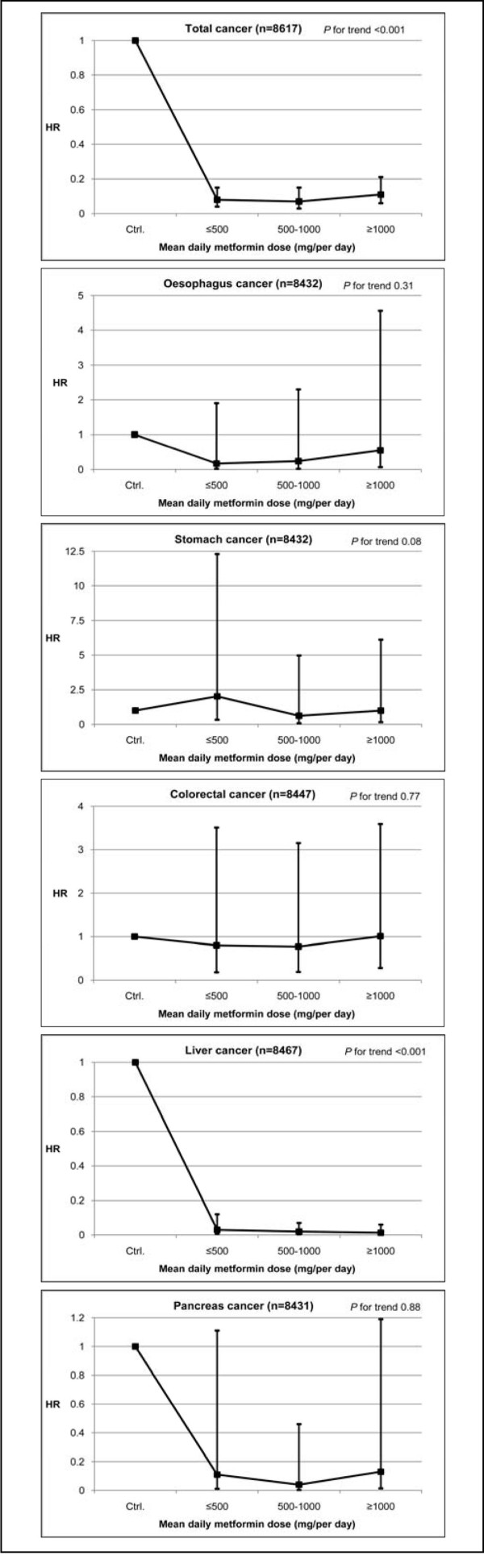
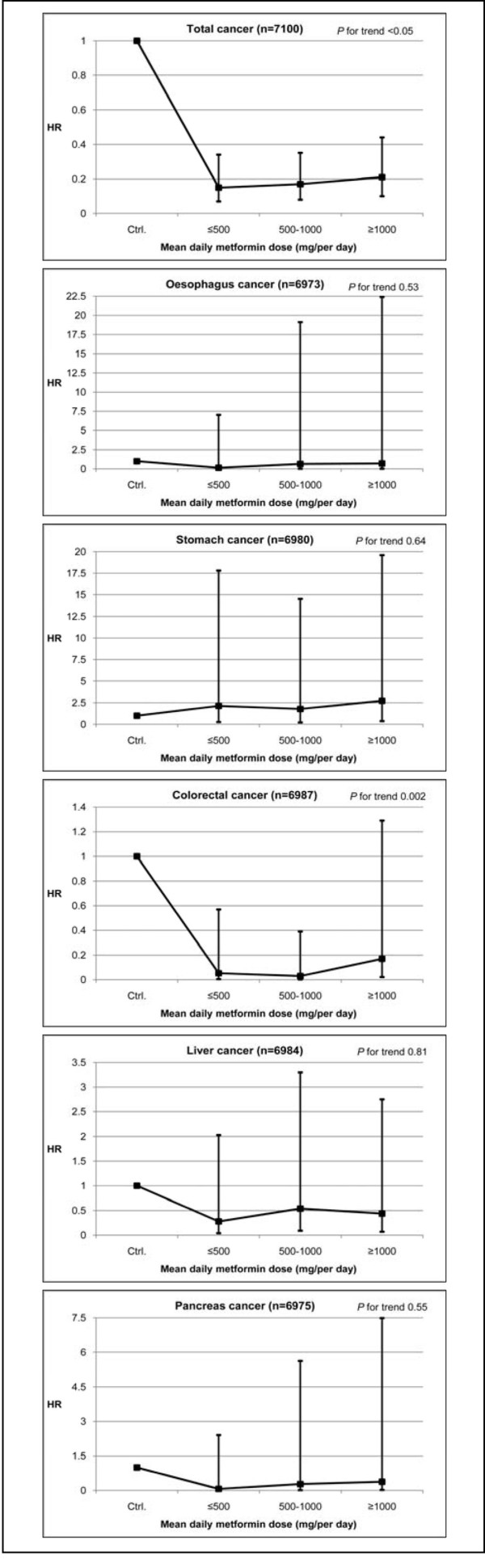
With diabetes but no anti-hyperglycemic medication, cancer incidence density increased at least 2-fold for total, CRC and HCC. On metformin, total, CRC and HCC incidences decreased to near non-diabetic levels but to varying degrees depending on gender and cancer type (CRC in women, liver in men). Adjustment for other oral anti-hyperglycemic agents usage and CCI made the benefit of metformin more evident [hazard ratios (95% confidence intervals): total 0.12 (0.08-0.19), CRC 0.36 (0.13-0.98), liver 0.06 (0.02-0.16), pancreas 0.15 (0.03-0.79)]. There was a significant gender interaction with metformin in CRC which favored women. Metformin dosage for a significant decrease in cancer incidence was ≤ 500 mg/day.
Metformin can reduce the incidences of several gastroenterological cancers in treated diabetes.
二甲双胍对东亚人群的癌症风险的保护作用尚不确定。我们在台湾队列中研究了二甲双胍对总癌症、食管癌、胃癌、结直肠癌(CRC)、肝细胞癌(HCC)和胰腺癌的可能作用。
从 2000 年台湾全民健康保险数据中抽取了一个 80 万人的代表性样本。2000 年 1 月 1 日时年龄在 20 岁或以上、无糖尿病-癌症病史的参与者组成了一个队列,共 480984 人,根据 DM 和二甲双胍的使用情况分为四组。符合条件的新发癌症事件必须在指数日期后一年至 2007 年底发生。Cox 比例风险模型评估了有或无二甲双胍的治疗性糖尿病患者的癌症相对风险。协变量包括年龄、性别、其他口服降糖药、Charlson 合并症指数(CCI)评分以及二甲双胍暴露剂量和持续时间。
患有糖尿病但未使用降糖药物的患者,总癌症、CRC 和 HCC 的癌症发生率密度增加了至少 2 倍。使用二甲双胍后,总癌症、CRC 和 HCC 的发病率下降到接近非糖尿病水平,但因性别和癌症类型而异(女性 CRC,男性肝脏)。调整其他口服降糖药的使用和 CCI 后,二甲双胍的益处更加明显[风险比(95%置信区间):总癌症 0.12(0.08-0.19),CRC 0.36(0.13-0.98),肝脏 0.06(0.02-0.16),胰腺 0.15(0.03-0.79)]。二甲双胍在 CRC 中的作用存在显著的性别交互作用,对女性有利。二甲双胍剂量降低癌症发生率需要≤500mg/天。
二甲双胍可降低治疗性糖尿病患者多种胃肠道癌症的发病率。