Research Program for Molecular Medicine, Biomedicum Helsinki, University of Helsinki, Helsinki, Finland.
BMC Med Genet. 2011 Jan 18;12:11. doi: 10.1186/1471-2350-12-11.
Long QT syndrome (LQTS) is an inherited ion channel disorder manifesting with prolongation of the cardiac repolarization phase and severe ventricular arrhythmias. The common KCNE1 D85N potassium channel variant prolongs QT interval by inhibiting IKs (KCNQ1) and IKr (KCNH2) currents and is therefore a suitable candidate for a modifier gene in LQTS.
We studied the effect of D85N on age-, sex-, and heart rate-adjusted QT-interval duration by linear regression in LQTS patients carrying the Finnish founder mutations KCNQ1 G589D (n = 492), KCNQ1 IVS7-2A>G (n = 66), KCNH2 L552S (n = 73), and KCNH2 R176W (n = 88). We also investigated the association between D85N and clinical variables reflecting the severity of the disease.
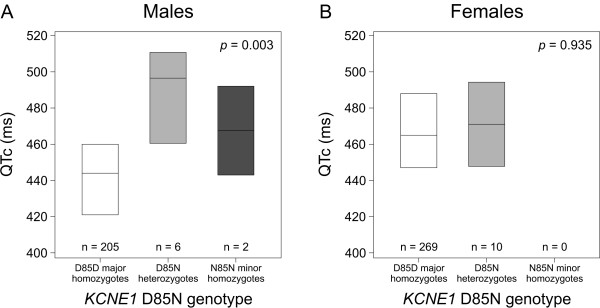
D85N was associated with a QT prolongation by 26 ms (SE 8.6, p = 0.003) in males with KCNQ1 G589D (n = 213), but not in females with G589D (n = 279). In linear regression, the interaction between D85N genotype and sex was significant (p = 0.028). Within the KCNQ1 G589D mutation group, KCNE1 D85N carriers were more often probands of the family (p = 0.042) and were more likely to use beta blocker medication (p = 0.010) than non-carriers. The number of D85N carriers in other founder mutation groups was too small to assess its effects.
We propose that KCNE1 D85N is a sex-specific QT-interval modifier in type 1 LQTS and may also associate with increased severity of disease. Our data warrant additional studies on the role of KCNE1 D85N in other genetically homogeneous groups of LQTS patients.
长 QT 综合征(LQTS)是一种遗传性离子通道疾病,表现为心脏复极期延长和严重的室性心律失常。常见的 KCNE1 D85N 钾通道变体通过抑制 IKs(KCNQ1)和 IKr(KCNH2)电流延长 QT 间期,因此是 LQTS 修饰基因的合适候选基因。
我们通过线性回归研究了 D85N 在携带芬兰创始突变 KCNQ1 G589D(n = 492)、KCNQ1 IVS7-2A>G(n = 66)、KCNH2 L552S(n = 73)和 KCNH2 R176W(n = 88)的 LQTS 患者中对年龄、性别和心率校正的 QT 间期持续时间的影响。我们还研究了 D85N 与反映疾病严重程度的临床变量之间的关联。
D85N 与 KCNQ1 G589D 男性患者的 QT 间期延长 26ms(SE 8.6,p = 0.003)相关,但与 G589D 女性患者无关(n = 279)。在线性回归中,D85N 基因型与性别的相互作用具有统计学意义(p = 0.028)。在 KCNQ1 G589D 突变组中,KCNE1 D85N 携带者更常为家族的先证者(p = 0.042),并且更可能使用β受体阻滞剂药物(p = 0.010)而非非携带者。其他创始突变组中 D85N 携带者的数量太少,无法评估其影响。
我们提出 KCNE1 D85N 是 1 型 LQTS 的性别特异性 QT 间期修饰基因,也可能与疾病严重程度增加相关。我们的数据需要在其他遗传同质的 LQTS 患者群体中进一步研究 KCNE1 D85N 的作用。