Yoon Chang-Hwan, Zo Joo-Hee, Kim Yong-Jin, Kim Hyung-Kwan, Shine Dong-Ho, Kim Kyung-Hwan, Kim Ki-Bong, Ahn Hyuk, Sohn Dae-Won, Oh Byung-Hee, Park Young-Bae
Cardiovascular Center, Seoul National University Bundang Hospital, Seongnam, Korea.
J Cardiovasc Ultrasound. 2010 Dec;18(4):139-45. doi: 10.4250/jcu.2010.18.4.139. Epub 2010 Dec 31.
The plasma B-type natriuretic peptide (BNP) level is a useful prognostic marker in heart failure and valvular heart disease. In patients with isolated severe tricuspid regurgitation (TR), little is known about the determinants of plasma BNP levels and the correlation with future outcome. The purpose of this study was to identify the determinants of plasma BNP levels in patients with isolated severe TR and the value of the BNP level in predicting postoperative outcomes after corrective surgery.
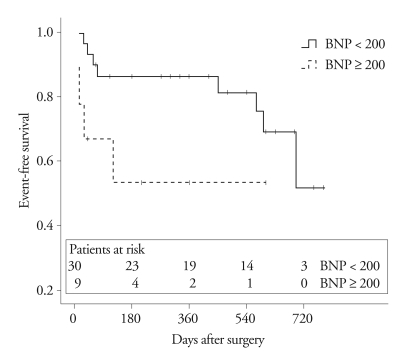
We prospectively enrolled 39 patients with isolated, severe TR undergoing corrective surgery. A plasma BNP assay and cardiac magnetic resonance (CMR) imaging were performed before surgery. The combined end-point was the occurrence of cardiac death or readmission due to heart failure.
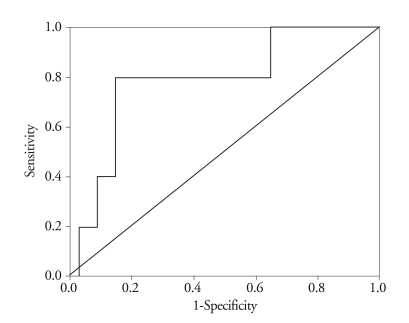
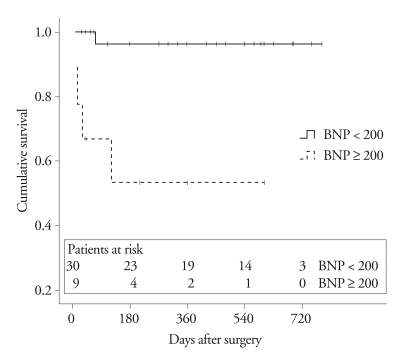
Linear regression analysis showed that the left ventricular ejection fraction and right ventricular end systolic volume were the most important determinants of the BNP levels (p = 0.002, R(2) = 0.315). Based on the receiver operating characteristics (ROC) curve, we were able to derive an optimal cutoff value (200 pg/mL) to predict postoperative cardiac death with a sensitivity of 80% and a specificity of 85%. The one-year survival rate was 96% in patients with a BNP < 200 pg/mL and 53% in patients with a BNP ≥ 200 pg/dL (p = 0.001).
An elevation in the BNP level is determined by the functional status of the right and left ventricles in patients with isolated, severe TR. An elevated BNP predicts adverse events after corrective surgery. Therefore, the BNP level should be included in the clinical evaluation and risk stratification of patients with isolated TR.
血浆B型利钠肽(BNP)水平是心力衰竭和心脏瓣膜病中一种有用的预后标志物。在孤立性严重三尖瓣反流(TR)患者中,关于血浆BNP水平的决定因素以及与未来预后的相关性知之甚少。本研究的目的是确定孤立性严重TR患者血浆BNP水平的决定因素以及BNP水平在预测矫正手术后的术后结果中的价值。
我们前瞻性纳入了39例接受矫正手术的孤立性严重TR患者。术前进行了血浆BNP检测和心脏磁共振(CMR)成像。联合终点是心脏死亡或因心力衰竭再次入院的发生情况。
线性回归分析表明,左心室射血分数和右心室收缩末期容积是BNP水平的最重要决定因素(p = 0.002,R² = 0.315)。根据受试者工作特征(ROC)曲线,我们能够得出一个最佳临界值(200 pg/mL)来预测术后心脏死亡,敏感性为80%,特异性为85%。BNP < 200 pg/mL的患者一年生存率为96%,BNP≥200 pg/dL的患者一年生存率为53%(p = 0.001)。
在孤立性严重TR患者中,BNP水平的升高由左右心室的功能状态决定。BNP升高预示着矫正手术后的不良事件。因此,BNP水平应纳入孤立性TR患者的临床评估和风险分层。