Department of Psychiatry, Faculty of Medicine, McGill University, Douglas Mental Health University Institute, FBC Building, 6875 boul. LaSalle, Verdun, QC H4H 1R3, Canada.
Eur J Neurosci. 2011 Mar;33(5):968-77. doi: 10.1111/j.1460-9568.2010.07550.x. Epub 2011 Jan 24.
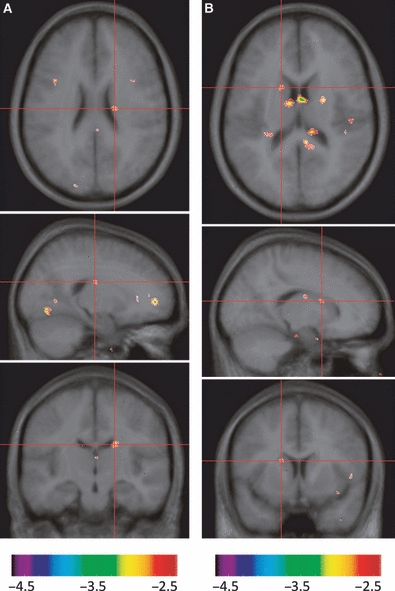
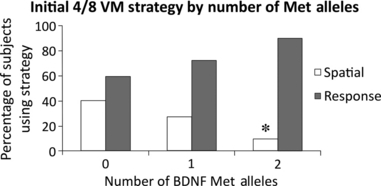
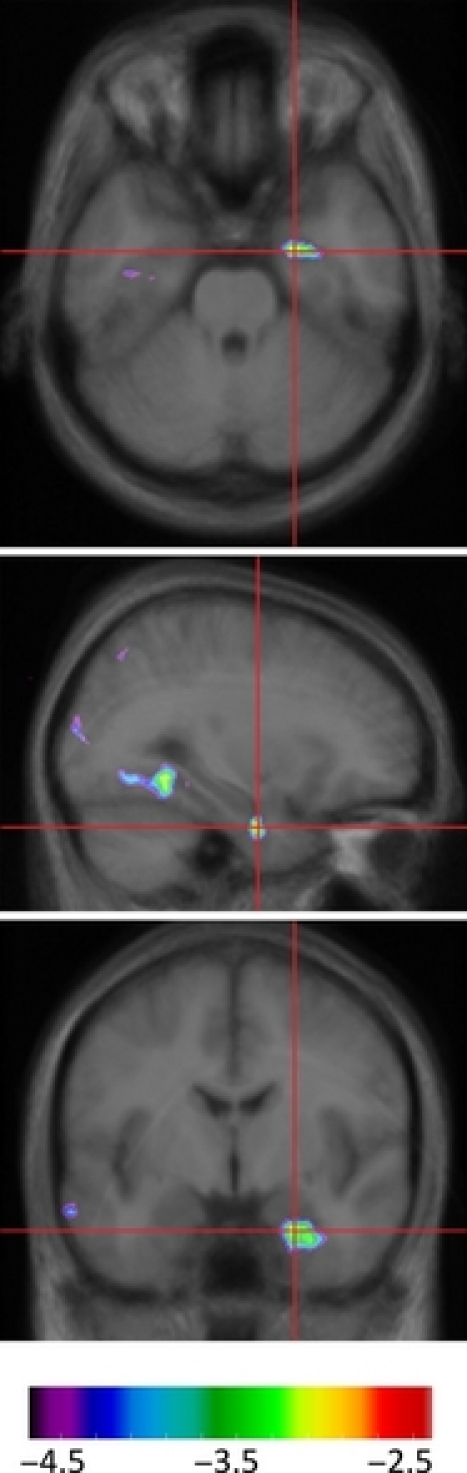
Multiple memory systems are involved in parallel processing of spatial information during navigation. A series of studies have distinguished between hippocampus-dependent 'spatial' navigation, which relies on knowledge of the relationship between landmarks in one's environment to build a cognitive map, and habit-based 'response' learning, which requires the memorization of a series of actions and is mediated by the caudate nucleus. Studies have demonstrated that people spontaneously use one of these two alternative navigational strategies with almost equal frequency to solve a given navigation task, and that strategy correlates with functional magnetic resonance imaging (fMRI) activity and grey matter density. Although there is evidence for experience modulating grey matter in the hippocampus, genetic contributions may also play an important role in the hippocampus and caudate nucleus. Recently, the Val66Met polymorphism of the brain-derived neurotrophic factor (BDNF) gene has emerged as a possible inhibitor of hippocampal function. We have investigated the role of the BDNF Val66Met polymorphism on virtual navigation behaviour and brain activation during an fMRI navigation task. Our results demonstrate a genetic contribution to spontaneous strategies, where 'Met' carriers use a response strategy more frequently than individuals homozygous for the 'Val' allele. Additionally, we found increased hippocampal activation in the Val group relative to the Met group during performance of a virtual navigation task. Our results support the idea that the BDNF gene with the Val66Met polymorphism is a novel candidate gene involved in determining spontaneous strategies during navigation behaviour.
在导航过程中,多个记忆系统参与空间信息的并行处理。一系列研究区分了海马体依赖的“空间”导航,它依赖于对环境中地标之间关系的了解来构建认知地图,以及基于习惯的“反应”学习,它需要记忆一系列动作,并由尾状核介导。研究表明,人们在解决给定的导航任务时,几乎以相同的频率自发地使用这两种替代导航策略中的一种,并且该策略与功能磁共振成像 (fMRI) 活动和灰质密度相关。尽管有证据表明经验可以调节海马体中的灰质,但遗传因素也可能在海马体和尾状核中发挥重要作用。最近,脑源性神经营养因子 (BDNF) 基因的 Val66Met 多态性已成为海马体功能的可能抑制剂。我们研究了 BDNF Val66Met 多态性对 fMRI 导航任务中虚拟导航行为和大脑激活的作用。我们的研究结果表明,遗传因素对自发策略有影响,即“Met”携带者比“Val”等位基因纯合子更频繁地使用反应策略。此外,我们发现,在执行虚拟导航任务时,Val 组的海马体激活程度高于 Met 组。我们的结果支持这样一种观点,即具有 Val66Met 多态性的 BDNF 基因是参与决定导航行为中自发策略的一个新候选基因。