Bakhtiari Jalal, Kajbafzadeh Abdol Mohammad, Marjani Mahdi, Veshkini Abbas, Tavakoli Azin, Gharagozlou Mohammad Javad, Niasari-Naslaji Amir
Pediatric Urology Research Center, Department of Pediatric Urology, Children's Hospital Medical Center, Tehran University of Medical Sciences, Tehran, Iran.
BMC Res Notes. 2011 Jan 22;4:14. doi: 10.1186/1756-0500-4-14.
Injection of biomaterial to suburetral region, using minimally invasive procedure, has become an interesting topic for urologists to treat vesicoureteral reflux. The objective of this study was to evaluate the feasibility of injecting newly introduced calcium hydroxyl apatite to suburetral region, for treating an experimentally induced vesicoureteral reflux in dogs.
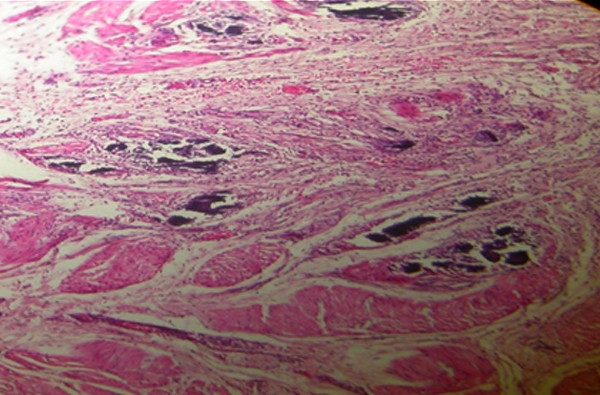
Bilateral vesicoureteral refluxed (VUR) mixed breed dogs (n = 12; 10-15 kg live weight, 3-6 months of age) were selected for this study. The presence and grade of the reflux were determined using cystography. Accordingly, 6 dogs displayed grade 1 & 2 and the other 6 showed grade 3 & 4 bilateral VUR. Every single dog, with bilateral VUR, underwent endoscopic treatment and received an injection of calcium hydroxyl apatite (an Iranian made product) into the left (treated side) and an injection of the similar volume of normal saline in to the right (control side) subureteric space. One week, 3 and 6 months after treatment, cystography was performed. On each occasion, 4 dogs were euthanized by gas inhalation and biopsy samples were collected for histopathological study from ureter, bladder, kidney, lung and spleen in order to investigate the biomaterial migration into different organs. Data were analyzed using Chi-squared test. In control sides, radiographs confirmed the same grade of VUR, found at the initiation of the study. VUR was resolved in 100% (6/6) of Grade 1 & 2 and 83.33% (5/6) of Grade 3 & 4 in treated side. Therefore, the total success rate of this study was 91.67% (11/12). Macroscopic examination of the vesicouretral region of the treated side revealed a firm and consistent biomaterial mass at the site of injection. Histological findings confirmed inflammation at treated side. In contrast, there was no tissue reaction on control side. There was no evidence for biomaterial migration in macroscopic and microscopic observations in this study.
In the present study, a new biocompatible material produced a firm, consist and sustainable biomaterial mass in the suburetral region for treating vesicouretral reflux without any evidence of biomaterial migration.
采用微创方法将生物材料注射至膀胱下区域,已成为泌尿外科医生治疗膀胱输尿管反流的一个有趣课题。本研究的目的是评估将新引入的羟基磷灰石注射至膀胱下区域治疗犬实验性诱导膀胱输尿管反流的可行性。
本研究选用了双侧膀胱输尿管反流(VUR)的杂种犬(n = 12;体重10 - 15千克,年龄3 - 6个月)。通过膀胱造影确定反流的存在及分级。据此,6只犬表现为1级和2级反流,另外6只表现为3级和4级双侧VUR。每只患有双侧VUR的犬均接受了内镜治疗,并在左侧(治疗侧)注射羟基磷灰石(一种伊朗产产品),在右侧(对照侧)膀胱下间隙注射相同体积的生理盐水。治疗后1周、3个月和6个月进行膀胱造影。每次均通过吸入气体对4只犬实施安乐死,并从输尿管、膀胱、肾脏、肺和脾脏采集活检样本进行组织病理学研究,以调查生物材料向不同器官的迁移情况。数据采用卡方检验进行分析。在对照侧,X线片证实反流分级与研究开始时相同。治疗侧1级和2级反流的治愈率为100%(6/6),3级和4级反流的治愈率为83.33%(5/6)。因此,本研究的总成功率为91.67%(11/12)。对治疗侧膀胱尿道区域的宏观检查显示,注射部位有坚实且均匀的生物材料团块。组织学检查结果证实治疗侧存在炎症。相比之下,对照侧未出现组织反应。在本研究的宏观和微观观察中均未发现生物材料迁移的证据。
在本研究中,一种新型生物相容性材料在膀胱下区域形成了坚实、均匀且可持续的生物材料团块,用于治疗膀胱尿道反流,且未发现生物材料迁移的任何证据。