Department of Molecular Medicine, Mayo Clinic, Rochester, Minnesota, United States of America.
PLoS One. 2011 Jan 14;6(1):e16121. doi: 10.1371/journal.pone.0016121.
Rhesus monkey TRIM5α (TRIM5αrh) recognizes the incoming HIV-1 core through its C-terminal B30.2(PRYSPRY) domain and promotes its premature disassembly or degradation before reverse transcription. Previously, we have shown that TRIM5αrh blocks HIV-1 production through the N-terminal RBCC domain by the recognition of Gag polyproteins. Although all TRIM family proteins have RBCC domains, it remains elusive whether they possess similar late-restriction activities.
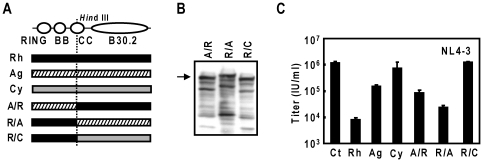
METHODOLOGY/PRINCIPAL FINDINGS: We examined the antiviral spectra of TRIM5α orthologues and human TRIM family members which have a genetic locus proximal to human TRIM5α (TRIM5αhu), against primate lentiviral production. When HIV-1 virus-like particles (VLPs) were generated in the presence of TRIM5α proteins, rhesus, African green and cynomolgus monkey TRIM5α (TRIM5αag and TRIM5αcy), but not TRIM5αhu, were efficiently incorporated into VLPs, suggesting an interaction between HIV-1 Gag and TRIM5α proteins. TRIM5αrh potently restricted the viral production of HIV-1 groups M and O and HIV-2, but not simian lentiviruses including SIV(MAC)1A11, SIV(AGM)Tan-1 or SIV(AGM)SAB-1. TRIM5αhu did not show notable late restriction activities against these lentiviruses. TRIM5αag and TRIM5αcy showed intermediate restriction phenotypes against HIV-1 and HIV-2, but showed no restriction activity against SIV production. A series of chimeric TRIM5α constructs indicated that the N-terminal region of TRIM5αag and TRIM5αcy are essential for the late restriction activity, while the C-terminal region of TRIM5αcy negatively regulates the late restriction activity against HIV-1. When select human TRIM family proteins were examined, TRIM21 and 22 were efficiently incorporated into HIV-1 VLPs, while only TRIM22 reduced HIV-1 titers up to 5-fold. The antiviral activities and encapsidation efficiencies did not correlate with their relative expression levels in the producer cells.
CONCLUSIONS/SIGNIFICANCE: Our results demonstrated the variations in the late restriction activities among closely related TRIM5α orthologues and a subset of human TRIM family proteins, providing further insights into the late restriction activities of TRIM proteins.
恒河猴 TRIM5α(TRIM5αrh)通过其 C 末端 B30.2(PRYSPRY)结构域识别进入的 HIV-1 核心,并在逆转录之前促进其过早的解体或降解。此前,我们已经表明,TRIM5αrh 通过识别 Gag 多聚蛋白,通过 N 末端 RBCC 结构域阻断 HIV-1 的产生。尽管所有 TRIM 家族蛋白都具有 RBCC 结构域,但它们是否具有相似的晚期限制活性仍不清楚。
方法/主要发现:我们研究了 TRIM5α 同源物和具有接近人类 TRIM5α(TRIM5αhu)遗传基因座的人类 TRIM 家族成员的抗病毒谱,以对抗灵长类慢病毒的产生。当 HIV-1 病毒样颗粒(VLPs)在 TRIM5α 蛋白存在的情况下生成时,恒河猴、非洲绿猴和食蟹猴 TRIM5α(TRIM5αag 和 TRIM5αcy),但不是 TRIM5αhu,被有效地掺入 VLPs 中,表明 HIV-1 Gag 和 TRIM5α 蛋白之间存在相互作用。TRIM5αrh 强烈限制了 HIV-1 组 M 和 O 以及 HIV-2 的病毒产生,但不限制包括 SIV(MAC)1A11、SIV(AGM)Tan-1 或 SIV(AGM)SAB-1 在内的灵长类慢病毒。TRIM5αhu 对这些慢病毒没有明显的晚期限制活性。TRIM5αag 和 TRIM5αcy 对 HIV-1 和 HIV-2 表现出中等限制表型,但对 SIV 的产生没有限制活性。一系列嵌合 TRIM5α 构建体表明,TRIM5αag 和 TRIM5αcy 的 N 末端区域是晚期限制活性所必需的,而 TRIM5αcy 的 C 末端区域负调节对 HIV-1 的晚期限制活性。当检查选定的人类 TRIM 家族蛋白时,TRIM21 和 22 被有效地掺入 HIV-1 VLPs 中,而只有 TRIM22 将 HIV-1 滴度降低了 5 倍。抗病毒活性和包装效率与它们在产生细胞中的相对表达水平无关。
结论/意义:我们的结果表明,在密切相关的 TRIM5α 同源物和人类 TRIM 家族蛋白的亚集中,晚期限制活性存在差异,这进一步深入了解了 TRIM 蛋白的晚期限制活性。