
在蜜蜂大脑中章鱼胺受体 AmOA1 的分布。
Distribution of the octopamine receptor AmOA1 in the honey bee brain.
机构信息
Arizona State University, School of Life Sciences, Tempe, Arizona, United States of America.
出版信息
PLoS One. 2011 Jan 18;6(1):e14536. doi: 10.1371/journal.pone.0014536.
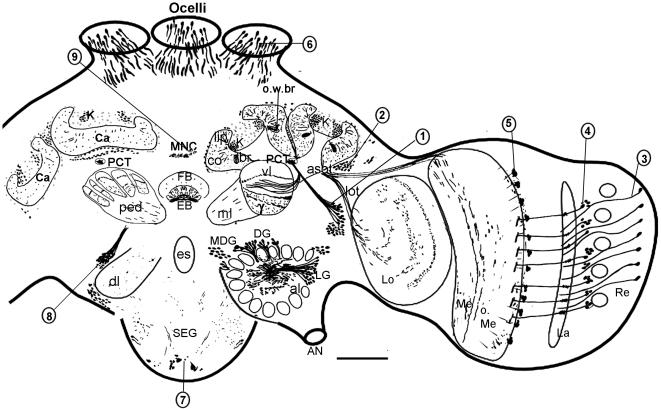
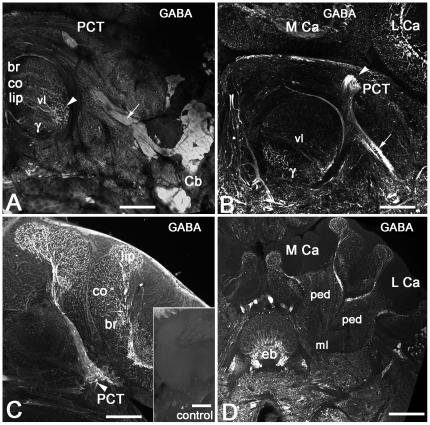
Octopamine plays an important role in many behaviors in invertebrates. It acts via binding to G protein coupled receptors located on the plasma membrane of responsive cells. Several distinct subtypes of octopamine receptors have been found in invertebrates, yet little is known about the expression pattern of these different receptor subtypes and how each subtype may contribute to different behaviors. One honey bee (Apis mellifera) octopamine receptor, AmOA1, was recently cloned and characterized. Here we continue to characterize the AmOA1 receptor by investigating its distribution in the honey bee brain. We used two independent antibodies produced against two distinct peptides in the carboxyl-terminus to study the distribution of the AmOA1 receptor in the honey bee brain. We found that both anti-AmOA1 antibodies revealed labeling of cell body clusters throughout the brain and within the following brain neuropils: the antennal lobes; the calyces, pedunculus, vertical (alpha, gamma) and medial (beta) lobes of the mushroom body; the optic lobes; the subesophageal ganglion; and the central complex. Double immunofluorescence staining using anti-GABA and anti-AmOA1 receptor antibodies revealed that a population of inhibitory GABAergic local interneurons in the antennal lobes express the AmOA1 receptor in the cell bodies, axons and their endings in the glomeruli. In the mushroom bodies, AmOA1 receptors are expressed in a subpopulation of inhibitory GABAergic feedback neurons that ends in the visual (outer half of basal ring and collar regions) and olfactory (lip and inner basal ring region) calyx neuropils, as well as in the collar and lip zones of the vertical and medial lobes. The data suggest that one effect of octopamine via AmOA1 in the antennal lobe and mushroom body is to modulate inhibitory neurons.
章鱼胺在无脊椎动物的许多行为中起着重要作用。它通过与位于反应细胞质膜上的 G 蛋白偶联受体结合来发挥作用。在无脊椎动物中已经发现了几种不同的章鱼胺受体亚型,但对于这些不同受体亚型的表达模式以及每种亚型如何促进不同的行为知之甚少。一种蜜蜂(Apis mellifera)章鱼胺受体 AmOA1 最近被克隆并进行了特征描述。在这里,我们通过研究其在蜜蜂大脑中的分布,继续对 AmOA1 受体进行特征描述。我们使用针对羧基末端两个不同肽段产生的两种独立抗体来研究 AmOA1 受体在蜜蜂大脑中的分布。我们发现,两种抗 AmOA1 抗体都揭示了整个大脑以及以下脑神经叶中细胞体簇的标记:触角叶;calyces、pedunculus、垂直(alpha、gamma)和内侧(beta)蘑菇体叶;视神经叶;食管下神经节;以及中央复合体。使用抗 GABA 和抗 AmOA1 受体抗体进行双重免疫荧光染色显示,触角叶中一群抑制性 GABA 能局部中间神经元在细胞体、轴突及其末梢在神经节中表达 AmOA1 受体。在蘑菇体中,AmOA1 受体表达在抑制性 GABA 能反馈神经元的一个亚群中,其末梢在视觉(基底环外半环和环区)和嗅觉(唇和内基底环区)calyces 神经叶以及垂直和内侧叶的环和唇区。数据表明,章鱼胺通过 AmOA1 在触角叶和蘑菇体中的一种作用是调节抑制性神经元。






 Zotero 插件