Institut für Neurobiologie, Freie Universität Berlin Berlin, Germany.
Front Syst Neurosci. 2009 Dec 4;3:16. doi: 10.3389/neuro.06.016.2009. eCollection 2009.
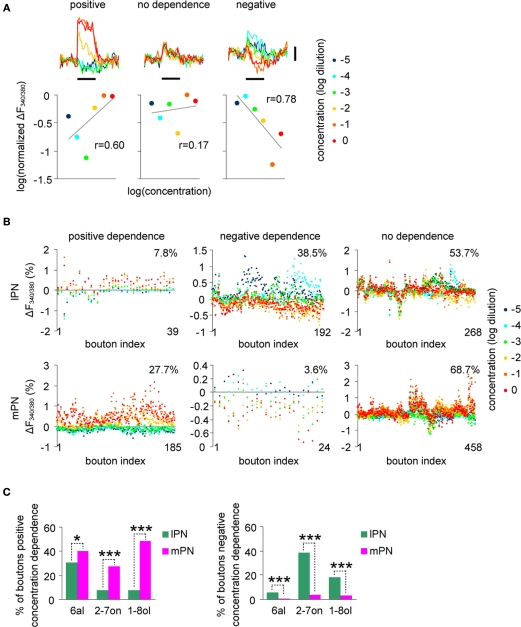
An important component in understanding central olfactory processing and coding in the insect brain relates to the characterization of the functional divisions between morphologically distinct types of projection neurons (PN). Using calcium imaging, we investigated how the identity, concentration and mixtures of odors are represented in axon terminals (boutons) of two types of PNs - lPN and mPN. In lPN boutons we found less concentration dependence, narrow tuning profiles at a high concentration, which may be optimized for fine, concentration-invariant odor discrimination. In mPN boutons, however, we found clear rising concentration dependence, broader tuning profiles at a high concentration, which may be optimized for concentration coding. In addition, we found more mixture suppression in lPNs than in mPNs, indicating lPNs better adaptation for synthetic mixture processing. These results suggest a functional division of odor processing in both PN types.
理解昆虫大脑中中枢嗅觉处理和编码的一个重要组成部分涉及到对形态上不同类型投射神经元 (PN) 的功能划分进行特征描述。我们使用钙成像技术研究了两种类型的 PN——lPN 和 mPN 的轴突末梢(末梢)中气味的身份、浓度和混合物是如何被表示的。在 lPN 末梢中,我们发现浓度依赖性较小,在高浓度下的调谐曲线较窄,这可能是为了精细、浓度不变的气味辨别而优化的。然而,在 mPN 末梢中,我们发现了明显的浓度依赖性增加,在高浓度下的调谐曲线较宽,这可能是为了浓度编码而优化的。此外,我们发现 lPN 中的混合物抑制作用比 mPN 中更明显,这表明 lPN 更适合于合成混合物的处理。这些结果表明在两种 PN 类型中存在气味处理的功能划分。