• 文献检索
  • 文档翻译
  • 深度研究
  • 学术资讯
  • Suppr Zotero 插件Zotero 插件
  • 邀请有礼
  • 套餐&价格
  • 历史记录
应用&插件
Suppr Zotero 插件Zotero 插件浏览器插件Mac 客户端Windows 客户端微信小程序
定价
高级版会员购买积分包购买API积分包
服务
文献检索文档翻译深度研究API 文档MCP 服务
关于我们
关于 Suppr公司介绍联系我们用户协议隐私条款
关注我们

Suppr 超能文献

核心技术专利:CN118964589B侵权必究
粤ICP备2023148730 号-1Suppr @ 2026

文献检索

告别复杂PubMed语法,用中文像聊天一样搜索,搜遍4000万医学文献。AI智能推荐,让科研检索更轻松。

立即免费搜索

文件翻译

保留排版,准确专业,支持PDF/Word/PPT等文件格式,支持 12+语言互译。

免费翻译文档

深度研究

AI帮你快速写综述,25分钟生成高质量综述,智能提取关键信息,辅助科研写作。

立即免费体验

四氢异喹啉-乙基-苯胺系列P-糖蛋白调节剂的计算机辅助定量构效关系研究

In silico quantitative structure-activity relationship studies on P-gp modulators of tetrahydroisoquinoline-ethyl-phenylamine series.

作者信息

Gadhe Changdev G, Madhavan Thirumurthy, Kothandan Gugan, Cho Seung Joo

机构信息

Departments of Bio-New Drug Development, College of Medicine, Chosun University, 375 Seosuk-dong, Dong-gu, Gwangju 501-759, Korea.

出版信息

BMC Struct Biol. 2011 Jan 26;11:5. doi: 10.1186/1472-6807-11-5.

DOI:10.1186/1472-6807-11-5
PMID:21269449
原文链接:https://pmc.ncbi.nlm.nih.gov/articles/PMC3038138/
Abstract

BACKGROUND

Multidrug resistance (MDR) is a major obstacle in cancer chemotherapy. The drug efflux by a transport protein is the main reason for MDR. In humans, MDR mainly occurs when the ATP-binding cassette (ABC) family of proteins is overexpressed simultaneously. P-glycoprotein (P-gp) is most commonly associated with human MDR; it utilizes energy from adenosine triphosphate (ATP) to transport a number of substrates out of cells against concentration gradients. By the active transport of substrates against concentration gradients, intracellular concentrations of substrates are decreased. This leads to the cause of failure in cancer chemotherapy.

RESULTS

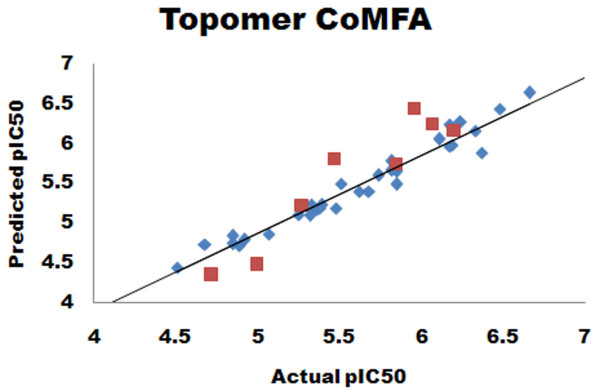
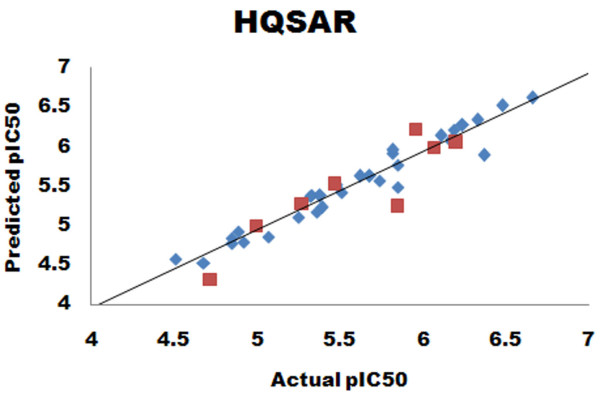
Herein, we report Topomer CoMFA (Comparative Molecular Field Analysis) and HQSAR (Hologram Quantitative Structure Activity Relationship) models for third generation MDR modulators. The Topomer CoMFA model showed good correlation between the actual and predicted values for training set molecules. The developed model showed cross validated correlation coefficient (q2) = 0.536 and non-cross validated correlation coefficient (r2) = 0.975 with eight components. The best HQSAR model (q2 = 0.777, r2 = 0.956) with 5-8 atom counts was used to predict the activity of test set compounds. Both models were validated using test set compounds, and gave a good predictive values of 0.604 and 0.730.

CONCLUSIONS

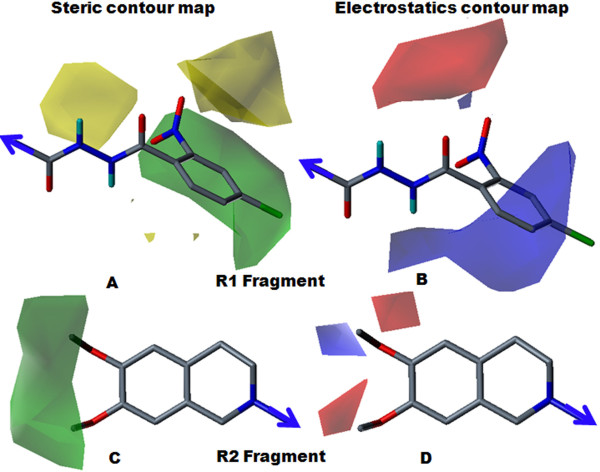
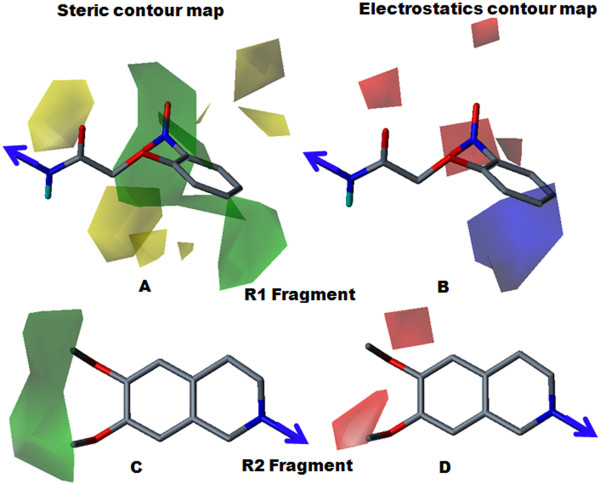
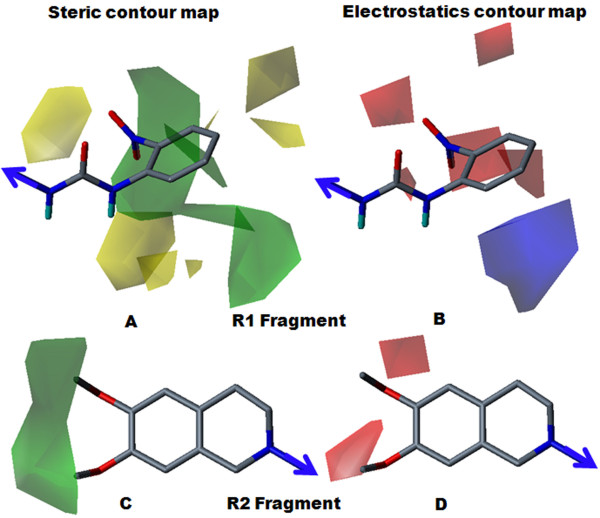
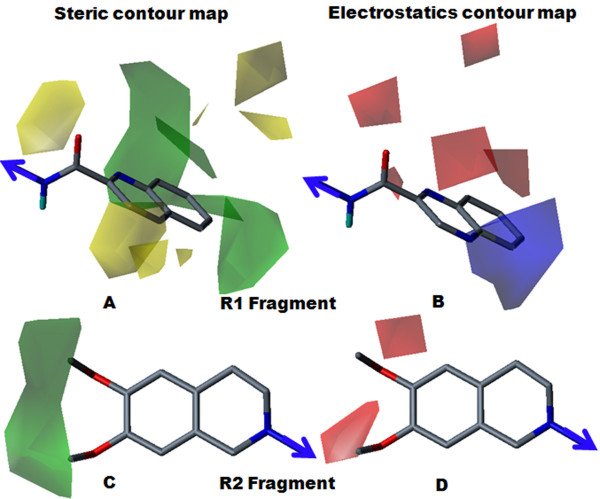
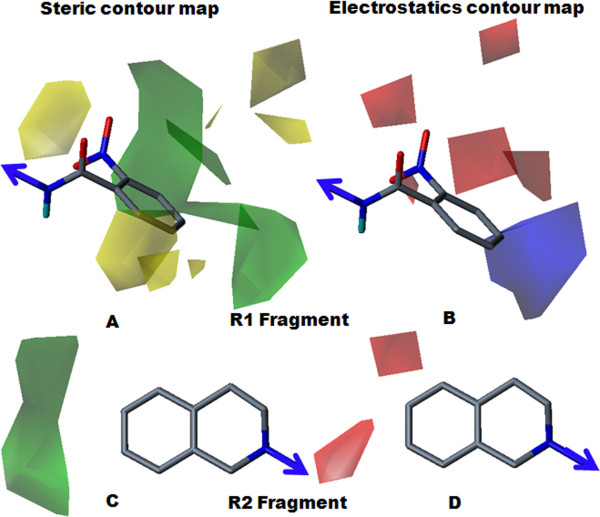
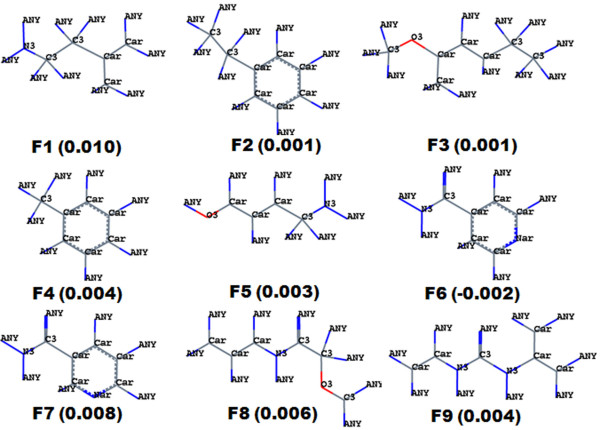
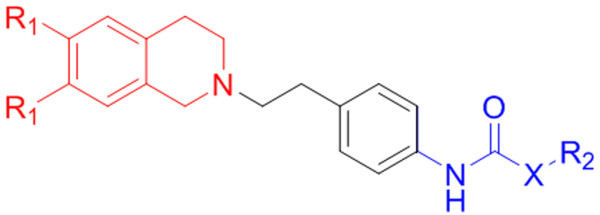
The contour map near R1 indicates that substitution of a bulkier and polar group to the ortho position of the benzene ring enhances the inhibitory effect. This explains why compounds with a nitro group have good inhibitory potency. Molecular fragment analyses shed light on some essential structural and topological features of third generation MDR modulators. Fragments analysis showed that the presence of tertiary nitrogen, a central phenyl ring and an aromatic dimethoxy group contributed to the inhibitory effect. Based on contour map information and fragment information, five new molecules with variable R1 substituents were designed. The activity of these designed molecules was predicted by the Topomer CoMFA and HQSAR models. The novel compounds showed higher potency than existing compounds.

摘要

背景

多药耐药性(MDR)是癌症化疗中的主要障碍。转运蛋白介导的药物外排是多药耐药的主要原因。在人类中,多药耐药主要发生在ATP结合盒(ABC)蛋白家族同时过度表达时。P-糖蛋白(P-gp)与人类多药耐药最为相关;它利用三磷酸腺苷(ATP)提供的能量将多种底物逆浓度梯度转运出细胞。通过将底物逆浓度梯度主动转运,底物的细胞内浓度降低。这导致了癌症化疗失败的原因。

结果

在此,我们报告了第三代多药耐药调节剂的Topomer CoMFA(比较分子场分析)和HQSAR(全息定量构效关系)模型。Topomer CoMFA模型显示训练集分子的实际值与预测值之间具有良好的相关性。所开发的模型显示交叉验证相关系数(q2)= 0.536,非交叉验证相关系数(r2)= 0.975,有八个成分。最佳的HQSAR模型(q2 = 0.777,r2 = 0.956),原子数为5 - 8,用于预测测试集化合物的活性。两个模型均使用测试集化合物进行验证,预测值分别为0.604和0.730,效果良好。

结论

R1附近的等高线图表明,在苯环邻位取代一个更大的极性基团可增强抑制作用。这解释了为什么含硝基的化合物具有良好的抑制效力。分子片段分析揭示了第三代多药耐药调节剂的一些基本结构和拓扑特征。片段分析表明叔氮、中心苯环和芳族二甲氧基的存在有助于抑制作用。基于等高线图信息和片段信息,设计了五个具有可变R1取代基的新分子。这些设计分子的活性通过Topomer CoMFA和HQSAR模型进行预测。新化合物显示出比现有化合物更高的效力。
https://cdn.ncbi.nlm.nih.gov/pmc/blobs/b2dd/3038138/96b3c36e937c/1472-6807-11-5-10.jpg
https://cdn.ncbi.nlm.nih.gov/pmc/blobs/b2dd/3038138/2997d2bfeb74/1472-6807-11-5-1.jpg
https://cdn.ncbi.nlm.nih.gov/pmc/blobs/b2dd/3038138/1e11850ec9fe/1472-6807-11-5-2.jpg
https://cdn.ncbi.nlm.nih.gov/pmc/blobs/b2dd/3038138/a19546453050/1472-6807-11-5-3.jpg
https://cdn.ncbi.nlm.nih.gov/pmc/blobs/b2dd/3038138/12dd303d27b8/1472-6807-11-5-4.jpg
https://cdn.ncbi.nlm.nih.gov/pmc/blobs/b2dd/3038138/460b57e3a676/1472-6807-11-5-5.jpg
https://cdn.ncbi.nlm.nih.gov/pmc/blobs/b2dd/3038138/bba486f40c74/1472-6807-11-5-6.jpg
https://cdn.ncbi.nlm.nih.gov/pmc/blobs/b2dd/3038138/47bdb25f65db/1472-6807-11-5-7.jpg
https://cdn.ncbi.nlm.nih.gov/pmc/blobs/b2dd/3038138/a11f84a71db2/1472-6807-11-5-8.jpg
https://cdn.ncbi.nlm.nih.gov/pmc/blobs/b2dd/3038138/488881742f52/1472-6807-11-5-9.jpg
https://cdn.ncbi.nlm.nih.gov/pmc/blobs/b2dd/3038138/96b3c36e937c/1472-6807-11-5-10.jpg
https://cdn.ncbi.nlm.nih.gov/pmc/blobs/b2dd/3038138/2997d2bfeb74/1472-6807-11-5-1.jpg
https://cdn.ncbi.nlm.nih.gov/pmc/blobs/b2dd/3038138/1e11850ec9fe/1472-6807-11-5-2.jpg
https://cdn.ncbi.nlm.nih.gov/pmc/blobs/b2dd/3038138/a19546453050/1472-6807-11-5-3.jpg
https://cdn.ncbi.nlm.nih.gov/pmc/blobs/b2dd/3038138/12dd303d27b8/1472-6807-11-5-4.jpg
https://cdn.ncbi.nlm.nih.gov/pmc/blobs/b2dd/3038138/460b57e3a676/1472-6807-11-5-5.jpg
https://cdn.ncbi.nlm.nih.gov/pmc/blobs/b2dd/3038138/bba486f40c74/1472-6807-11-5-6.jpg
https://cdn.ncbi.nlm.nih.gov/pmc/blobs/b2dd/3038138/47bdb25f65db/1472-6807-11-5-7.jpg
https://cdn.ncbi.nlm.nih.gov/pmc/blobs/b2dd/3038138/a11f84a71db2/1472-6807-11-5-8.jpg
https://cdn.ncbi.nlm.nih.gov/pmc/blobs/b2dd/3038138/488881742f52/1472-6807-11-5-9.jpg
https://cdn.ncbi.nlm.nih.gov/pmc/blobs/b2dd/3038138/96b3c36e937c/1472-6807-11-5-10.jpg

相似文献

1
In silico quantitative structure-activity relationship studies on P-gp modulators of tetrahydroisoquinoline-ethyl-phenylamine series.四氢异喹啉-乙基-苯胺系列P-糖蛋白调节剂的计算机辅助定量构效关系研究
BMC Struct Biol. 2011 Jan 26;11:5. doi: 10.1186/1472-6807-11-5.
2
Modeling study of phenylsulfonylfuroxan derivatives as P-gp inhibitors: a combined approach of CoMFA, CoMSIA and HQSAR.
Anticancer Agents Med Chem. 2014;14(7):1019-30. doi: 10.2174/18715206113136660335.
3
Modulation of the spacer in N,N-bis(alkanol)amine aryl ester heterodimers led to the discovery of a series of highly potent P-glycoprotein-based multidrug resistance (MDR) modulators.调节 N,N-双(烷醇)胺芳基酯杂二聚体中的间隔基,发现了一系列强效基于 P-糖蛋白的多药耐药(MDR)调节剂。
Eur J Med Chem. 2019 Jun 15;172:71-94. doi: 10.1016/j.ejmech.2019.03.054. Epub 2019 Mar 27.
4
6,7-Dimethoxy-2-phenethyl-1,2,3,4-tetrahydroisoquinoline amides and corresponding ester isosteres as multidrug resistance reversers.6,7-二甲氧基-2-苯乙基-1,2,3,4-四氢异喹啉酰胺及其酯类结构类似物作为多药耐药逆转剂。
J Enzyme Inhib Med Chem. 2020 Dec;35(1):974-992. doi: 10.1080/14756366.2020.1747449.
5
Improvement of conventional anti-cancer drugs as new tools against multidrug resistant tumors.提高传统抗癌药物作为对抗多药耐药肿瘤的新工具。
Drug Resist Updat. 2020 May;50:100682. doi: 10.1016/j.drup.2020.100682. Epub 2020 Feb 7.
6
N,N-bis(cyclohexanol)amine aryl esters: the discovery of a new class of highly potent inhibitors of transporter-dependent multidrug resistance (MDR).N,N-双(环己醇)胺芳基酯:一类新型高效转运蛋白依赖性多药耐药(MDR)抑制剂的发现。
Curr Top Med Chem. 2010;10(17):1715-31. doi: 10.2174/156802610792928031.
7
The Tetrahydroisoquinoline Scaffold in ABC Transporter Inhibitors that Act as Multidrug Resistance (MDR) Reversers.作为多药耐药性(MDR)逆转剂的ABC转运蛋白抑制剂中的四氢异喹啉支架结构
Curr Top Med Chem. 2022;22(31):2535-2569. doi: 10.2174/1568026623666221025111528.
8
1,2,3,4-Tetrahydroisoquinoline/2H-chromen-2-one conjugates as nanomolar P-glycoprotein inhibitors: Molecular determinants for affinity and selectivity over multidrug resistance associated protein 1.1,2,3,4-四氢异喹啉/2H-色烯-2-酮缀合物作为纳摩尔级 P 糖蛋白抑制剂:对多药耐药相关蛋白 1 的亲和力和选择性的分子决定因素。
Eur J Med Chem. 2019 Jan 1;161:433-444. doi: 10.1016/j.ejmech.2018.10.043. Epub 2018 Oct 18.
9
6,7-Dimethoxy-2-{2-[4-(1H-1,2,3-triazol-1-yl)phenyl]ethyl}-1,2,3,4-tetrahydroisoquinolines as superior reversal agents for P-glycoprotein-mediated multidrug resistance.6,7-二甲氧基-2-{2-[4-(1H-1,2,3-三唑-1-基)苯基]乙基}-1,2,3,4-四氢异喹啉作为P-糖蛋白介导的多药耐药的高效逆转剂。
ChemMedChem. 2015 Feb;10(2):336-44. doi: 10.1002/cmdc.201402463. Epub 2014 Dec 2.
10
Interaction field based and hologram based QSAR analysis of propafenone-type modulators of multidrug resistance.基于相互作用场和全息图的多药耐药性普罗帕酮型调节剂的定量构效关系分析
Med Chem. 2005 Sep;1(5):431-44. doi: 10.2174/1573406054864061.

引用本文的文献

1
Binding Studies and Lead Generation of Pteridin-7(8)-one Derivatives Targeting FLT3.针对 FLT3 的蝶啶-7(8)-酮衍生物的结合研究和先导化合物生成。
Int J Mol Sci. 2022 Jul 12;23(14):7696. doi: 10.3390/ijms23147696.
2
Structural Insights from Molecular Modeling of Isoindolin-1-One Derivatives as PI3Kγ Inhibitors against Gastric Carcinoma.异吲哚啉-1-酮衍生物作为PI3Kγ抑制剂抗胃癌的分子模拟结构见解
Biomedicines. 2022 Mar 30;10(4):813. doi: 10.3390/biomedicines10040813.
3
Molecular Modeling Studies of -phenylpyrimidine-4-amine Derivatives for Inhibiting FMS-like Tyrosine Kinase-3.

本文引用的文献

1
Comparative molecular field analysis (CoMFA). 1. Effect of shape on binding of steroids to carrier proteins.比较分子场分析(CoMFA)。1. 形状对类固醇与载体蛋白结合的影响。
J Am Chem Soc. 1988 Aug 1;110(18):5959-67. doi: 10.1021/ja00226a005.
2
Synthesis and biological evaluation of a small molecule library of 3rd generation multidrug resistance modulators.第三代多药耐药调节剂小分子文库的合成与生物学评价
Bioorg Med Chem. 2009 Mar 15;17(6):2524-35. doi: 10.1016/j.bmc.2009.01.072. Epub 2009 Feb 5.
3
ABCG2: structure, function and role in drug response.
-苯基嘧啶-4-胺衍生物抑制 FMS 样酪氨酸激酶-3 的分子建模研究。
Int J Mol Sci. 2021 Nov 19;22(22):12511. doi: 10.3390/ijms222212511.
4
Designing of the N-ethyl-4-(pyridin-4-yl)benzamide based potent ROCK1 inhibitors using docking, molecular dynamics, and 3D-QSAR.基于对接、分子动力学和三维定量构效关系设计N-乙基-4-(吡啶-4-基)苯甲酰胺类高效ROCK1抑制剂
PeerJ. 2021 Aug 9;9:e11951. doi: 10.7717/peerj.11951. eCollection 2021.
5
Molecular Modelling Studies on Pyrazole Derivatives for the Design of Potent Rearranged during Transfection Kinase Inhibitors.分子模拟研究吡唑衍生物在设计强效重排型转染酶激酶抑制剂中的应用。
Molecules. 2021 Jan 28;26(3):691. doi: 10.3390/molecules26030691.
6
Molecular Modeling Study of c-KIT/PDGFRα Dual Inhibitors for the Treatment of Gastrointestinal Stromal Tumors.分子建模研究 c-KIT/PDGFRα 双重抑制剂治疗胃肠道间质瘤。
Int J Mol Sci. 2020 Nov 3;21(21):8232. doi: 10.3390/ijms21218232.
7
Novel Potent ABCB1 Modulator, Phenethylisoquinoline Alkaloid, Reverses Multidrug Resistance in Cancer Cell.新型强效 ABCB1 调节剂,苯乙基异喹啉生物碱,逆转肿瘤细胞多药耐药。
Mol Pharm. 2018 Sep 4;15(9):4021-4030. doi: 10.1021/acs.molpharmaceut.8b00457. Epub 2018 Aug 13.
8
Biophysical Approaches Facilitate Computational Drug Discovery for ATP-Binding Cassette Proteins.生物物理方法助力ATP结合盒蛋白的计算药物发现。
Int J Med Chem. 2017;2017:1529402. doi: 10.1155/2017/1529402. Epub 2017 Mar 19.
9
Yeast ABC proteins involved in multidrug resistance.参与多药耐药的酵母ABC蛋白。
Cell Mol Biol Lett. 2014 Mar;19(1):1-22. doi: 10.2478/s11658-013-0111-2. Epub 2013 Dec 2.
10
Development of classification models for identifying "true" P-glycoprotein (P-gp) inhibitors through inhibition, ATPase activation and monolayer efflux assays.通过抑制、ATP酶激活和单层外排试验开发用于鉴定“真正”P-糖蛋白(P-gp)抑制剂的分类模型。
Int J Mol Sci. 2012;13(6):6924-6943. doi: 10.3390/ijms13066924. Epub 2012 Jun 7.
ABCG2:结构、功能及在药物反应中的作用
Expert Opin Drug Metab Toxicol. 2008 Jan;4(1):1-15. doi: 10.1517/17425255.4.1.1.
4
Functional assay and structure-activity relationships of new third-generation P-glycoprotein inhibitors.新型第三代P-糖蛋白抑制剂的功能测定及构效关系
Bioorg Med Chem. 2008 Mar 1;16(5):2448-62. doi: 10.1016/j.bmc.2007.11.057. Epub 2007 Nov 28.
5
Human multidrug resistance ABCB and ABCG transporters: participation in a chemoimmunity defense system.人类多药耐药性ABCB和ABCG转运蛋白:参与化学免疫防御系统。
Physiol Rev. 2006 Oct;86(4):1179-236. doi: 10.1152/physrev.00037.2005.
6
Targeting multidrug resistance in cancer.针对癌症中的多药耐药性
Nat Rev Drug Discov. 2006 Mar;5(3):219-34. doi: 10.1038/nrd1984.
7
Structure-activity relationships of a series of tariquidar analogs as multidrug resistance modulators.一系列作为多药耐药调节剂的塔里夸德类似物的构效关系
Bioorg Med Chem. 2006 Mar 1;14(5):1588-98. doi: 10.1016/j.bmc.2005.10.058. Epub 2005 Nov 22.
8
Topomers: a validated protocol for their self-consistent generation.
J Chem Inf Comput Sci. 2004 Jul-Aug;44(4):1221-7. doi: 10.1021/ci049961d.
9
Multidrug resistance reversal agents.多药耐药逆转剂
J Med Chem. 2003 Nov 6;46(23):4805-17. doi: 10.1021/jm030183a.
10
Multidrug resistance mediated by the breast cancer resistance protein BCRP (ABCG2).由乳腺癌耐药蛋白BCRP(ABCG2)介导的多药耐药。
Oncogene. 2003 Oct 20;22(47):7340-58. doi: 10.1038/sj.onc.1206938.